24 related resources

Octopus Activity

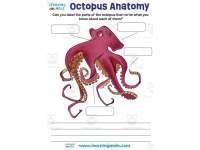
Octopus Anatomy asks a student to label the parts of an octopus and then write what they know about each one, on a sheet that supplies no word bank of its own.
Grades
Grades 3–9, Elementary, Middle School, High School
Pages
1
File type
PDF
Preparation
Print ready

Updated Aug 09, 2024

Subject
Science, Life Sciences, Biology, Animals
Topic
Octopus Activity, Octopus
Resource types
Activities
Preparation
Print ready

About this resource

What's inside this resource

Activity Introduction

An amazing activity designed for the students to learn more about famous places in different countries.

The Octopus

Do you like animals? what is your favorite one?

Do you own a pet? If yes, tell us more about it, like what its name? And what do you like most about it?

What are the animal kingdoms?

Can you write down the characteristics of each animal class like mammals, birds, reptiles, amphibian, fish and mollusks.

Do you know that some animals can sing, can you name any of them?

What is the largest and the smallest mammal in the world?

What is the largest and the smallest bird in the world?

What is the largest and the smallest fish in the world?

Octopus Activity

The activity is perfect for encouraging the researching skills for the students, while learning more about this fantastic place.

Octopus

This friendly designed worksheet is suitable for students at school, homeschooling, and as a group activity.

Instructions

Can you label the parts of the octopus then write what you know about each of them?

Format

Available in a PDF format.

In the classroom

Teaching tips & learning objectives

Learning objectives

  • Name the external parts of an octopus directly on a diagram

  • Write what is already known about each labelled part, in the student's own words

Teaching tips

  • Nothing on the sheet supplies the vocabulary, so decide first whether students label from memory, from a text or from a labelled reference on the board — the page supports all three

  • The writing half of the task takes longer than the labelling and is what separates this from a plain diagram sheet; budget time for it rather than treating the page as a five-minute filler

  • With no printed list to mark against, building a shared class list of the parts after the labelling is the fastest way to check the sheets

  • The same page works twice in a unit — once at the start to surface what a class already knows, once at the end as a written summary

Skills covered

  • Labelling a biological diagram — the page asks a student to write the names of an octopus's parts onto the illustration itself.

  • Recalling and recording knowledge in writing — the direction goes past naming and asks for what the student knows about each part.

  • Working without a word bank — no vocabulary is printed anywhere on the sheet, so the terms have to come from the student's own reading or from a reference the lesson supplies.

Good to know

Questions teachers ask about this resource

Where do the part names come from?

From whatever the lesson supplies. Nothing is printed on the sheet — no word bank, no list of parts, no definitions — so students draw on a text, a class display or what they already know.

What is the second half of the task?

Writing. After the labelling, the direction asks students to "write what you know about each of them", so every part that gets a name also gets a written note beside it.

No reviews yet

Downloaded this resource? Tell other teachers how it went.

Resource details

Concepts & topics

Explore more

Categories this resource belongs to

Explore related searches

More to explore

You may also like