



Passé simple - 28 CÀT / Past simple French grammar



- Grades
- Grades 4–8, Elementary, Middle School
- Pages
- 11
- File type
- Answer key
- Included


- Subject
- Foreign Languages, French
- Topic
- Modes et temps, Conjugaison
- Resource types
- Task Cards, Worksheets & Printables
- Answer key
- Included
Product description
From the author
Passé simple – 28 cartes à tâches
Vous cherchez un moyen ludique et efficace pour faire pratiquer le passé simple à vos élèves ? Ce jeu de 28 cartes à tâches est parfait pour dynamiser vos leçons tout en facilitant l’apprentissage !
Ce que contient le produit :
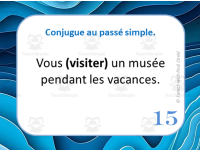
- 28 cartes à tâches : Chaque carte propose une phrase où un verbe entre parenthèses doit être conjugué au passé simple .
- Des feuilles-réponses : Pour permettre aux élèves de noter leurs réponses de manière claire.
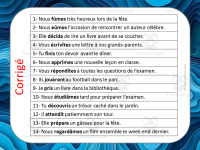
- Un corrigé complet : Un outil pratique pour valider les réponses et encourager les discussions en classe.
Ces cartes à tâches sont idéales pour les élèves du primaire et du secondaire. Elles leur permettent de s’approprier cette notion souvent complexe en la rendant plus accessible et interactive.
Utilisables en classe pour des activités en groupe ou à la maison pour des révisions autonomes, elles transforment la conjugaison en un défi stimulant et amusant.
Avec ce matériel, vos élèves apprendront à conjuguer au passé simple tout en s’amusant !
Related resources
More resources teachers may find useful
24 related resources were found using this product's title, contributor, categories and tags.


In the classroom
Teaching tips & learning objectives

Learning objectives
Conjugate regular -er, -ir and -re verbs in the passé simple across all six grammatical persons
Form the passé simple of high-frequency irregulars, including être (fûmes), avoir (eûmes), prendre (pris), écrire (écrivîtes), lire (lut), voir (vîmes) and courir (courûmes)
Rewrite a complete French sentence with the bracketed infinitive replaced by its conjugated passé simple form

Teaching tips
Cut pages 1-7 along the four-per-page grid; the printed numbers 1 to 28 keep a scoot or centre rotation in sequence without re-sorting the deck
Hand out the first «Je réponds» sheet with cards 1-14 and the second with cards 15-28, which splits the deck into two equal sittings
The corrigé prints each sentence complete rather than the verb alone, so it doubles as a short model text for reading the passé simple aloud

Skills covered
Passé simple formation — students convert a bracketed infinitive into its passé simple form inside a written French sentence on each of the twenty-eight cards.
Irregular verb recall — the deck includes être, avoir, prendre, écrire, lire, voir and courir alongside regular patterns.
Independent answer recording — students write their answers on the numbered «Je réponds» sheets and check them against the corrigé's completed sentences.
Good to know
Questions teachers ask about this resource
Is the whole set written in French, or is there English support on the cards?
French throughout. The instruction line «Conjugue au passé simple», all twenty-eight sentences, the «Je réponds» recording sheets and the corrigé are in French, with no English translation printed anywhere in the file.
Which verbs does the twenty-eight-card deck actually cover?
Regular -er verbs (décider, jouer, préparer, regarder, visiter, réciter, terminer, fabriquer, écouter, apporter, demander, parler, étudier), -ir verbs with regular patterns (finir, réussir, réfléchir) and -re verbs (répondre, attendre, descendre), plus the irregulars découvrir, être, avoir, apprendre, prendre, écrire, lire, voir and courir.

No reviews yet
Downloaded this resource? Tell other teachers how it went.
Resource details
Concepts & topics
Core concepts
 Core concepts
Passé simple
French verb conjugation
Irregular verbs
Subject-verb agreement
Simple tenses
 Topics
Explore more
Categories this resource belongs to
Explore related searches
More to explore
You may also like


