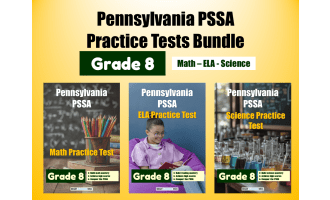
Pennsylvania (PSSA) Practice Tests Bundle for Grade 3

- Grades
- Grade 3, Elementary
- Pages
- 43
- File type
- Answer key
- Included
- Subject
- ELA, Math
- Topic
- pennsylvania, pssa
- Resource types
- Assessments, Teacher Tools, Tests, Quizzes and Tests, Worksheets & Printables
- Answer key
- Included
About this resource
What's inside this resource
Make PSSA test prep simple and effective with this Grade 3 PSSA Practice Tests Bundle. This resource helps students build confidence and strengthen key skills in both ELA and Math.
The bundle includes a full ELA practice test and a full Math practice test. All questions are standards-aligned and follow the format of the real PSSA. The materials are printable and easy to use. Answer keys are included for quick grading.
You can use this resource in many ways. Assign it for test prep before the PSSA. Use it for independent practice or homework. Work with small groups for extra support. Use it for whole class review or test simulations.
Students practice reading comprehension, vocabulary, and text analysis. They also build math skills like problem-solving, computation, and reasoning. The tests help students get used to PSSA question types and structure.
Teachers love this bundle because it saves time and requires no prep. It also helps track progress and identify learning gaps.
Use it to prepare your students with confidence for test day.
In the classroom
Teaching tips & learning objectives
Learning objectives
Student can solve one- and two-step multiplication and division word problems and explain the strategy used.
Student can compare, generate, and reason about equivalent fractions using a number line or visual model.
Student can compute area and perimeter of rectangles and composite rectangular figures.
Student can determine central message, character motivation, and figurative language in a literary passage.
Student can identify main idea, cause and effect, and author's purpose in an informational passage.
Teaching tips
Administer the two sections (multiple choice, then open-ended) across two shorter sessions if a class needs breaks, as the teacher's guide suggests.
Sort missed answers by the printed standard code after scoring to target reteaching to the two or three standards causing the most errors.
Use the class data tracker to group students by performance level (Advanced/Proficient/Basic/Below Basic) for small-group reteaching.
Skills covered
Multiplication and division fluency — students solve array, equal-groups, and fact-family problems drawn from 3.OA standards.
Fraction reasoning — students locate, compare, and justify equivalent fractions such as 2/4 = 1/2 on a number line.
Area and perimeter computation — students calculate the area of composite rectangular figures and solve for an unknown side given the perimeter.
Reading comprehension of literary and informational text — students answer inference, vocabulary-in-context, and author's-purpose questions across a fable, a science passage, and a narrative.
Evidence-based short-response writing — students justify an answer with textual evidence following a two-point rubric.
Good to know
Questions teachers ask about this resource
How are the standard codes printed next to each math and ELA item meant to help a teacher plan reteaching?
Each item lists its exact Pennsylvania/CCSS code (e.g., 3.OA.B.5, RL.3.4) next to the explanation, so a teacher can sort a class's missed items by domain and target instruction to the standards causing the most errors, using the Class Data Tracker to record scores by domain.
Why does the math multiple-choice quick-reference table skip some question numbers, such as going straight from 24 to 26?
The skipped numbers are the open-ended items (Q11, Q12, Q25, Q38, Q43), which are scored separately with a rubric later in the same document rather than listed in the multiple-choice grid.
No reviews yet
Downloaded this resource? Tell other teachers how it went.
Curriculum
Standards, concepts & topics
Standards
- 3. NF.A.3 — Explain equivalence of fractions in special cases, and compare fractions by reasoning about their size. a. Understand two fractions as equivalent (equal) if they are the same size, or the same point on a number line. b. Recognize and generate simple equivalent fractions, e.g., 1/2 = 2/4, 4/6 = 2/3). Explain why the fractions are equivalent, e.g., by using a visual fraction model. c. Express whole numbers as fractions, and recognize fractions that are equivalent to whole numbers. Examples: Express 3 in the form 3 = 3/1; recognize that 6/1 = 6; locate 4/4 and 1 at the same point of a number line diagram. d. Compare two fractions with the same numerator or the same denominator by reasoning about their size. Recognize that comparisons are valid only when the two fractions refer to the same whole. Record the results of comparisons with the symbols >, =, or <, and justify the conclusions, e.g., by using a visual fraction model.
- 3. MD.C.7 — Relate area to the operations of multiplication and addition. a. Find the area of a rectangle with whole-number side lengths by tiling it, and show that the area is the same as would be found by multiplying the side lengths. b. Multiply side lengths to find areas of rectangles with whole-number side lengths in the context of solving real world and mathematical problems, and represent whole-number products as rectangular areas in mathematical reasoning. c. Use tiling to show in a concrete case that the area of a rectangle with wholenumber side lengths a and b + c is the sum of a × b and a × c. Use area models to represent the distributive property in mathematical reasoning. d. Recognize area as additive. Find areas of rectilinear figures by decomposing them into non-overlapping rectangles and adding the areas of the nonoverlapping parts, applying this technique to solve real world problems.
- 3.OA.A.3 — Use multiplication and division within 100 to solve word problems in situations involving equal groups, arrays, and measurement quantities, e.g., by using drawings and equations with a symbol for the unknown number to represent the problem.1
Core concepts
operations and algebraic thinking
fractions
measurement and data
geometry
reading comprehension
Topics
More to explore