Physical Science Bell Ringers FULL YEAR - 180 Daily Warm-Ups




About This Product
This is a full year of physical science bell-ringers - 180 short daily prompts that give middle school students a steady, five-minute way to begin class. The set spans an entire course. It opens with the properties of matter, the states of matter and the particle model, phase changes, the difference between elements, compounds and mixtures, solutions and how mixtures are separated, the structure of the atom, the organization of the periodic table, metals and nonmetals, and density and measurement. The second quarter turns to change: physical versus chemical change, the signs of a reaction, chemical formulas and symbols, reading and writing equations, conservation of mass, balancing, synthesis and decomposition, acids and bases, and the pH scale and neutralization. The third covers motion and reference points, speed and velocity, acceleration, forces and all three of Newton's laws, gravity and friction, work, power and simple machines, and energy transformations. The final quarter covers waves and wave properties, reflection, refraction and absorption, sound, light and the electromagnetic spectrum, color and optics, heat and thermal energy transfer, static electricity and current, series and parallel circuits, and magnetism and electromagnets.
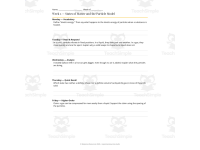
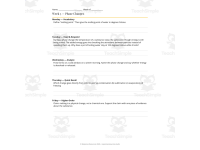
Prompts are arranged into 36 weekly pages, each holding five days of work a teacher can hand out on Monday and collect on Friday. Every week rotates through the same five kinds of thinking: a vocabulary term used rather than recited, a short reading with a question that requires reading it, an analysis problem or a short calculation, a quick multiple-choice check, and a question that asks students to state a claim and back it with evidence. That last one is the reasoning skill the standards weight most heavily and the one students practice least, so it appears every single Friday for 36 weeks.
A wrong key is worse than no key, so every quantitative prompt in this set was written to resolve to a clean whole number - a density of 8 grams per cubic centimetre, a speed of 5 metres per second, an acceleration of 5 metres per second squared, 100 joules of work delivered at 25 watts, 25 grams of product from 10 grams and 15 grams of reactants. Students get real practice with the procedure without a five-minute warm-up turning into a ten-minute arithmetic exercise.
Everything is print-first: one clean PDF that copies well, uses little ink, prints two-sided so a full week fits on a single sheet, and needs no student accounts, devices, or logins. A complete answer key covers all 180 prompts, and a standards page lists the NGSS middle school physical science codes and the CCSS literacy in science and technical subjects codes the set actually addresses - each one earned by a recurring prompt slot rather than claimed in general. Built for grades 6-8, it works as a daily opener while attendance is taken, as an exit slip at the end of the period, as spiral review before an exam, or as ready-made work to leave for a substitute teacher on short notice.
Resource Tags
0 Reviews
Check out these other great products