



Integrated Science Bell Ringers FULL YEAR - 180 Daily Warm-Ups




About This Product
This is a full year of integrated science bell-ringers - 180 short daily prompts that give middle school students a steady, five-minute way to begin class. It is written for the schools that teach one general science course each year instead of a separate life science year, Earth science year and physical science year. Teachers in those schools cannot use a single-strand warm-up set without leaving two thirds of their course uncovered, and that gap is what this resource fills.
The set spans an entire course. It opens with how science actually works: the difference between an observation and an inference, asking a question and writing a hypothesis that can be tested, designing a controlled experiment with one variable, collecting and averaging data, measurement and the metric system, lab safety, and the use of models. The opening unit closes with two deliberately cross-strand weeks that introduce matter, energy and life together and treat Earth as a single system of interacting spheres. The second quarter covers the life science core: cells and their organelles, transport across the membrane, photosynthesis and cellular respiration, levels of organization and homeostasis, the digestive, circulatory, respiratory, nervous and muscular systems, heredity and Punnett squares, DNA and variation, and ecosystems and energy flow. The third covers Earth and space: Earth's layers and plate tectonics, earthquakes and volcanoes, minerals and the rock cycle, weathering and erosion, the water cycle and the oceans, the atmosphere and weather, weather versus climate, the Earth-Moon-Sun system, and the solar system and stars. The final quarter covers physical science - properties and states of matter, atoms and the periodic table, chemical change and conservation of mass, motion and acceleration, forces and Newton's laws, work and energy, waves, sound and light, and heat, electricity and magnetism - and finishes with a year-end review week that carries one idea back through all three strands at once.
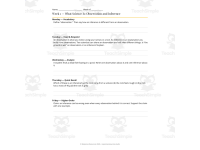
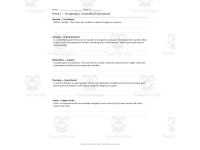
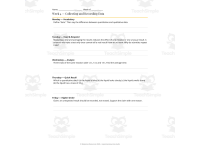
Prompts are arranged into 36 weekly pages, each holding five days of work a teacher can hand out on Monday and collect on Friday. Every week rotates through the same five kinds of thinking: a vocabulary term used rather than recited, a short reading with a question that requires reading it, an analysis problem or a short calculation, a quick multiple-choice check, and a question that asks students to state a claim and back it with evidence. That last one is the reasoning skill the standards weight most heavily and the one students practice least, so it appears every single Friday for 36 weeks.
A wrong key is worse than no key, so every quantitative prompt in this set was written to resolve to a clean whole number - an average of 13 seconds, a density of 8 grams per cubic centimetre, a mass number of 16, 25 grams of product from 10 grams and 15 grams of reactants, a speed of 5 metres per second, an acceleration of 5 metres per second squared, and 100 joules of work delivered at 25 watts. Students get real practice with the procedure without a five-minute warm-up turning into a ten-minute arithmetic exercise.
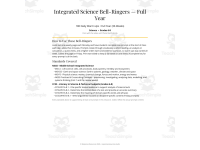
Everything is print-first: one clean PDF that copies well, uses little ink, prints two-sided so a full week fits on a single sheet, and needs no student accounts, devices, or logins. A complete answer key covers all 180 prompts, and a standards page lists the NGSS middle school life, Earth and physical science codes along with the CCSS literacy in science and technical subjects codes the set actually addresses - each one earned by a named week rather than claimed in general. Built for grades 6-8, it works as a daily opener while attendance is taken, as an exit slip at the end of the period, as spiral review before an exam, or as ready-made work to leave for a substitute teacher on short notice.
Resource Tags
0 Reviews
Check out these other great products


