Printable Articles (a, an, the) English Grammar Worksheets for Grade 1





- Grades
- Grades 1–2, Elementary
- Pages
- 9
- File type
- Preparation
- Print ready


- Subject
- Grammar, Language Development, ELA
- Topic
- articles worksheets, a an the worksheets
- Resource types
- Worksheets, Worksheets & Printables
- Preparation
- Print ready
- Standards
- CCSS.L.1.1
About this resource
What's inside this resource
Introduction
This worksheet pack helps students practice using the articles “a,” “an,” and “the” correctly in sentences. Through a variety of engaging grammar activities, learners strengthen sentence structure, reading comprehension, and writing skills while building confidence with English articles.
What’s Included:
A variety of article practice activities
Exercises using “a,” “an,” and “the”
Fill-in-the-blank sentence activities
Multiple-choice and circle-the-answer exercises
Sentence completion practice
Noun and article matching tasks
Reading and grammar reinforcement activities
Fun and simple grammar exercises designed for young learners
Grades / Ages:
Ideal for Grades 1–5
Implementation Format:
Perfect for classwork, homework, literacy centers, or independent practice
Great for grammar lessons, ESL activities, and vocabulary review
Supports both guided and independent learning
Answer Key:
Not included
File Type:
PDF (Non-editable)
Number of Pages:
9 pages total
License:
Paid product for personal or single-classroom use only
Tags to Use:
articles worksheets, a an the worksheets, grammar practice activities, english grammar worksheets, elementary grammar practice, ESL grammar worksheets, sentence structure activities
Related resources
More resources teachers may find useful
24 related resources were found using this product's title, contributor, categories and tags.


In the classroom
Teaching tips & learning objectives

Learning objectives
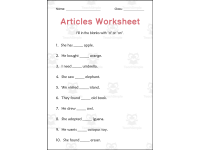
Choose between 'a' and 'an' based on whether the following word begins with a vowel or consonant sound.
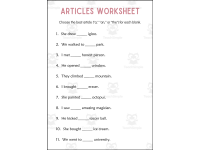
Distinguish when to use the definite article 'the' versus an indefinite article ('a'/'an') depending on sentence context.
Apply article rules correctly both within full sentences and before isolated nouns.

Teaching tips
Start with the first worksheet, which only asks students to choose between 'a' and 'an,' before moving to later pages that add 'the' as a third option.
Use the noun-list worksheet as a quick standalone check, since it isolates article choice from sentence context.
Since no answer key is included, review answers as a class or prepare your own key before assigning these pages as independent or homework practice.

Skills covered
Article selection by sound — students choose 'a' or 'an' based on whether the next word starts with a vowel or consonant sound, using words like 'umbrella,' 'owl,' and 'octopus.'
Definite vs. indefinite article use — students choose 'the' versus 'a'/'an' depending on sentence context across most of the nine worksheets.
Applied grammar in context — students complete full sentences, such as 'We visited ___ island,' rather than isolated fill-ins on most pages.
Good to know
Questions teachers ask about this resource
Does the word list include any nouns where the initial letter and initial sound point to different articles?
Yes — 'university' appears twice in the set. It starts with the vowel letter U but a consonant 'y' sound, making it a useful case for reinforcing that article choice depends on sound rather than spelling.

No reviews yet
Downloaded this resource? Tell other teachers how it went.
Curriculum
Standards, concepts & topics
Standards
 Standards
- CCSS.L.1.1 — Demonstrate command of the conventions of standard English grammar and usage when writing or speaking. a. Print all upper- and lowercase letters. b. Use common, proper, and possessive nouns. c. Use singular and plural nouns with matching verbs in basic sentences (e.g., He hops; We hop). d. Use personal, possessive, and indefinite pronouns (e.g., I, me, my; they, them, their; anyone, everything). e. Use verbs to convey a sense of past, present, and future (e.g., Yesterday I walked home; Today I walk home; Tomorrow I will walk home). f. Use frequently occurring adjectives. g. Use frequently occurring conjunctions (e.g., and, but, or, so, because). h. Use determiners (e.g., articles, demonstratives). i. Use frequently occurring prepositions (e.g., during, beyond, toward). j. Produce and expand complete simple and compound declarative, interrogative, imperative, and exclamatory sentences in response to prompts
Core concepts
 Core concepts
Articles (a, an, the)
Parts of speech
Grammar
 Topics
More to explore
You may also like