



Reading Comprehension Passage: Fast Fashion (PDF Sample)




- Grades
- Grades 6–9, Middle School, Homeschool Resources, High School
- Pages
- 5
- File type
- Answer key
- Included


- Subject
- ELA, Reading, Reading Comprehension, Strategies, Resources for Teachers, Social Studies, Sociology
- Topic
- Middle School, Reading Comprehension
- Resource types
- Writing Prompts, Worksheets & Printables, Centers, Activities, Teacher Tools, Assessments, Quizzes and Tests, Quizzes, Tests
- Answer key
- Included
- Standards
- CCSS.RI.6.1 CCSS.RI.6.2 +10
About this resource
What's inside this resource
This is a ONE PASSAGE SAMPLE. The following is the description of the FULL resource and the downloading links:
Social Studies Reading Comprehension Passages and Questions: Fashion, Society, and Power (PDF)
This resource introduces a collection of Social Studies reading comprehension passages with questions about Fashion, Society, and Power. The passages are carefully designed to bridge the gap between social studies and literacy through strengthening reading comprehension and sparking knowledge curiosity in middle school students. Each passage blends English Language Arts skills with accurate social studies content. Ideal for interdisciplinary learning in ELA and Social Studies. Suitable for Grade 9 review, too!
What Is Included in this Collection?
There are three informational passages (with full answer keys):
Beyond the Price Tag: How Fast Fashion Affects the World
The Fur Debate: Ethics, Fashion, and Survival
Designing Change: Chanel, Dior, and Women’s Lives
For Each Passage, students will have multiple tasks to complete as follow:
5 multiple-choice questions targeting main idea, key details, inference, vocabulary in context, and use of evidence
5 vocabulary matching items with clear, student-friendly definitions
5 text-based questions that require citing specific lines or facts
1 summary prompt that asks students to condense central ideas accurately
Available Formats for this Resource
Fillable PDF
Word Docs
Google Docs
For more Social Studies Reading Passages, check the following Links:
Ancient Civilizations
Early Empires and Trade Networks
The Founding of the United States
Fillable PDF
Word Docs
Google Docs
Language, Culture, and Meaning
PDF
Fillable PDF
Word Docs
Google Docs
Psychology and Society
PDF
Fillable PDF
Word Docs
Google Docs
Global Festivals and Traditions
PDF
Fillable PDF
Word Docs
Google Docs
Extreme Environments and People
PDF
Fillable PDF
Word Docs
Google Docs
Food, Culture, and Preservation
PDF
Fillable PDF
Word Docs
Google Docs
Global Food Customs
PDF
Fillable PDF
Word Docs
Google Docs
Media, Communication, and Popular Culture
PDF
Fillable PDF
Word Docs
Google Docs
Human Impact on the Environment
PDF
Fillable PDF
Word Docs
Google Docs
Civic Action and Social Change
PDF
Fillable PDF
Word Docs
Google Docs
Fashion, Society, and Power
PDF
Fillable PDF
Word Docs
Google Docs
People, Places, and Unusual Histories
PDF
Fillable PDF
Word Docs
Google Docs
Product Details
Length: 15 pages total
Grades: 6–8, also suitable for Grade 9 review
Use cases: close reading, stations, homework, intervention, test prep, and sub plans
Why Teachers Choose This Set
Authentic social studies content paired with rigorous literacy practice
Consistent task structure across all passages for easier planning and smoother student routines
Clear, age-appropriate writing that builds confidence without oversimplifying
Use this set to reinforce ELA skills in social studies, to add literacy to your lessons, and to support independent work. The passages strengthen main idea, evidence use, vocabulary in context, inference, cause and effect, and summary writing. With ready-to-use assessments and complete answer keys, you can provide focused practice that is simple to run and fast to review.
Related resources
More resources teachers may find useful
24 related resources were found using this product's title, contributor, categories and tags.


In the classroom
Teaching tips & learning objectives

Learning objectives
- Identify the central idea of an informational passage about fast fashion's environmental and social costs.
- Determine the meaning of a word (e.g., 'decompose') using context clues from the passage.
- Draw inferences and conclusions about cause and effect (e.g., low prices and worker conditions) using textual evidence.

Teaching tips
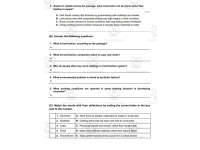
- Use the vocabulary matching section (garments, synthetic, labor, trend, secondhand) as a pre-reading activity, since those same words appear directly in the passage.
- Have students complete the short-answer section (B) before the inference-based multiple-choice questions (A), since B's questions closely track the passage's paragraph order and can build confidence first.
- Remove the two-page promotional insert (readme1.pdf) before printing for students, since it's a review request and catalog ad rather than passage content.

Skills covered
- reading comprehension
- vocabulary
Good to know
Questions teachers ask about this resource
What's in the second file, readme1.pdf?
It isn't additional passage content - it's a two-page promotional insert asking for a review and advertising the vendor's full Teach Simple catalog.

No reviews yet
Downloaded this resource? Tell other teachers how it went.
Curriculum
Standards, concepts & topics
Standards
 Standards
- CCSS.RI.6.1 — Cite textual evidence to support analysis of what the text says explicitly as well as inferences drawn from the text.
- CCSS.RI.6.2 — Determine a central idea of a text and how it is conveyed through particular details; provide a summary of the text distinct from personal opinions or judgments.
- CCSS.RI.7.1 — Cite several pieces of textual evidence to support analysis of what the text says explicitly as well as inferences drawn from the text.
- CCSS.RI.7.2 — Determine two or more central ideas in a text and analyze their development over the course of the text; provide an objective summary of the text.
- CCSS.RI.8.1 — Cite the textual evidence that most strongly supports an analysis of what the text says explicitly as well as inferences drawn from the text.
- CCSS.RI.8.2 — Determine a central idea of a text and analyze its development over the course of the text, including its relationship to supporting ideas; provide an objective summary of the text.
- CCSS.RI.9.1 — Cite strong and thorough textual evidence to support analysis of what the text says explicitly as well as inferences drawn from the text.
- CCSS.RI.9.2 — Determine a central idea of a text and analyze its development over the course of the text, including how it emerges and is shaped and refined by specific details; provide an objective summary of the text.
- CCSS.L.6.4 — Determine or clarify the meaning of unknown and multiple-meaning words and phrases based on grade 6 reading and content, choosing flexibly from a range of strategies. a. Use context (e.g., the overall meaning of a sentence or paragraph; a word’s position or function in a sentence) as a clue to the meaning of a word or phrase. b. Use common, grade-appropriate Greek or Latin affixes and roots as clues to the meaning of a word (e.g., audience, auditory, audible). c. Consult reference materials (e.g., dictionaries, glossaries, thesauruses), both print and digital, to find the pronunciation of a word or determine or clarify its precise meaning or its part of speech. d. Verify the preliminary determination of the meaning of a word or phrase (e.g., by checking the inferred meaning in context or in a dictionary).
- CCSS.L.7.4 — Determine or clarify the meaning of unknown and multiple-meaning words and phrases based on grade 6 reading and content, choosing flexibly from a range of strategies. a. Use context (e.g., the overall meaning of a sentence or paragraph; a word’s position or function in a sentence) as a clue to the meaning of a word or phrase. b. Use common, grade-appropriate Greek or Latin affixes and roots as clues to the meaning of a word (e.g., audience, auditory, audible). c. Consult reference materials (e.g., dictionaries, glossaries, thesauruses), both print and digital, to find the pronunciation of a word or determine or clarify its precise meaning or its part of speech. d. Verify the preliminary determination of the meaning of a word or phrase (e.g., by checking the inferred meaning in context or in a dictionary).
- CCSS.L.8.4 — Determine or clarify the meaning of unknown and multiple-meaning words or phrases based on grade 8 reading and content, choosing flexibly from a range of strategies. a. Use context (e.g., the overall meaning of a sentence or paragraph; a word’s position or function in a sentence) as a clue to the meaning of a word or phrase. b. Use common, grade-appropriate Greek or Latin affixes and roots as clues to the meaning of a word (e.g., precede, recede, secede). c. Consult general and specialized reference materials (e.g., dictionaries, glossaries, thesauruses), both print and digital, to find the pronunciation of a word or determine or clarify its precise meaning or its part of speech. d. Verify the preliminary determination of the meaning of a word or phrase (e.g., by checking the inferred meaning in context or in a dictionary).
- CCSS.L.9.4 — Determine or clarify the meaning of unknown and multiple-meaning words and phrases based on grades 9–10 reading and content, choosing flexibly from a range of strategies. a. Use context (e.g., the overall meaning of a sentence, paragraph, or text; a word’s position or function in a sentence) as a clue to the meaning of a word or phrase. b. Identify and correctly use patterns of word changes that indicate different meanings or parts of speech (e.g., analyze, analysis, analytical; advocate, advocacy). c. Consult general and specialized reference materials (e.g., dictionaries, glossaries, thesauruses), both print and digital, to find the pronunciation of a word or determine or clarify its precise meaning, its part of speech, or its etymology. d. Verify the preliminary determination of the meaning of a word or phrase (e.g., by checking the inferred meaning in context or in a dictionary).
Core concepts
 Core concepts
- fast fashion
- nonfiction reading
 Topics
Explore more
Categories this resource belongs to
Explore related searches
More to explore
You may also like


