Science Reading Comprehension Passage: Animal Behavior (Fillable)

Science, ELA, Reading, Reading Comprehension, Strategies, Resources for Teachers, Life Sciences, Biology, Animals
Worksheets & Printables, Centers, Activities, Teacher Tools, Assessments, Quizzes and Tests, Quizzes, Literacy Readers, Worksheets, Workbooks


About This Product
Life Science Reading Comprehension Passage and Questions: Animal Behavior (Fillable PDF)
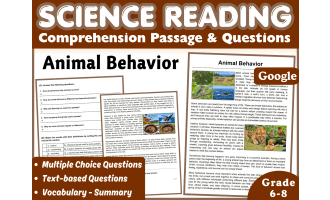
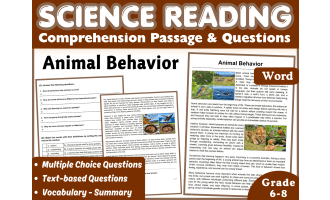
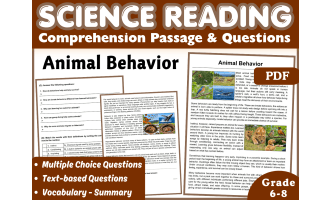
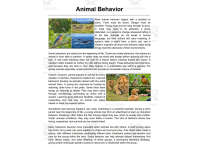
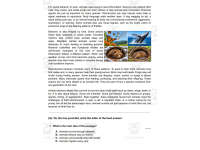
Introduce your students to the fascinating world of animal behavior with this engaging Life Science reading comprehension resource designed for Grades 6–8. Through an illustrated informational passage and structured comprehension activities, students will explore innate and learned behaviors, animal communication, social interactions, migration, hibernation, and reproductive behaviors while strengthening essential reading comprehension and scientific literacy skills.
Students will learn how animals use different behaviors to find food, avoid danger, communicate, reproduce, and care for their young. They will discover the differences between innate behaviors and learned behaviors, including examples such as spiders spinning webs, sea turtle hatchlings moving toward the ocean, young lions learning to hunt, and pets responding to rewards. The passage also explores imprinting, conditioning, and social behavior, showing how experience and group living can influence animal survival. Students will examine how animals communicate through sounds, chemical signals, body language, and visual displays, as well as how circadian rhythms, migration, and hibernation help animals respond to daily and seasonal changes. Reproductive behaviors, including attracting mates and caring for offspring, are also discussed.
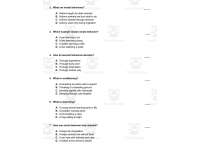
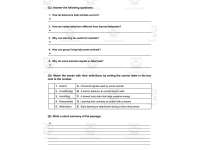
This 7-page reading comprehension resource features an illustrated informational reading passage followed by 10 multiple-choice questions (targeting main idea, key details, behavioral concepts, examples of innate and learned behaviors, animal communication, and survival), 10 true-or-false statements, 5 short-answer comprehension questions, a vocabulary matching activity with 5 terms, and a written summary activity. A complete answer key, including sample responses, is provided to support straightforward grading and review.
The activities are designed to reinforce students' understanding of key scientific concepts while developing their ability to identify important details, interpret informational texts, apply scientific vocabulary, and summarize what they have learned.
This passage is designed as a fillable PDF, which means students can type their answers directly into the document on any computer or tablet. Each page includes highlighted text fields that show them exactly where to type!
Available Formats for this Resource
PDF
Word Docs
Google Docs
This resource can be incorporated into different instructional settings and activities:
Science Lessons
Reading Comprehension Practice: Develop students' understanding of science-based informational texts.
Independent Work: Provide a structured activity students can complete at their own pace.
Homework: Reinforce classroom learning through reading and comprehension exercises.
Bell Ringers or Review: Use selected questions for brief science review activities.
Substitute Teacher Plans: Provide a ready-to-use instructional activity requiring minimal preparation.
Small-Group Learning: Encourage students to discuss animal characteristics and compare invertebrate groups.
Assessment and Revision: Evaluate understanding through multiple-choice, true-or-false, short-answer, and vocabulary exercises.
It also provides a practical opportunity to integrate Science and English Language Arts (ELA), helping students build reading comprehension and vocabulary skills through meaningful science content.
> Other Science Reading Collections and Topics You May Find in the Store:
1. Astronomy & Space Science
2. Volcanoes, Rocks, & Mountains
3. Rock Cycle, Soil, & Sinkholes
4. Mars, Glaciers, & Antarctica
5. Water Cycle, Acid Rain, & Wastewater
6. Insects, Animals, & Ecosystems
7. Bioluminescence & Insects
8. Animal Skin, Cats, & T. Rex
9. Human Body and Senses
10. Health & Applied Bioscience
11. Waves, Light, & Imaging
12. Electricity & Energy
13. Motion & Materials
14. Chemistry and Materials Science
15. Electromagnetism
16. Acids and Bases
17. Gas Laws
18. Biotechnology
19. Periodic Trends
20. Protists and Fungi
21. Microevolution
22. Blood
23. Chemical Bonding
24. Magnets
25. Muscles
26. Nuclear Chemistry
27. Electromagnetic Devices
28. Epigenetics
29. The Law of Conservation of Mass
30. Atomic Models
31. Isotopes and Ions
32. Light
33. Human-Environment Interaction
34. Theory of Evolution
35. Photosynthesis
36. Origins of Life and Early Earth
37. Gene Expression and Regulation
38. Thermochemistry
39. Allergies
40. Coevolution
41. Birth to Adulthood
42. Cells
43. Entropy and Free Energy
44. The Human Brain
45. Mixtures and Solutions
46. Invertebrates
47. Zoo Animals
48. Biochemistry
49. Animal Behavior
50. Population Ecology
...and many more engaging science reading passages that cover intriguing and important topics designed to spark curiosity and support student learning.
Use this passage to reinforce ELA skills in science, to add literacy to your lessons, and to support independent work. The passages strengthen main idea, evidence use, vocabulary in context, inference, cause and effect, and summary writing. With ready-to-use assessments and complete answer keys, you can provide focused practice that is simple to run and fast to review.
Resource Tags
0 Reviews
Check out these other great products