Straw Tower Challenge - MIDDLE SCHOOL - STEM Engineering
- Grades
- Grades 6–8
- Pages
- 9
- File type
- Multiple File Types
- Answer key
- Included


- Subject
- Science
- Topic
- Straw tower, Engineering design
- Resource types
- Projects, Activities
- Answer key
- Included
Product description
From the author
Straw Tower STEM Challenge for Middle School Students.
My Straw Tower Challenge is an excellent way to get your students excited for STEM in an engaging hands-on way. It also is a great way to introduce them to the world of engineering.
This activity is designed for Middle School students.
In this activity, students will work in groups to design and build a freestanding tower using only straws and paper clips. Their goal is to build a tower that will be tall and yet stable enough to hold a small weight at the top.
By doing this activity, your students will experience the process of creating something new as they brainstorm, plan, design, and test their ideas.
This challenge allows students to apply what they're learning in science and math classes, including geometry, physics, material science and more as they problem-solve to create a strong, stable tower using only simple materials. Additionally, they will develop critical thinking, creativity, communication, and collaboration skills while working in a group setting.
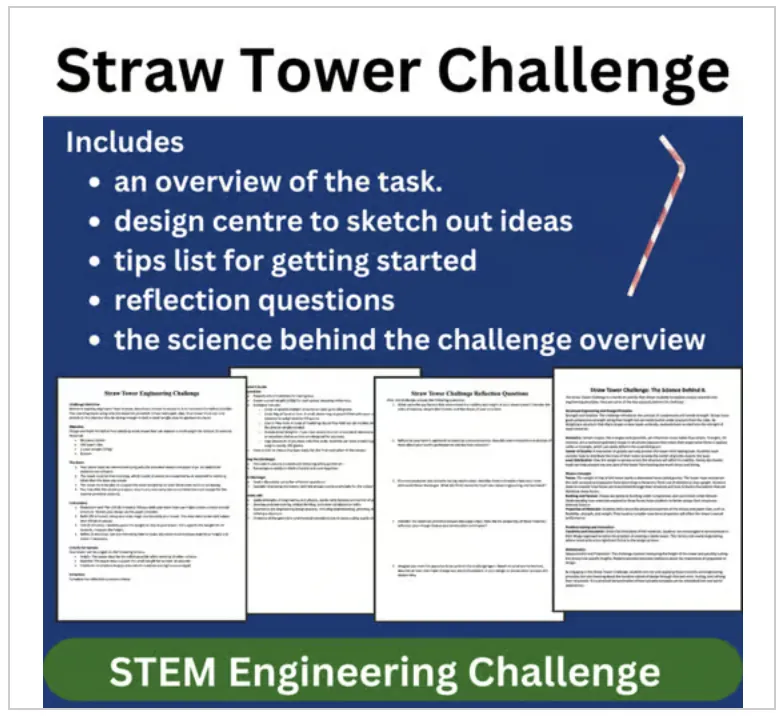
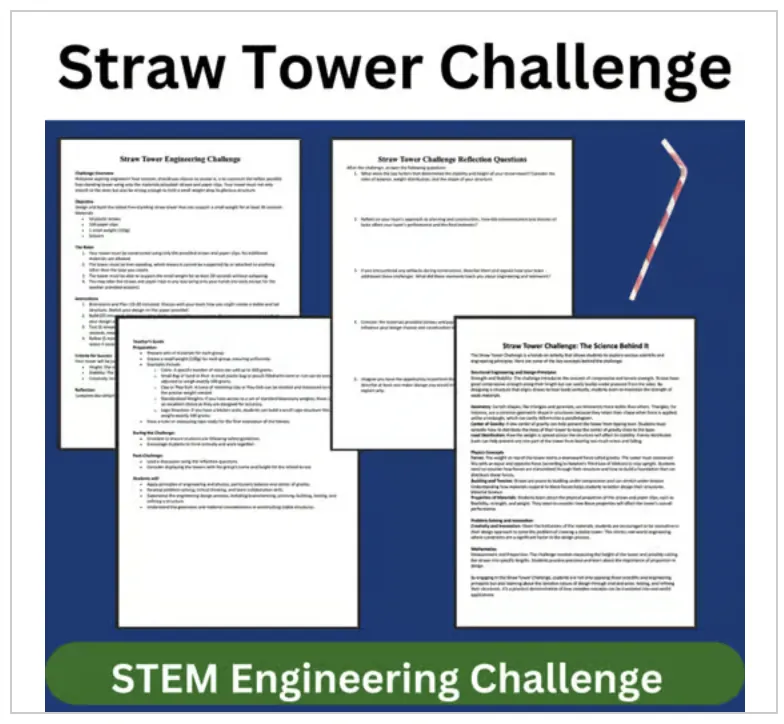
Your STEM Challenge comes with:
A full set of instructions
Reflection questions
An explanation on the science behind the challenge
Instructions on creating their design
Tips for getting started on the challenge
The Straw Tower Challenge is an activity your students will enjoy. It will allow them to:
explore how shapes and structure affect stability.
learn principles of weight distribution.
use the engineering design process.
develop perseverance, resourcefulness and an ability to learn from setbacks and mistakes.
This activity is easy to implement with step-by-step instructions and is adaptable to different learning styles and abilities as you can customize it however you like to suit your students. It encourages students to embrace productive failure and to work together to create something tangible.
Related resources
More resources teachers may find useful
24 related resources were found using this product's title, contributor, categories and tags.




In the classroom
Teaching tips & learning objectives

Learning objectives
Design and build a free-standing structure that carries a 100 g load for at least thirty seconds using only fifty straws and a hundred paper clips
Work through the full engineering design cycle named in the file — brainstorm, plan, build, test, refine — inside fixed time limits
Explain how balance, weight distribution and the shape of the structure determined the tower's height and stability

Teaching tips
Make the 100g weights before the lesson and keep them uniform; the Teacher's Guide offers coins, a small bag of sand or rice, clay or Play-Doh, standard laboratory weights, or a Lego build weighed on a kitchen scale
Have a ruler or measuring tape ready for the final evaluation — height is one of the three judged criteria and is measured only after the tower holds the weight for thirty seconds
The Teacher's Guide suggests displaying the finished towers with each group's name and height for the school to see, which gives the measurement step a purpose beyond scoring

Skills covered
Engineering design process — students brainstorm, sketch a blueprint, build, test with the weight and then refine, with each stage given its own time allowance in the instructions.
Structural reasoning — the science briefing sets out why triangles and pyramids hold their shape while a rectangle deforms into a parallelogram, and students apply that when choosing a tower form.
Working within constraints — only fifty straws, a hundred paper clips and teacher-provided scissors are allowed, so a design that needs anything else has to be rethought.
Good to know
Questions teachers ask about this resource
What exactly are students allowed to build with?
Straws and paper clips, and nothing else. The rules state the tower must be constructed using only the provided straws and paper clips, that it must stand free of any support other than its own base, and that students may alter the materials with their hands using no tool except the teacher-provided scissors. The 100g weight and a ruler or measuring tape are supplied by the teacher for testing and measuring.
How can a uniform 100g weight be put together without laboratory equipment?
The Teacher's Guide gives five routes: a counted number of coins, a small plastic bag or pouch of sand or rice adjusted to weight, a lump of modelling clay or Play-Doh, standard laboratory weights where a set is available, or a small Lego structure built to exactly 100 grams on a kitchen scale. The guide stresses making them uniform across groups so the towers are comparable.
How long does the build itself take?
The instructions time each stage: 15 to 20 minutes to brainstorm and sketch, 25 minutes to build, 5 minutes to test the weight and measure the height, and 5 minutes to refine and retest. That comes to roughly fifty to fifty-five minutes before the reflection discussion, which the Teacher's Guide places after the challenge.

No reviews yet
Downloaded this resource? Tell other teachers how it went.
Resource details
Concepts & topics
Core concepts
 Core concepts
Engineering design process
Structural stability
Center of gravity
Load distribution
Forces
 Topics
Explore related searches
More to explore