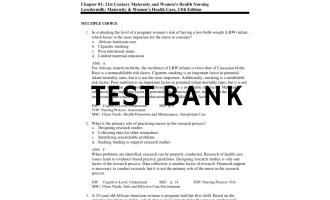
Test Bank for Essential Health Assessment 2nd Edition Thompson
- Grades
- Not Grade Specific
- Pages
- 837
- File type
- Preparation
- Print ready


- Subject
- Social Studies
- Topic
- Test Bank for Essential Health Assessment 2nd Edition Thompson
- Resource types
- Teacher Tools
- Preparation
- Print ready
About this resource
What's inside this resource
Essential Health Assessment, 2nd Edition by Thompson Test Bank
Develop this fundamental skill of health assessment and do well on your exams with the definitive test bank for the 2nd Edition of "Essential Health Assessment" by Thompson. This comprehensive test bank is an amazing resource for nursing students and allied health professionals who are looking for ways to advance their assessment knowledge and skills of patients, chapter-by-chapter.
As the perfect companion study guide to this top textbook, this test bank contains an extensive library of high-quality questions and rationales. It is systematically organized to match the structure of the textbook so you can practice and reinforce every concept from the first contact and initial patient interview and health history, to a head-to-toe, systematically organized physical examination of all body systems. You may be a student who needs to develop a strong understanding of assessment findings, or an instructor who needs to develop effective, comprehensive exams; this test bank is what you need.
Key Features and Benefits for Your Studies:
Comprehensive chapter coverage: Get a comprehensive knowledge base for the entire textbook. This test bank includes a vast array of questions for every individual chapter in "Essential Health Assessment, 2nd Edition," and it tests every possible assessment technique and finding, by chapter.
Clinically relevant question formats: Prepare if you have any question dm me
Related resources
More resources teachers may find useful
24 related resources were found using this product's title, contributor, categories and tags.



In the classroom
Teaching tips & learning objectives

Learning objectives
Distinguish primary subjective data from secondary subjective and objective data in documentation scenarios
Apply the SOAP charting categories to sample chart entries, separating assessment from objective data, subjective report and plan
Sequence the four basic assessment techniques correctly, including the altered order used for the abdomen (inspection, auscultation, percussion, palpation)

Teaching tips
Assign each chapter's items as the matching textbook chapter closes; the bank's twenty-four chapters run in the book's own sequence.
Filter by the Cognitive Level tag to build either a recall set or an application set from the same chapter's questions.
Assemble review sessions around the Client Need tags — Physiological Integrity, Health Promotion and Maintenance — rather than around a body system, when the goal is licensure-style practice.

Skills covered
Clinical reasoning in the nurse's role — items set scenarios such as choosing the correct order of abdominal assessment or the best interview response to a client who reports being healthy while describing an unhealed leg ulcer.
Health-assessment content recall by body system — eye structures involved in refraction, femur bone type, adolescent vital-sign ranges, gestational-diabetes risk factors and hemorrhoid presentation.
Distractor analysis — a separate rationale is printed for every option, not only the correct one, so each wrong choice can be traced to the reason it fails.
Good to know
Questions teachers ask about this resource
Every item carries a Client Need line — what does it record?
The NCLEX Client Needs category the item maps to, such as Health Promotion and Maintenance or Physiological Integrity, with a Client Need Sub line beneath it. Alongside it sit a Cognitive Level (Remembering, Understanding, Applying or Analyzing), a Nursing/Integrated Concepts line naming the step of the nursing process, and a numbered Learning Outcome.
Two different item layouts appear in the file — how do they differ?
Most chapters number each item as a Question with a Type line, options numbered 1 to 5, a Correct Answer line and a rationale for every option. Other stretches — parts of the health-history chapters, the anus and rectum chapter and the newborn and child sections — use lettered options a to d with a single ANS line, one explanation, and DIF, REF and MSC tags, where REF cites a textbook page.
Which chapters does the bank cover?
Twenty-four, in the textbook's order: Understanding Health Assessment; Interviewing the Patient for a Health History; Taking the Health History; Nutrition and Anthropometric Measurements; Assessment Techniques; General Survey and Vital Signs; Pain; then skin, hair and nails; head, face, mouth and neck; ears; eyes; respiratory; cardiovascular; abdomen; peripheral vascular and lymphatic; musculoskeletal; neurological; female and male breasts and reproductive systems; anus and rectum; the newborn; the child and adolescent; the pregnant woman; and the older adult.

No reviews yet
Downloaded this resource? Tell other teachers how it went.
Resource details
Concepts & topics
Core concepts
 Core concepts
Health assessment
Nursing process
NCLEX-style exam preparation
Physical examination by body system
 Topics
Explore related searches
More to explore
You may also like