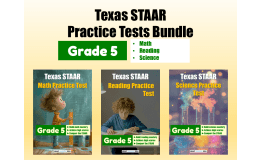
Texas STAAR Math Practice Test with Teacher's Guide



- Grades
- Grade 5
- Pages
- 15
- File type
- Answer key
- Included


- Subject
- Math
- Topic
- Texas STAAR, Grade 5 math
- Resource types
- Assessments
- Answer key
- Included
- Standards
- 5.NBT.B.7
Product description
From the author
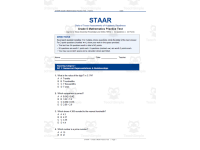
This fifteen-page math practice bundle contains a seven-page test with twenty-six multiple-choice questions and eight written-response questions, a three-page answer guide and a five-page teacher guide.
Topics include decimals, fractions, expressions, volume, coordinates, data and financial calculations. The teacher guide provides administration suggestions, differentiation ideas and a class tracker; the answer guide includes written-response rubrics.
Select items against the curriculum you have taught and apply the question-specific scoring clarifications. The bundle is independent practice material, and its performance bands should not be used as official STAAR score predictions.
Related resources
More resources teachers may find useful
24 related resources were found using this product's title, contributor, categories and tags.


In the classroom
Teaching tips & learning objectives

Learning objectives
Solve place-value, rounding, decimal and fraction calculations.
Use expressions and measurements in word problems.
Calculate rectangular-prism volume and work with coordinate locations.

Teaching tips
Review items against your taught curriculum before using them. The printed code table contains mismatches: 5.5A classifies two-dimensional figures, while 5.4H includes volume; 5.4F excludes exponents.
For question 7, both 7 0/5 and 7 equal the result. For question 9, both 1/2 and 6/12 are equivalent correct choices. Accept either or revise these questions before scoring.
The stated weights total 42 points. Use item-level results and the written-response rubrics; the guide’s approximate reporting-category totals and performance bands are not official STAAR score conversions.

Skills covered
Decimal place value, rounding and arithmetic
Fraction and mixed-number operations
Expressions, volume and coordinate calculations
Good to know
Questions teachers ask about this resource
How are the eight two-point constructed-response items scored differently from the twenty-six one-point items?
Two-point items use a rubric awarding 2 points for a fully correct response with work shown, 1 point for correct method or a correct answer without work, and 0 points for incorrect or blank; one-point items are simply scored correct or incorrect.
What differentiation supports does the teacher's guide suggest for advanced students versus struggling students?
For struggling students: focus on Readiness Standards first, use manipulatives before algorithms, and teach students to underline key numbers in word problems. For advanced students: extend to multi-step problems combining multiple TEKS and have them write original word problems to swap with a partner.

No reviews yet
Downloaded this resource? Tell other teachers how it went.
Curriculum
Standards, concepts & topics
Standards
 Standards
- 5.NBT.B.7
Core concepts
 Core concepts
TEKS
STAAR test prep
Fractions
Volume
Financial literacy
 Topics
More to explore
You may also like