24 related resources

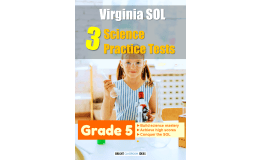
Virginia SOL Science Practice Test for Grade 5

Fifty multiple-choice questions, each coded to a Virginia SOL standard, cover scientific investigation through adaptations and heredity.
Grades
Grade 5, Homeschool Resources, Elementary
Pages
18
File type
PDF
Answer key
Included

Updated Jul 26, 2026

Subject
Science
Topic
science, virginia
Resource types
Assessments, Teacher Tools, Tests, Quizzes and Tests, Worksheets & Printables
Answer key
Included

About this resource

What's inside this resource

Virginia SOL Science Practice Test for Grade 5

Looking for a rigorous Grade 5 Virginia SOL Science practice test that helps students feel prepared and confident before testing day? This Virginia SOL Science review resource includes a full-length 45-question practice test, answer key, teacher guide, student answer sheet, and targeted reteaching tools aligned to the official VDOE Grade 5 Science Test Blueprint. Perfect for SOL prep, intervention, review, and science test practice!

⭐ Created to mirror the structure and rigor of the real Virginia SOL Science assessment, this science practice test helps students build testing stamina while giving teachers meaningful data for reteaching and intervention.

What’s Included

  • 1 full-length Grade 5 Virginia SOL Science practice test

  • 45 multiple-choice questions

  • Student bubble answer sheet

  • Complete answer key

  • Skill-by-skill question breakdown

  • SOL-aligned score conversion chart

  • Class data tracker

  • Teacher pacing guide

  • Quick reteaching strategies

  • Test-day tips and accommodations

  • Standards alignment pages

🔬 Standards & Topics Covered

This Grade 5 Virginia SOL Science test prep resource covers BOTH Grade 4 and Grade 5 science standards:

RC1: Force, Motion, Energy, & Matter

  • Energy transformation

  • Conservation of energy

  • Friction and motion

  • Atoms and mixtures

  • Kinetic energy

RC2: Electricity, Sound, & Light

  • Circuits

  • Conductors and insulators

  • Static electricity

  • Sound waves

  • Reflection and refraction

RC3: Living Systems & Ecosystems

  • Photosynthesis

  • Food webs and ecosystems

  • Animal adaptations

  • Classification

  • Ocean organism interactions

RC4: Earth, Space, & Resources

  • Weather and climate

  • Moon phases and seasons

  • Plate tectonics

  • Rock cycle

  • Renewable resources

Aligned directly to the Virginia SOL Grade 5 Science blueprint and reporting categories.

🧪 How It Works in the Classroom

Use this Grade 5 science practice test for:

✅ SOL review and test prep

✅ Diagnostic assessments

✅ Small group intervention

✅ Independent practice

✅ Homework or sub plans

✅ Test-taking strategy review

✅ End-of-year review

Teachers can administer the assessment as a diagnostic, mid-prep checkpoint, or dress rehearsal before the SOL exam.

🎯 Why Teachers Love It

⭐ Saves prep time with print-and-go testing materials
⭐ Provides meaningful standards-based data
⭐ Helps students build testing confidence
⭐ Easy-to-use answer keys and tracking tools
⭐ Includes reteaching support and pacing guidance
⭐ Professional, classroom-ready formatting
⭐ Supports data-driven intervention planning

The included teacher guide offers quick reteaching strategies for key science concepts and skills.

📚 Perfect For

  • 5th Grade Science

  • Virginia SOL Science Review

  • Science Test Prep

  • End-of-Year Review

  • Science Intervention

  • Homeschool Science Practice

  • Benchmark Assessments

  • Science Review Packets

If you're searching for a high-quality Grade 5 Virginia SOL Science practice test with teacher-friendly support tools, this resource is ready to help your students succeed!

In the classroom

Teaching tips & learning objectives

Learning objectives

  • Students distinguish accuracy from precision and identify appropriate tools and controls in a scientific investigation.

  • Students explain force, motion, and energy concepts, including balanced/unbalanced forces and energy transformations.

  • Students classify physical versus chemical changes in matter, citing evidence such as gas production or new-substance formation.

  • Students explain ecosystem roles and relationships, including decomposers, food chains, biodiversity, and invasive species.

  • Students apply Earth and space science concepts, such as the causes of seasons, moon phases, and rock formation, to answer test-style questions.

Teaching tips

  • Use the test as a diagnostic before instruction, a unit review, or a full practice run before the state SOL test, per the teacher's guide's own suggested uses (page 15).

  • Split the 50 questions into two 25-question sessions by strand for students needing extended time, as the guide recommends for IEP/504 accommodations (page 18).

  • After scoring, use the SOL alignment table to identify which specific SOL standards a student missed and target those in follow-up instruction (page 18).

  • For struggling learners, the guide suggests re-teaching with hands-on labs and PhET Interactive Simulations before repeating the vocabulary-heavy sections (page 18).

Skills covered

  • Scientific investigation reasoning — students evaluate accuracy vs. precision, experimental controls, and independent variables across six questions (Q1-5, 49).

  • Force, motion, and energy analysis — students reason about balanced forces, energy transformations, and heat flow across eight questions (Q6-12, 50).

  • Matter classification — students distinguish physical from chemical changes and identify density-based behavior across six questions (Q13-18).

  • Earth and space science reasoning — students explain seasons, star brightness, moon phases, and rock types across nine questions (Q29-37).

  • Ecosystem and life-science content knowledge — students explain decomposer roles, food-chain energy loss, biodiversity, and cell structures across ten questions (Q19-28).

Good to know

Questions teachers ask about this resource

How are the test questions organized?

The 50 questions are grouped by strand — for example, all six Scientific Investigation questions appear first, followed by Force/Motion/Energy, Matter, Ecosystems, and so on through Adaptations & Heredity — with each strand's Virginia SOL code listed in the teacher's guide's alignment table.

What does each solution provide beyond the correct letter?

Each question's SOL code plus a full written explanation of why the correct answer is right, not just a letter answer.

No reviews yet

Downloaded this resource? Tell other teachers how it went.

Resource details

Concepts & topics

Core concepts

  • scientific investigation

  • force and energy

  • matter and change

  • ecosystems

  • Earth and space science

Explore more

Categories this resource belongs to

Explore related searches

More to explore

You may also like