



3,990 products added recently
Page 65 - Science Activities
Ignite your students' interest in science with activities that make learning interactive and exciting. This collection offers experiments, demonstrations, and inquiry-based projects covering various scientific fields. By integrating these science activities into your lessons, you can encourage critical thinking, foster curiosity, and deepen understanding of scientific concepts.

 Show filters

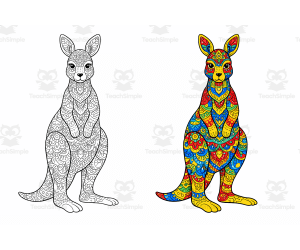
kangaroo Mandala Coloring Page Worksheet activity
Common Core, Life Studies, Animals, Life Sciences, Science, Not Grade Specific, Activities, Coloring Pages, Worksheets, Worksheets & Printables
Use the Mandala Coloring Page Worksheet Activity to engage your students by combining creativity, calmness, and education into an enjoyable, easy-to-use learning resource. Colouring mandalas encourages learners to engage their focus and imagination as they explore their chosen topic while using the mandala-style design they have created. Colouring mandalas to build coordination between the eyes and hands, improve fine motor skills and enhance attention to detail as well as foster creativity and the ability to express oneself artistically. The calmness and structure of this type of design allow learners to slow down, focus and enjoy a more meaningful learning experience. You can incorporate the Mandala Colouring Page Worksheet Activity into many different subject areas such as science, social studies, art, and social and emotional. As an ideal way to assist early finishers or facilitate quiet learning, the Mandala Colouring Activity provides an excellent opportunity to provide students balance between relaxation and learning. What are the Aims of the Mandala Colouring Activity? The Mandala Colouring Page Worksheet Activity aims to: Enhance understanding of a specific subject. Strengthen fine motor skills and pencil grasp ✏️ Help develop focus, patience, and concentration 🧠 Encourage artistic confidence and develop creativity 🎨 Allow students to experience a mindful, stress-reducing educational experience. Completing a mandala is a tactile and fun way to create a fun and engaging method of learning for a wider audience. Steps for Using the Mandala Colouring Page Worksheet Activity The following procedures should be followed to utilize the Mandala Colouring Page Worksheet Activity. The Mandala Colouring Page Worksheet Activity can be accomplished in five simple steps. 1. Print the Mandala Colouring Page. 2. Discuss or introduce key concept(s) associated with the theme. 3. Have students colour in an orderly fashion and pay close attention to symmetry. 4. Discuss relevant vocabulary or concepts related to the theme. 5. Extension of learning: labelling, writing prompts, or creative designs are optional and encouraged. ✅ General Audience All ages and learning levels. Suitable for: Individual or paired work Learning centres Activities for early finishers Mindfulness/calm down activities Homework or take-home assignments Lesson plans for substitutes Use in the Classroom The Mandala Colouring Page Worksheet Activity can be used in many different settings and serves as a versatile tool for both classroom and home. Variations and Extensions to the Mandala Colouring Page Worksheet Activity in the Classroom Creative/Visual Art Extensions 🎨 Design a new mandala focused on the topic. Add images or patterns that represent significant concept(s) Mindful/Intentional Colouring Time ⏳ Establish a time for quiet, deliberate colouring. Writing/Reflection ✏️ Write a short statement, fact, or reflection pertaining to the studied theme. Creative Thinking 🧩 Create, design, or think of new ideas inspired by the theme. Skills Developed Through the Mandala Colouring Page Worksheet Activity: Fine Motor Skills Hand-Eye Coordination Focus & Concentration Creativity & Self-Expression Cross-disciplinary Use of the Mandala Colouring Page Worksheet. File Type / Info to Use When Printing File ✔️ Able to Print as PDF Document ✔️ Pages are Black & White – Save Ink While Printing ✔️ Print Out For Your Classroom Easily ✔️ No Preparation Needed For Teachers To Get Started Teacher Strategies 🌟: Encourage students to take their time, pay attention to the details, and have fun while creating. Coloring Mandalas can be used as an avenue to assist students in their learning by providing a calming, community-oriented environment and motivating the students to remain focused on their work and encourage creative thought within the students as they complete their designs.
Author Classsim
Rating
Tags Kangaroo, Mandala , Coloring Page, Worksheet , Activity, Printable, Kangaroo Mandala , Kangaroo Mandala Coloring Page , Kangaroo Mandala Coloring Page Worksheet , Kangaroo Mandala Coloring Page Worksheet Activity
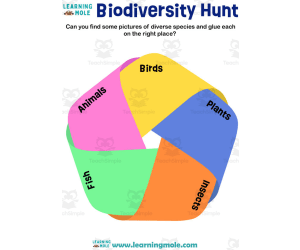
Biodiversity Hunt Activity
Environmental Science, Earth and Environmental Sciences, Science, Grade 2, 3, 4, 5, 6, 7, 8, 9, 10, 11, 12, Activities
Activity Introduction An amazing activity designed for the students to learn more about STEM. Biodiversity Hunt Do you like STEM subjects? what is your favorite one? Have you ever tried to plant a seed? If yes, tell us more about it. Or have you ever tried to invent something? If yes, tell us more about it. And how do you think it will help us? Have you ever seen a microorganism under a microscope? What was it? And how it looked like? Mathematics is a marvelous subject. Let' sharpen our brains and solve some equations. Do you like timetable tricks? What is your favorite one? Do you know how to code? Have you ever created an app or a game before? If yes, how was it like? Biodiversity Hunt Activity The activity is perfect for encouraging the researching skills for the students, while learning more about this fantastic topic. Biodiversity Hunt This friendly designed worksheet is suitable for students at school, homeschooling, and as a group activity. Instructions Can you find some pictures of diverse species and glue each on the right place? Format Available in a PDF format.
Author Educational Voice
Tags Biodiversity Hunt Activity, Biodiversity Hunt, Biodiversity Activity, Biodiversity, Biodiversity Facts, Biodiversity Facts For Kids, Environment, Animals, Birds, Plants
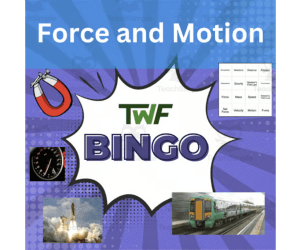
Force and Motion Science BINGO Activity
Science, Physics, Grade 6, 7, 8, 9, 10, 11, Activities
Your students will love this engaging science review activity. Everyone loves BINGO and it makes for a great review activity that is fun and competitive. This interactive game reinforces key scientific concepts and theories, ensuring curriculum relevance and accuracy. The game package includes 36 unique 4x4 bingo cards featuring essential terms and concepts from Force and Motion, a set of call-out cards with clear and concise definitions tailored to the students' level, and detailed gameplay instructions. The included terms encompass a wide range of topics, such as; Force, Motion, Gravity, Friction, Mass, Acceleration, Velocity, Newton's First Law, Displacement, Speed, Distance, Newton's Third Law, Newtons, Electromagnetic, Net Force, F=ma. To play, simply distribute the bingo cards to your students along with markers or chips. Read out the definitions from the call-out cards in a random order, and have students place a marker on the corresponding term on their card. The first student to complete a row or column exclaims "Bingo!" and emerges victorious. Following the game, engage in a discussion of the terms to reinforce understanding and clarify any misconceptions. The beauty of this game is that it allows for multiple rounds of learning and review. Teachers will appreciate the game's ability to encourage active participation and engagement in the classroom setting, catering to various student learning styles and promoting differentiated learning. By matching definitions to terms on their bingo cards, students actively engage with the material, enhancing their retention and comprehension of complex scientific theories. Here is a sample from the instructions. BINGO – Instructions, Terms, and Descriptions Cut out and distribute the BINGO cards to your students. Each student will get a unique card. Students can use markers or chips to cover squares that have been called. Print out and cut out each term/description below – these are the call-out cards. Fold each call-out card and place in a hat or box and remove one at a time. After you’ve read the call-out card description, your students are to place a marker on the term associated with the description located on their card. The first student to get 4 in a row horizontally or vertically, wins. Ensure accuracy by checking marked terms on student card to the called-out descriptions.
Author Teach With Fergy
Tags Science Bingo, Bingo Activity, Force, Motion, Force And Motion

Pill Bug Flipbook crafts Roly Poly Animal Science Study writing prompt
Animals, Life Sciences, Science, Biology, Grade 1, 2, 3, 4, Crafts, Activities, Parts of and Anatomy of, Worksheets & Printables, Writing Prompts
Make learning about pill bugs (roly-polies) fun and interactive with this printable DIY flipbook craft! Students will explore the fascinating world of pill bugs by learning about their habitat, diet, body features, life cycle, adaptations, and interesting facts while strengthening reading comprehension and writing skills through engaging science activities. I like using this resource during invertebrate units, bug and insect studies, animal science lessons, classroom centers, independent work, and homeschool learning. It’s a low-prep activity that combines science, reading, writing, and creativity into one meaningful project. What You Will Get This resource includes a printable Pill Bug (Roly Poly) DIY flipbook that helps students organize and record what they learn about this fascinating terrestrial crustacean through reading, writing, and hands-on learning. What’s Included in this Flipbook? • Pill Bug (Roly Poly) DIY flipbook craft templates • Reading and writing activities • Animal facts and science research pages • Habitat, diet, and life cycle sections • Physical characteristics and adaptations pages • Writing prompts and reflection activities • Easy-to-follow assembly instructions This resource is perfect for: • Animal science lessons • Invertebrate studies • Bug and insect units • Classroom science centers • Homeschool learning • Independent work and early finishers Why you will love this? • Easy to print and assemble • Encourages reading, writing, and scientific thinking • Builds nonfiction reading comprehension skills • Supports research and observation skills • Makes science learning hands-on and engaging • Creates a meaningful keepsake students can share This Pill Bug (Roly Poly) DIY Flipbook Craft is a fun and interactive way for students to discover the unique characteristics, adaptations, and life cycle of these fascinating little creatures while developing reading, writing, and science skills through creative, hands-on learning.
Author Perfect_Printables
Rating
Tags Animal Science, Writing Prompt, Science Craft, Nonfiction Activities, Science Centers, Animal Research, Flipbook, Pill Bug, Pill Bug Flipbook, Roly Poly

Rock Cycle, Soil, & Sinkholes: SAMPLE Reading Passage (Word)
Science, Earth and Environmental Sciences, ELA, Reading, Reading Comprehension, Strategies, Resources for Teachers, Geology, Earth Sciences, Grade 6, 7, 8, 9, Writing Prompts, Worksheets & Printables, Centers, Activities, Teacher Tools, Assessments, Quizzes and Tests, Quizzes, Tests
This is a ONE PASSAGE SAMPLE. The following is the description of the FULL resource and the downloading links: Rock Cycle, Soil, & Sinkholes: Reading Comprehension Passages (Word) This very engaging collection of earth science reading passages about Rock Cycle, Soil, and Sinkholes is designed to bridge the gap between science and literacy through strengthening reading comprehension and sparking scientific curiosity in middle school students. Each passage blends English Language Arts skills with accurate science content that supports NGSS classroom practice. Ideal for interdisciplinary learning in ELA and Science. Suitable for Grade 9 review, too! What Is Included? There are (3) informational passages: Soil: The Life Beneath Our Feet Explore how minerals, organic matter, water, and air build layered soil, and see how texture and structure affect roots, drainage, clean water, and healthy habitats. The Science of Sinkholes Understand how dissolving rock creates underground voids, what can trigger subsidence or collapse, and how mapping and prevention reduce risk in vulnerable areas. The Rock Cycle: How Rocks Form and Change Follow rock material as it melts, crystallizes, weathers, compacts, and transforms under heat and pressure, then connect these processes to examples in nature and everyday life. Student Tasks for Each Passage: 5 multiple-choice questions targeting main idea, key details, inference, vocabulary in context, and use of evidence 5 vocabulary matching items with clear, student-friendly definitions 5 text-based questions that require citing specific lines or facts 1 summary prompt that asks students to condense central ideas accurately Full answer key for every section Available Formats for this Resource PDF Google Docs FULL CATALOG OF DOWNLOADING LINKS HERE Other Science Reading Collections and Topics You May Find in the Store: 1. Astronomy & Space Science 2. Volcanoes, Rocks, & Mountains 3. Rock Cycle, Soil, & Sinkholes 4. Mars, Glaciers, & Antarctica 5. Water Cycle, Acid Rain, & Wastewater 6. Insects, Animals, & Ecosystems 7. Bioluminescence & Insects 8. Animal Skin, Cats, & T. Rex 9. Human Body and Senses 10. Health & Applied Bioscience 11. Waves, Light, & Imaging 12. Electricity & Energy 13. Motion & Materials 14. Chemistry and Materials Science 15. Electromagnetism 16. Acids and Bases 17. Gas Laws 18. Biotechnology 19. Periodic Trends 20. Protists and Fungi 21. Microevolution 22. Blood 23. Chemical Bonding 24. Magnets 25. Muscles 26. Nuclear Chemistry 27. Electromagnetic Devices 28. Epigenetics 29. The Law of Conservation of Mass 30. Atomic Models 31. Isotopes and Ions 32. Light 33. Human-Environment Interaction 34. Theory of Evolution 35. Photosynthesis 36. Origins of Life and Early Earth 37. Gene Expression and Regulation 38. Thermochemistry 39. Allergies 40. Coevolution 41. Birth to Adulthood 42. Cells 43. Entropy and Free Energy 44. The Human Brain 45. Mixtures and Solutions 46. Invertebrates 47. Zoo Animals 48. Biochemistry 49. Animal Behavior 50. Population Ecology ...and many more engaging science reading passages that cover intriguing and important topics designed to spark curiosity and support student learning. Product Details Length: 15 pages total Grades: 6–8, also suitable for Grade 9 review Use cases: close reading, stations, homework, intervention, test prep, and sub plans Standards support: reinforces informational-text skills and supports NGSS-style sense making through observation, modeling, and clear use of claim, evidence, and reasoning Why Teachers Choose This Set Authentic science content paired with rigorous literacy practice Consistent task structure across all passages for easier planning and smoother student routines Clear, age-appropriate writing that builds confidence without oversimplifying Use this set to reinforce ELA skills in science, to add literacy to your lessons, or to support independent work. The passages strengthen main idea, evidence use, vocabulary in context, inference, cause and effect, and summary writing. With ready-to-use assessments and complete answer keys, you can provide focused practice that is simple to run and fast to review.
Author Middle & High School - CORED Education
Rating 5
Tags Middle School, Reading Comprehension, Reading Strategies, Reading Passages, ELA, Centers, Reading Passage, Assessments, Vocabulary, Earth Science
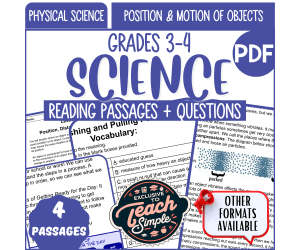
Reading Passages on Position and Motion of Objects (PDF)
ELA, Reading, Reading Comprehension, Science, Physics, Common Core, ESL, Language Development, Vocabulary, Grade 2, 3, 4, Worksheets & Printables, Worksheets, Assessments, Teacher Tools, Tests, Quizzes and Tests, Centers, Activities
Reading Passages on Position and Motion of Objects for Physical Science Position and Motion of Objects: Reading Passages Physical Science incorporates science literacy seamlessly into your teaching plans. The pack not only facilitates learning in crucial scientific domains but also offers an engaging variety of questions to reinforce comprehension. Focused on essential topics like motion, forces, and sound, these passages serve as a dual-purpose educational tool. By integrating this resource, you'll be able to tackle key scientific concepts while also honing your students' reading skills. The diverse set of questions that follow each passage—spanning multiple-choice, analytical, and more—provide a comprehensive approach to understanding both the text and the scientific principles it covers. What's inside? Part 2 - Position & Motion of Objects. Reading Passage 1: Position, Distance, and Motion Reading Passage 2: Pushing and Pulling Forces Reading Passage 3: Sound, Hearing, and Force Reading Passage 4: Characteristics of Sound Product Info: 23 pages Teaching Duration: 2 Weeks Science Reading Comprehension Outline: Targeted for students in 3rd and 4th grades, these reading passages are enhanced with illustrations and graphs to elucidate critical points. Each lesson aligns with the Common Core State Standards, allowing you to integrate science reading practice effortlessly, knowing that minimal preparation is needed on your part. Each passage comes with a variety of questions in different formats, including multiple-choice formats, data analysis, and fill-in-the-blanks. The topics covered strike a balance between engaging content and core curriculum-based science subjects. Versatile in application, these lessons are suitable for a variety of settings such as whole-class instruction, morning activities, independent desk work, small group discussions, contingency plans for substitute teachers, homework assignments, or even special holiday-themed tasks. FULL CATALOG OF DOWNLOAD LINKS HERE Grade 3/4 Links: Physical Science Part 1 - Properties of Objects and Materials Google Docs/Slides/Forms PDF PPT Word Free Supplementary Pack Accompanying Videos Physical Science Part 2 - Position and Motion of Objects Google Docs/Slides/Forms PDF PPT Word Free Supplementary Pack Accompanying Videos Physical Science Part 3 - Light, Heat, Electricity, Magnetism Google Docs/Slides/Forms PDF PPT Word Free Supplementary Pack Accompanying Videos Life Science Part 1 - Characteristics of Organisms Google Docs/Slides/Forms PDF PPT Word Free Supplementary Pack Accompanying Videos Life Science Part 2 - Life Cycles of Organisms Google Docs/Slides/Forms PDF PPT Word Free Supplementary Pack Accompanying Videos Life Science Part 3 - Organisms and Environments Google Docs/Slides/Forms PDF PPT Word Free Supplementary Pack Accompanying Videos Earth Science Part 1 - Properties of Earth Materials Google Docs/Slides/Forms PDF PPT Word Free Supplementary Pack Accompanying Videos Earth Science Part 2 - Changes in the Earth and Sky Google Docs/Slides/Forms PDF PPT Word Free Supplementary Pack Accompanying Videos Earth Science Part 3 - Objects in the Sky Google Docs/Slides/Forms PDF PPT Word Free Supplementary Pack Accompanying Videos For similar products and other frees, do check out Cored Group on TeachSimple .
Author Cored Education
Rating
Tags Science, Elementary, Reading, Comprehension, Physics, Physical Science, Reading Centers, Reading Comprehension Assessments, Science Assessments, Vocabulary Assessments
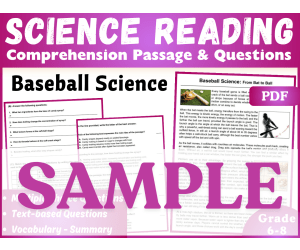
Science Reading Comprehension Passage: Baseball Science. SAMPLE
Science, ELA, Reading, Reading Comprehension, Strategies, Resources for Teachers, Physics, Grade 6, 7, 8, 9, Writing Prompts, Worksheets & Printables, Centers, Activities, Teacher Tools, Assessments, Quizzes and Tests, Quizzes, Tests
This is a free passage sample from the complete resource. The full version includes everything needed for a complete reading comprehension activity: the passage, multiple-choice questions, short-answer questions, vocabulary matching, a summary-writing task, and a detailed answer key. Download the complete passage resource by clicking on the following links: PDF Fillable PDF Word Docs Google Docs Science Reading Comprehension Passage and Questions: Baseball Science (PDF) This very engaging science reading passage is about the physics of baseball , especially how forces and energy affect the way a baseball moves after it is hit or pitched. It explains how kinetic energy transfers from the bat to the ball, how launch angle affects distance, how air resistance/drag slows the ball, and how spin creates the Magnus effect, which can make pitches curve or make batted balls carry farther. It also explains how weather and location, such as high altitude, warm air, and humidity, can affect how far a ball travels. This passage is designed to bridge the gap between science and literacy through strengthening reading comprehension and sparking scientific curiosity in middle school students. The passage blends English Language Arts skills with accurate science content that supports NGSS classroom practice. Ideal for interdisciplinary learning in ELA and Science. Suitable for Grade 9 review, too! Student Tasks for The Passage: 5 multiple-choice questions targeting main idea, key details, inference, vocabulary in context, and use of evidence 5 vocabulary matching items with clear, student-friendly definitions 5 text-based questions that require citing specific lines or facts 1 summary prompt that asks students to condense central ideas accurately Full answer key for every section FULL CATALOG OF DOWNLOADING LINKS HERE Product Details Length: 4 pages total Grades: 6–8, also suitable for Grade 9 review Use cases: close reading, stations, homework, intervention, test prep, and sub plans Standards support: reinforces informational-text skills and supports NGSS-style sense making through observation, modeling, and clear use of claim, evidence, and reasoning Why Teachers Choose This Set Authentic science content paired with rigorous literacy practice Consistent task structure across all passages for easier planning and smoother student routines Clear, age-appropriate writing that builds confidence without oversimplifying Other Science Reading Collections you May find in the store: 1. Astronomy & Space Science 2. Volcanoes, Rocks, & Mountains 3. Rock Cycle, Soil, & Sinkholes 4. Mars, Glaciers, & Antarctica 5. Water Cycle, Acid Rain, & Wastewater 6. Insects, Animals, & Ecosystems 7. Bioluminescence & Insects 8. Animal Skin, Cats, & T. Rex 9. Human Body and Senses 10. Health & Applied Bioscience 11. Waves, Light, & Imaging 12. Electricity & Energy 13. Motion & Materials 14. Chemistry and Materials Science Use this set to reinforce ELA skills in science, to add literacy to your lessons, and to support independent work. The passages strengthen main idea, evidence use, vocabulary in context, inference, cause and effect, and summary writing. With ready-to-use assessments and complete answer keys, you can provide focused practice that is simple to run and fast to review.
Author Middle & High School - CORED Education
Rating
Tags Middle School, Reading Comprehension, Reading Strategies, ELA, Centers, Reading Passage, Assessments, Vocabulary, Making Candy, Physics

Life Science Reading Comprehension Passage: Goosebumps (PDF)
Science, ELA, Reading, Reading Comprehension, Strategies, Resources for Teachers, Life Sciences, Biology, Grade 6, 7, 8, 9, Writing Prompts, Worksheets & Printables, Centers, Activities, Teacher Tools, Assessments, Quizzes and Tests, Quizzes, Tests
Life Science Reading Comprehension Passage and Questions: Goosebumps (PDF) This very engaging life science reading passage about goosebumps and why humans still get them. It explains that goosebumps happen when tiny muscles attached to hair follicles tighten and pull hairs upright. In furry animals, this reaction helps trap heat and can make the animal look larger when threatened. In humans, the reflex is mostly vestigial , meaning it is a leftover from ancestors who had more body hair. The passage also explains how goosebumps connect to the sympathetic nervous system , adrenaline , strong emotions, music, fear, cold, and even scientific research on stress and feelings. This passage is designed to bridge the gap between science and literacy through strengthening reading comprehension and sparking scientific curiosity in middle school students. The passage blends English Language Arts skills with accurate science content that supports NGSS classroom practice. Ideal for interdisciplinary learning in ELA and Science. Suitable for Grade 9 review, too! Student Tasks for The Passage: 5 multiple-choice questions targeting main idea, key details, inference, vocabulary in context, and use of evidence 5 vocabulary matching items with clear, student-friendly definitions 5 text-based questions that require citing specific lines or facts 1 summary prompt that asks students to condense central ideas accurately Full answer key for every section Available Formats for this Resource Fillable PDF Word Docs Google Docs FULL CATALOG OF DOWNLOADING LINKS HERE Product Details Length: 5 pages total Grades: 6–8, also suitable for Grade 9 review Use cases: close reading, stations, homework, intervention, test prep, and sub plans Standards support: reinforces informational-text skills and supports NGSS-style sense making through observation, modeling, and clear use of claim, evidence, and reasoning Why Teachers Choose This Set Authentic science content paired with rigorous literacy practice Consistent task structure across all passages for easier planning and smoother student routines Clear, age-appropriate writing that builds confidence without oversimplifying Other Science Reading Collections you May find in the store: 1. Astronomy & Space Science 2. Volcanoes, Rocks, & Mountains 3. Rock Cycle, Soil, & Sinkholes 4. Mars, Glaciers, & Antarctica 5. Water Cycle, Acid Rain, & Wastewater 6. Insects, Animals, & Ecosystems 7. Bioluminescence & Insects 8. Animal Skin, Cats, & T. Rex 9. Human Body and Senses 10. Health & Applied Bioscience 11. Waves, Light, & Imaging 12. Electricity & Energy 13. Motion & Materials 14. Chemistry and Materials Science Use this set to reinforce ELA skills in science, to add literacy to your lessons, and to support independent work. The passages strengthen main idea, evidence use, vocabulary in context, inference, cause and effect, and summary writing. With ready-to-use assessments and complete answer keys, you can provide focused practice that is simple to run and fast to review.
Author Middle & High School - CORED Education
Rating
Tags Middle School, Reading Comprehension, Reading Strategies, ELA, Centers, Reading Passage, Assessments, Vocabulary, Life Science, Biology

Motion & Materials: Physical Science Reading Comprehension (PDF)
Science, ELA, Reading, Reading Comprehension, Strategies, Resources for Teachers, Physics, Grade 6, 7, 8, 9, Writing Prompts, Worksheets & Printables, Centers, Activities, Teacher Tools, Assessments, Quizzes and Tests, Quizzes, Tests
Electricity and Energy: Physical Science Reading Comprehension Passages and Questions (PDF) This very engaging collection of physical science reading passages about electricity and energy is designed to bridge the gap between science and literacy through strengthening reading comprehension and sparking scientific curiosity in middle school students. Each passage blends English Language Arts skills with accurate science content that supports NGSS classroom practice. Ideal for interdisciplinary learning in ELA and Science. Suitable for Grade 9 review, too! What Is Included? There are (3) informational passages: Sweet Science: How Heat Shapes Candy: Heating sugar syrup to precise temperatures changes how much water remains and how sugar crystals form, turning one mixture into smooth fudge, chewy caramels, or hard, glassy brittle. Baseball Science: From Bat to Ball: Each pitch and hit shows physics at work, as bat speed, launch angle, air resistance, and spin team up to decide whether the ball curves, drops, or carries toward the fence. Electric vs. Gasoline Cars: The Road Ahead: Both car types move people, but gasoline models burn fuel while electric cars draw power from batteries, leading drivers to compare cost, refueling time, and emissions when choosing what to drive. Student Tasks for Each Passage: 5 multiple-choice questions targeting main idea, key details, inference, vocabulary in context, and use of evidence 5 vocabulary matching items with clear, student-friendly definitions 5 text-based questions that require citing specific lines or facts 1 summary prompt that asks students to condense central ideas accurately Full answer key for every section Available Formats for this Resource Word Docs Google Docs FULL CATALOG OF DOWNLOADING LINKS HERE Other Science Reading Collections and Topics You May Find in the Store: 1. Astronomy & Space Science 2. Volcanoes, Rocks, & Mountains 3. Rock Cycle, Soil, & Sinkholes 4. Mars, Glaciers, & Antarctica 5. Water Cycle, Acid Rain, & Wastewater 6. Insects, Animals, & Ecosystems 7. Bioluminescence & Insects 8. Animal Skin, Cats, & T. Rex 9. Human Body and Senses 10. Health & Applied Bioscience 11. Waves, Light, & Imaging 12. Electricity & Energy 13. Motion & Materials 14. Chemistry and Materials Science 15. Electromagnetism 16. Acids and Bases 17. Gas Laws 18. Biotechnology 19. Periodic Trends 20. Protists and Fungi 21. Microevolution 22. Blood 23. Chemical Bonding 24. Magnets 25. Muscles 26. Nuclear Chemistry 27. Electromagnetic Devices 28. Epigenetics 29. The Law of Conservation of Mass 30. Atomic Models 31. Isotopes and Ions 32. Light 33. Human-Environment Interaction 34. Theory of Evolution 35. Photosynthesis 36. Origins of Life and Early Earth 37. Gene Expression and Regulation 38. Thermochemistry 39. Allergies 40. Coevolution 41. Birth to Adulthood 42. Cells 43. Entropy and Free Energy 44. The Human Brain 45. Mixtures and Solutions 46. Invertebrates 47. Zoo Animals 48. Biochemistry 49. Animal Behavior 50. Population Ecology ...and many more engaging science reading passages that cover intriguing and important topics designed to spark curiosity and support student learning. Product Details Length: 12 pages total Grades: 6–8, also suitable for Grade 9 review Use cases: close reading, stations, homework, intervention, test prep, and sub plans Standards support: reinforces informational-text skills and supports NGSS-style sense making through observation, modeling, and clear use of claim, evidence, and reasoning Why Teachers Choose This Set Authentic science content paired with rigorous literacy practice Consistent task structure across all passages for easier planning and smoother student routines Clear, age-appropriate writing that builds confidence without oversimplifying Use this set to reinforce ELA skills in science, to add literacy to your lessons, or to support independent work. The passages strengthen main idea, evidence use, vocabulary in context, inference, cause and effect, and summary writing. With ready-to-use assessments and complete answer keys, you can provide focused practice that is simple to run and fast to review. Use this electricity effects organizer after a passage about electricity.
Author Middle & High School - CORED Education
Rating
Tags Middle School, Reading Comprehension, Reading Strategies, ELA, Centers, Reading Passage, Assessments, Vocabulary, Physical Science, Physics

Science Reading Comprehension Passage: How Sound Travels (Word)
Science, ELA, Reading, Reading Comprehension, Strategies, Resources for Teachers, Physics, Grade 6, 7, 8, 9, Writing Prompts, Worksheets & Printables, Centers, Activities, Teacher Tools, Assessments, Quizzes and Tests, Quizzes, Tests
Physical Science Reading Comprehension Passage and Questions: How Sound Travels (Word) This very engaging Physical science reading passage is about how sound travels . More specifically, it explains that sound begins with vibrations , moves as a longitudinal wave through a medium such as air, liquid, or solid, and then reaches the ear. It also explains how the eardrum, ossicles, cochlea, auditory nerve, and brain work together so we can recognize pitch and loudness. The passage also corrects the misconception that sound travels fastest in air by explaining that sound often travels faster in solids because their particles are packed closer together. This passage is designed to bridge the gap between science and literacy through strengthening reading comprehension and sparking scientific curiosity in middle school students. The passage blends English Language Arts skills with accurate science content that supports NGSS classroom practice. Ideal for interdisciplinary learning in ELA and Science. Suitable for Grade 9 review, too! These worksheets are designed as fillable PDFs , which means students can type their answers directly into the document on any computer or tablet . Each page includes highlighted text fields that show them exactly where to type! Student Tasks for The Passage: 5 multiple-choice questions targeting main idea, key details, inference, vocabulary in context, and use of evidence 5 vocabulary matching items with clear, student-friendly definitions 5 text-based questions that require citing specific lines or facts 1 summary prompt that asks students to condense central ideas accurately Full answer key for every section Available Formats for this Resource PDF Fillable PDF Google Docs FULL CATALOG OF DOWNLOADING LINKS HERE Product Details Length: 5 pages total Grades: 6–8, also suitable for Grade 9 review Use cases: close reading, stations, homework, intervention, test prep, and sub plans Standards support: reinforces informational-text skills and supports NGSS-style sense making through observation, modeling, and clear use of claim, evidence, and reasoning Why Teachers Choose This Set Authentic science content paired with rigorous literacy practice Consistent task structure across all passages for easier planning and smoother student routines Clear, age-appropriate writing that builds confidence without oversimplifying Other Science Reading Collections you May find in the store: 1. Astronomy & Space Science 2. Volcanoes, Rocks, & Mountains 3. Rock Cycle, Soil, & Sinkholes 4. Mars, Glaciers, & Antarctica 5. Water Cycle, Acid Rain, & Wastewater 6. Insects, Animals, & Ecosystems 7. Bioluminescence & Insects 8. Animal Skin, Cats, & T. Rex 9. Human Body and Senses 10. Health & Applied Bioscience 11. Waves, Light, & Imaging 12. Electricity & Energy 13. Motion & Materials 14. Chemistry and Materials Science Use this set to reinforce ELA skills in science, to add literacy to your lessons, and to support independent work. The passages strengthen main idea, evidence use, vocabulary in context, inference, cause and effect, and summary writing. With ready-to-use assessments and complete answer keys, you can provide focused practice that is simple to run and fast to review.
Author Middle & High School - CORED Education
Rating
Tags Middle School, Reading Comprehension, Reading Strategies, ELA, Centers, Reading Passage, Assessments, Vocabulary, Physical Science, Physics

Storytime Discoveries: Physical Science: Read-Aloud Stories and Demonstrations About Physical Science
Science, Physics, Grade 1, 2, 3, Read Alouds, Activities
Storytime Discoveries: Physical Science Storytime Discoveries: Physical Science is an engaging teaching resource that combines storytelling with hands-on demonstrations for first through third grade students. Its focus is on making physical science understandable and captivating for young learners. The magic happens where scientific experiments merge seamlessly with story time, resulting in a fun and interactive learning experience. Children are naturally engrossed when stories like 'The Famous Feud of Mason Jar Gulch' or 'How the Cat Got Its Purr' are unfolded along with simple yet stimulating physical science experiments . Making complex scientific concepts tangible Translating seemingly complex scientific concepts into tangible, relatable contexts significantly enhances comprehension and retention in children. Hence, by connecting the world of literature to real-world applications of physics, this product fosters deeper learning and understanding among students. Versatile Teaching Scenarios This resource could be utilized during whole-group instruction to create discussion and interaction A unique small-group activity fostering teamwork while exploring science concepts Serve as interesting homework assignments that continue cultivating interest in science at home Ease Of Use & Comparability Across Learner Levels A comprehensive lesson plan based on physical sciences, it proves advantageous across various levels of learners from different backgrounds. The ease-of-use factor is another highlight - as each instructional component comes packaged neatly into a single PDF file, teachers can conveniently use this readiness material without any extensive preparation effort needed on their part. In summary, Storytime Discoveries: Physical Science stands out as an innovative cross-disciplinary teaching tool ingeniously merging story comprehension with experimental evidence-based learning—an invaluable asset for educators seeking novel strategies to engage their students while effectively imparting essential scientific knowledge.
Author Classroom Complete Press
Tags PDF

Liquids and Gases – Lab Station Activity
Science, Physics, Grade 6, 7, 8, 9, Labs, Experiments, Activities
Liquids and Gases – Lab Station Activity is a valuable educational resource designed to enhance classroom learning for middle and high school students, especially those studying physical science. This affirmative lab activity engages students with an in-depth examination of Earth's biomes, promoting student movement and interaction. What sets this comprehensive resource apart is its coverage of critical topics like: Biome Types, Aquatic areas, Grasslands, Forests, Deserts, Tundra, etc., Beyond passive learning, different stations offer tasks that engage students actively, teaching them through the process of doing. The task may range from"drawing", or"constructing at one station", to developing their own comprehension testing queries at another. The way these stations function: Drawing or Construction tasks which require creativity. Involves research where children can look into pre-set questions about relevant subjects using either classroom computers or personal devices. , Inclusion of writing activities where participants express their formulated opinions cohesively in paragraphs form. . To counterbalance workload: We've got rest stations designed for reviewing prior content or preparing for future sections. More so there are real-life-based activity sections that lean into reading articles. Testing: The curriculum is reinforced with multiple-choice quizzes. Media-based Learning: Includes video content with corresponding questionnaires to further grasp comprehension level. Create your own Quiz Station: This exciting station allows students to both answer pre-set quiz questions and devise their student quizzes by creating multiple choice true/false queries alongside short response questions! For an elevated learning experience, word scramble and word search games have been cleverly interposed between activities; this sustains learner engagement and eradicates classroom monotony. Finally, Liquids and Gases – Lab Station Activity accounts for teachers' convenience too! Without requiring any elaborate preparations or setup hassles, even fully ready to print when needed! With its interactive nature, this lab activity could be easily incorporated into whole group studies, small group explorations, pair work or given as homework assignments. This makes it is versatile enough useful whether you're a public school teacher looking to provide engaging instruction or a homeschooler seeking varied resources.
Author Teach With Fergy
Tags Liquids, Gases, Lab Activity, Ecosystems, Hands-on Learning

Old World Globe Photoshop Activity 2
Science, Technology, Grade 7, 8, 9, 10, Activities
Students will work with digital tools in the Old World Globe Photoshop Activity . Students will use elements to create an old world map and then transform it into a globe. Step by step directions are included.
Author OK Products
Tags Old World Globe, Map, Mapping Skills, Clip Art, Graphics, Technology, Computer Science, Computer Project, Small Group, Photoshop

Types of Volcanoes Accordion Activity
Earth and Environmental Sciences, Science, Geography, Social Studies, Earth Sciences, Grade 2, 3, 4, 5, 6, 7, 8, 9, Activities
Activity Introduction An amazing activity designed for the students to learn more about natural disasters in different countries. Types of Volcanoes Accordion What do you know about this natural disaster? Do you know in which part of the world this could happen? Have you ever read about the safety misusers that we could have to protect ourselves from this natural disaster? If yes, can you tell us more about them? Can you name other natural disasters? If yes, tell us more about where they are likely to happen? And how frequently? Do you like reading about Geography? What is your favorite country in the whole world? If you are going on a trip where it will be? Which country? What you are going to see there? Does this country has a famous place to visit? Do you like reading about Geology? If yes, what is your favourite topic? Types of Volcanoes Accordion Activity The activity is perfect for encouraging the researching skills for the students, while learning more about this fantastic place. Types of Volcanoes Accordion This friendly designed worksheet is suitable for students at school, homeschooling, and as a group activity. Instructions Cut the shape out, write about these three types of volcanoes, then fold along the dotted lines to create an accordion. Format Available in a PDF format.
Author Educational Voice
Tags Types Of Volcanoes Accordion Activity, Volcanoes Accordion Activity, Volcanoes Activity, Types Of Volcanoes, Volcanoes, Volcano, Volcanoes Facts, Volcanoes Facts For Kids, Natural Disaster

Science: Biomes and Ecosystems
Science, Life Sciences, Biology, Earth and Environmental Sciences, Earth Sciences, Environmental Science, Grade 3, 4, 5, 6, Activities, Worksheets & Printables, Worksheets
Product Overview: Science: Biomes and Ecosystems This product serves as a teaching tool for educators instructing students on life sciences, particularly focusing on both aquatic and terrestrial biomes. It is designed to stimulate children's natural curiosity and provide insight into the world's biodiversity. Main Elements: Interactive Activities: The package includes multiple learning tools such as flip books, brochures, and an engaging 'playing cards' project. 'Playing Cards' Project: This activity helps familiarize students with all nine biomes included in this package. It combines creative expression with knowledge assimilation. Tactical Challenge: A competitive element is integrated which pairs students together in a challenge based on image recognition or revealing facts about different biomes. Illuminating Passages & Articles: The package contains non-fiction short passages for each environment along with insightful articles exploring complex concepts like symbiosis and competition amongst organisms within ecosystems. Additional Resources: Detailed instructions for teachers along with a criterion-based rubic are provided for implementing lessons appropriately. There are potential applications during whole class sessions or small group activities, even as homework assignments amplifying schema of biology amongst the student populace. Target Audience & Format: This resource is suitable for grade 3 to grade 6 students. Delivered as a PDF document revolving around subjects like Earth Sciences, Biology & Environmental Science, it makes environmental science more approachable by reducing theoretical learning hurdles which may discourage young learners from actively participating during lessons. Incorporation of this product promises immense invigoration within any science classroom demonstrating efficacy in enhancing pupil understanding of Life Sciences while simultaneously making the journey enjoyably interactive overall.
Author Big Apple Teaching
Tags Biomes, Ecosystems, Life Sciences, Interactive Learning, Environmental Science

All About Bees Book and Activities
ELA, Science, Life Sciences, Nature & Plants, Biology, Earth and Environmental Sciences, Environmental Science, Reading, Grade 2, 3, Activities
All About Bees Book and Activities This resources includes: 6 page bee book "A Bee's Life" Questions for the book Deciphering bee's activity Finding bee related words activity 3 word wall cards relating to bees answer key Your students will enjoy building the cute bee book included as they color, cut, and assemble. After they read their book they will get to go over what they learned about bees by answering 5 questions. The activities included will help students recall vocabulary relating to bee's. The 3 word wall cards include the vocabulary words nectar, pollen, and reproduce. This set is best suited for second/third graders. Enjoy! All About Bees Book and Activities All About Bees Book and Activities All About Bees Book and Activities All About Bees Book and Activities All About Bees Book and Activities All About Bees Book and Activities All About Bees Book and Activities All About Bees Book and Activities All About Bees Book and Activities All About Bees Book and Activities --------------------------------------------------------------------------------------------------- ♡ ♥ Follow me to be notified of NEW resources! All right reserved by author. By purchasing this resource, you have the right to use this resource in your classroom. Duplicating any parts of this resource for commercial use or sharing it with others is forbidden without written permission from the author. No part of this resource may be loaded to the internet, except to password protected sites for your students’ use. Violations are subject to penalties under the Digital Millennium Copyright Act (DMCA).
Author Soumara Siddiqui
Tags All About Bees, Bees Worksheets, Bee Book, Bee Activities
Down to Earth Season 1 Worksheet - 8 Episodes
Science, Earth and Environmental Sciences, Earth Sciences, Grade 7, 8, 9, 10, 11, 12, Activities
Down to Earth with Zac Efron - Season 1 Keep your students engaged with these worksheets. I've created 8 worksheets, 1 for each episode of season 1. Each worksheet contains 10 short answer questions and all answers are included. Down to Earth with Zac Efron takes viewers around the world with the famous actor as he explores different cultures and ways of life. The first season follows Zac and wellness expert Darin Olien as they travel to places like France, Iceland, Costa Rica, and Sardinia. Each location provides insights into sustainability practices, nature conservation, green energy, and environmentally-friendly living. While traveling, Zac and Darin try local foods, meet eco-innovators, and have unique experiences that shape their perspectives. Themes of the series include appreciating our planet, adopting healthier lifestyles, and finding meaning through new adventures. Get students thinking about eco-friendly living, green energy, healthy eating, and all the environmental issues Zac explores. They'll connect it back to their own lives and communities. Use the worksheets for: Individual/group work during each episode Pre and post episode discussions Extra credit or assessments These videos can be utilized in any climate change or ecology unit as a daily viewing exercise or as a one-off if needed.
Author Teach With Fergy
Tags Down To Earth, Environmentalism, Movie Worksheets, Science Movie Worksheets

Human Digestion and the Digestive System-Reading Comprehension Article
Science, Life Sciences, Biology, Grade 9, 10, 11, Activities
Human Digestion and the Digestive System-Reading Comprehension Article Delve into the intricate world of our digestive system with this comprehensive educational reading designed for students in the 9th grade and beyond. This educational tool is crafted to enlighten learners on the fascinating processes that fuel our bodies, from the initial intake of nutrients to their final journey within us. Key Learning Points: The Fundamentals of Digestive Processes The Complex Structure of the Digestive Network The Dynamics of Digestive Mechanics and Biochemical Breakdown The Role of Digestive Catalysts in Nutrient Breakdown The Pathway of Nutrient Assimilation The Cycle of Waste Disposal Strategies for Managing Digestive Health and Nutritional Well-being Embark on the Digestive Voyage The remarkable journey of digestion represents the body's natural mechanism for distilling nourishment from our intake. It initiates in the oral cavity, where edibles undergo preliminary processing via mastication and enzymatic action within the saliva. As food descends through the esophagus, it ventures into the gastric region, where further digestion occurs under the influence of stomach secretions. Advancing into the intestinal region, the core of digestive activity, various enzymes help break down our food into fundamental molecules ready for cellular uptake. This intricate process fuels our bodies and allows us to survive. Indigestible remains are sent to the large intestine and rectum where it is eventually released from the system. This intricate voyage from ingestion to excretion showcases the harmonious interplay between physical and biochemical digestion, enzyme functionality, and the collective effort of digestive organs to sustain life.
Author Teach With Fergy
Tags Teaching Resource, Health Education, Digestive, Digestive System, Human Digestion, Digestion Reading

Arctic Reading Comprehension Passage - Cored Ed Encyclopedia
ELA, Language Development, Resources for Teachers, Reading Comprehension, Reading, Pre-Reading, Strategies, Science, Geography, Social Studies, Grade 2, 3, 4, 5, Worksheets & Printables, Worksheets, Teacher Tools, Centers, Activities, Writing Prompts, Assessments, Tests, Quizzes and Tests, Quizzes
This Arctic reading comprehension contains the following: Pre-Reading Trivia Students will write down one thing they already know about the subject and then read five more facts and discuss. These facts are fun, and the students will enjoy learning about the subject before reading more. VIDEO NOW AVAILABLE (EMBEDDED AFTER PREVIEW PICTURES IN PRODUCT DESCRIPTION) Reading Passage The text is a high-interest reading passage with set paragraphs, roughly three to four paragraphs long. It contains a variety of themes about the topic, anywhere from history to technology. The passage is between 250 and 350 words in length. Mixed Questions The first question page contains four multiple-choice questions, each with a choice of four answers, and three written response questions that require a sentence or two from the student. Creative Writing In this question, the student will be required to write a five to eight sentence paragraph on a question related to the topic. Extension Activities This page is optional for fast finishers. If there are five to ten minutes left at the end of the lesson, the student can choose one of three activities, each one requiring a different skill. Answer Key There are answers for the multiple-choice questions and three written response questions have sample answers. FULL CATALOG OF DOWNLOAD LINKS AND ENCYCLOPEDIA INDEX HERE Cored Ed Encyclopedia Overview The Cored Ed Encyclopedia is a weekly series of lessons that you can pick up and use right away. These short readings fit into whatever time you have available. Each one includes a warm-up, a reading, and a set of questions, but it’s flexible — you can do just the reading, the full lesson, or skip the writing section if you need to. Each lesson focuses on a single topic so students don’t get lost. The writing is clear but never childish, making it perfect for grades two through five. Topics range from animals and science to history, inventions, and everyday things. No matter the level of the student, everyone should take away at least one new idea or fact from each lesson. The materials are easy to print, easy to explain, and require no setup. They work well for whole-class teaching, partner work, or independent study.
Author Cored Education
Rating
Tags Vocabulary, Spelling, Reading Comprehension, Reading Passages, Cored Encyclopedia, Facts, Reading, Geography, Arctic, Science

Natural Disasters: Weather and Climate Reading Article - Grade 8 and Up
Science, Earth and Environmental Sciences, Environmental Science, Grade 8, 9, 10, 11, Activities
Natural Disasters: Weather and Climate. This resource is suitable for high school students as well as strong middle school students. Tackle literacy and science by having your students read and answer questions from a scientific article. Questions include knowledge (direct from the paper), thinking, connecting, application, and open-ended varieties. No prep, no formatting, no issues. Simply download, print (or upload to your class site), and you're all set To give you an accurate idea of what this resource includes, I've included the complete versions of two other readings as the SAMPLE FILE - The Common Cold and Climate Change. You can also see exactly what the reading looks like in the preview images. This resource is fully editable for your convenience This resource covers the following topics: 1) What is a natural disaster? 2) Kinds of natural disasters 3) Meteorological natural disasters • Lightning • Tornadoes • Hurricanes • Tropical Storms • Blizzards • Hail 4) Climatological natural disasters • Drought • Extreme Heat • Wildfires 5) Summary The Problem You Face - Not having the time to properly teach scientific literacy (disciplinary literacy) or improve your students reading comprehension and analysis skills. The Solution This fully editable, NO PREP reading comprehension article is composed of relevant, applicable and engaging reading activities which can be used to: • introduce your topic • improve your students reading comprehension and scientific literacy skills • improve your students' analysis skills • provide an extension activity to students who move at a faster pace • provide extra credit to students in need • measure your students literacy skills Furthermore, this resource works very well as an emergency substitute plan as it will keep your students on task and focused while you are away. This resource will take your students between 50-75 minutes to complete and includes some open-ended questions. An answer key is also included for your reference. ----------------------------------------------- You might also be interested in the following individual reading comprehension articles: Earth and Space: • The Northern and Southern Lights • The Limitations of Space Travel • Why is the Sky Blue? An application of light waves • Stars - The Element Factories of the Universe • Solar and Lunar Eclipses • The Different Types of Clouds • How Weather Works • Natural Disasters • Natural Disasters: Weather and Climate Physics: • Magnets and Electromagnets • Roller Coasters - History, Design, and Function • How Do Boats Float? • Optical Phenomena • The Effects of Everyday Forces • Hydraulics Chemistry: • The Chemistry of Explosions • Plastics: A Marvel Of Innovation • The Chemistry of Paint • Water Softeners and Hard Water • Cleaning up Acid Spills • The Accumulation of Plastic in the Ocean • Chemistry of Cooking • Chemistry of Cosmetics • Blood Analysis and Forensics • Radioactivity • Desalination for Drinking Water Energy: • Fossil Fuels • Nuclear Energy: Fission and Fusion • Hydroelectric Energy Production • Solar Energy Production • Wind Energy Production • Renewable Energy Production • Hydraulic Fracturing - Fracking • Biofuels - Food or Fuel? Biology: • Fermentation and Food • DNA Paternity Tests • Laser Eye Surgery • Physical Adaptations • Muscle Growth • Genetically Modified Organisms • Mosquitoes And The Diseases They Spread • Twins • GERD and Acid Reflux - A Digestive System Disease • Bats – Misconceptions, Importance, and Facts • Superbugs - The Super Villains of Modern Medicine • Heart Attack and Stroke • Why Leaves Change Color In The Fall Health: • The Common Cold • The Flu • Exercise and its Importance for Health • Stem Cell Therapy: The Future of Medicine? • Concussions • Poliomyelitis - Polio • Smallpox • The Measles • Genetics and Gene Therapy • Heart Diseases • Cancer • The Effects of Caffeine • Down syndrome • HIV/AIDS - Informing the Public and Dispelling the Misconceptions • The Effect of Stress on the Brain • The Effect of Sugar on the Body • Whooping Cough • Asthma and Asthma Attacks • The Immune System • Farming: Organic vs. Conventional • The Dangers of Smoking • Parkinson’s Disease • Protective Equipment - Keeping you safe • Fats • Tinnitus – Ringing in the Ears • Cystic Fibrosis • The Effects Of Binge Drinking On Teenagers • Multiple Sclerosis • Painkillers • Diabetes • Radioactivity Ecology and the Environment: • Invasive Species • Ecosystems • Pesticides • The Importance of Bees • Coral Reef Ecosystems and their Future • Climate Change • Hydraulic Fracturing - Fracking • Farming: Organic vs. Conventional • Oil Spills and Their Consequences • Bioaccumulation and Biomagnification • RuBisCO - Earth's Most Important Protein • Symbiotic relationships between plants and insects • Smog - Its Causes and Dangers • Ocean Acidification • Pollution Control Devices • Tap vs Bottled Water • Predator Prey Relationships • Greenhouse Effect Natural Disasters: • Volcanoes: The Benefits and Devastation • Earthquakes • Tsunamis • How the Dinosaurs Died -------------------------------------------------- Each summary is rich with age appropriate content (grades 8 and up) and is 2.5-3 pages long (13-font). Following each is a list of 8-13 questions along with the answer key, which will help guide your students understanding. How this product will help your students: - Improve their scientific and disciplinary literacy skills - Improve their reading comprehension and scientific knowledge - Give them insights into important scientific concepts - Provide an extension activity for your faster moving/more gifted students How this product will help you: - Allow you to meet the NGSS, TEKS and Common Core Standards - Provide you with a concise introduction to your topic - Provide you with an engaging and easy to leave substitute plan which will keep your students engaged and on task - Prove you a means of measuring your students' literacy skills We don't spend enough time teaching scientific literacy to our students. This is either because we don't have the resources to do so effectively or we don't have the time. However, teaching our students to become scientifically literate is vital if we want them to succeed in life. We need them to know about the world they live in and about the issues they face. Even issues as simple as the common cold are misunderstood and can lead to the misuse of antibacterial drugs eventually rendering them ineffective. It can be used as a tool in your teaching arsenal on a regular basis, an extension activity for your faster learners, left for a substitute in an emergency or planned absence or as an extra bit of information for a topic. Add to cart
Author Teach With Fergy
Tags Natural Disasters, Weather, Climate, Science Article

Floating Island Photoshop Activity
Science, Technology, Grade 7, 8, 9, 10, Activities
Students will work with digital tools in the Floating Island Photoshop Activity . Students will learn how to create a floating island. Step by step directions are included.
Author OK Products
Tags Technology, Computer Lesson, Project, Floating Island, Computer Science, Photoshop, Graphic Design, Design Concepts, Art

We Need the Sun Activity Packet
Science, Earth and Environmental Sciences, Environmental Science, Preschool, Activities
We Need the Sun Activity Packet was designed for your Kindergarten students to have a better understanding of how the sunlight affects our weather on earth. This could also be the perfect activity for "book buddies" or higher grade students to do with kindergarteners. It includes a mini book, science experiments , weather data tracking and more. Experiments can be done individually, in small groups, in partners or as a whole group. It will be helpful to have multiple thermometers for tracking the temperature. All you have to do is print and go! The design allows for easy printing and less paper waste. This activity aligns with the following Next Generation Science standards: K-PS3-1: Make observations to determine the effect of sunlight on Earth's surface K-PS3-2: Use tools and materials to design and build a structure that will reduce the warming effect of sunlight on an area
Author Katie Maurice
Tags Weather, Nature, Science, Environment, Outdoors, Cross Curricular, Experiments, Vocabulary, Sequencing, Cause And Effect

Pixel Pics Spreadsheet Activity: Ocean Edition
Science, Technology, Computer Science, Not Grade Specific, Activities
Whether students are in the classroom or in the computer lab , you may be on the hunt for some computer skills resources that you know students will love. Many of our students, young and old, enjoy putting their tech skills to use. It is always impactful when we can give them opportunities to show what they know and/or teach them new things! This is a Pixel Pics Spreadsheet Activity. It is the Ocean Edition. This activity would work for any age of students who have learned about different computer applications, including Microsoft Excel. Students will be given access to 1 spreadsheet. On this spreadsheet, there are 5 tabs. Students can complete all 5 tabs, you can assign which tabs you want them to complete, or you can let the students choose which ones to complete. The tabs include: -Dolphin -Seahorse -Angelfish -Clown Fish -Whale On each tab, students will follow the color code to complete the picture. A completed example spreadsheet is included. Here are more resources to enjoy in my store: https://teachsimple.com/product/excel-stories-pirate-edition-computer-science-project https://teachsimple.com/product/excel-stories-detective-edition-computer-science-project https://teachsimple.com/product/finger-placement-practice-teaching-typing-lesson https://teachsimple.com/product/spot-the-differences-activity Check out many more resources at my storefront here: https://teachsimple.com/contributor/lab-llama-computer-skills-resources I can be contacted for questions and concerns at labllamasam@gmail.com .
Author Lab LLama - Computer Skills Resources
Tags Computer Science, Computer Skills, Ocean Clip Art, Pixel Pics, Spreadsheet Activity, Microsoft Excel, Lab Llama, Ocean Animals, Digital Coloring

Pluto's moons Activity
Science, Earth and Environmental Sciences, Space, Grade 2, 3, 4, 5, 6, 7, 8, Activities
Activity Introduction An amazing activity designed for the students to learn more about famous places in different countries. Pluto's moons Do you like reading about space? If yes, what is your favorite topic? What do you know about our solar system? What is the smallest planet in our solar system? What is the biggest plant in our solar system? What is the hottest plant in our solar system? And what is the coldest one? Do you think there are aliens? If yes, what do you think they look like? What do they eat and how they speak to each other? Where do they live? What is a galaxy? And what is a milky way? Have you recently saw a shooting star? If yes, tell us more about it, like when did it happen and where? What is a blackhole? Can a blackhole gets bigger by time? Do you like counting the stars? What do you think a star is made of? Pluto's moons Activity The activity is perfect for encouraging the researching skills for the students, while learning more about this fantastic place. Pluto This friendly designed worksheet is suitable for students at school, homeschooling, and as a group activity. Instructions Cut everything out, then write the name of each moon on the dotted lines. Pierce Pluto along the dotted circles, then arrange all the moons under Pluto and add a split-pin. Materials Needed Scissors Pencil Split pin Format Available in a PDF format.
Author Educational Voice
Tags Pluto's Moons Activity, Pluto's Moons, Pluto's Moons Facts, Pluto's Moons Facts For Kids, Pluto, Pluto Facts, Pluto Facts For Kids, Space, Space Facts, Space Facts For Kids