


9,736 products added recently
Page 501 - Best Teaching Resources

 Show filters


Letter Y Mazes
ELA, Language Development, Phonics, Kindergarten, Preschool, Mazes, Worksheets, Worksheets & Printables
With these letter Y mazes, students will practice their letter recognition skills to follow the letter Y through the maze. These pages are suitable to preschool and kindergarten students who are learning to recognize the letter Y. What is Included: This resource contains 2 capital letter mazes in different formats as well as 2 lowercase letter mazes in different formats These alphabet mazes are differentiated for students on different levels. There is an easy version of each capital letter maze and lowercase letter maze having fewer boxes and a more difficult maze with many more boxes. When to Use: Literacy Center Independent Practice Fine Motor Center Small Group Activity Homework Emergency Sub Plans Morning Work Skills Assessed Letter Recognition Skills Distinguishing the letter Y from amongst other letters Fine Motor Skills Following Directions These alphabet maze worksheets are no prep. Teachers simply need to print out and give to students to complete. The teacher may choose to add manipulatives or special utensils to complete these pages to make them more fun and interactive. Alternative Ways to Complete Students can use dot markers or bingo dabbers Students can cover the letter with stickers Students can use mini erasers or bingo chips to cover the letters Teachers can laminate to make it a write and wipe activity Students will enjoy completing these mazes. They create a fun, engaging way for students to get a lot of practice with recognizing the letter Y in both its capital letter form and its lowercase letter form as well as distinguishing the letter Y from among all the other letters of the alphabet. Whether you use this as independent practice, in a center setting, or send home for homework, students will gain ample practice with this important skill. You can find similar resources in my store!
Author The Connett Connection
Tags Alphabet Activities, Alphabet Worksheets, Alphabet Mazes, Preschool Mazes, Kindergarten Mazes, Letter Of The Week, Letter Recognition, Letter Y, Letter Y Activities, Letter Y Worksheets

Finger puppets - People in ancient China- People of the Past
Social Studies, First Peoples (Native), Grade 3, 4, 5, 6, Activities
Finger puppets: People in ancient China - Bringing the past to life - People in history Immerse yourself in the exciting world of the People in ancient China with these creative finger puppet templates! This interactive material brings history lessons to life in a fun and vivid way, while encouraging students' creativity. What's included? The set contains finger puppet templates in two variants: Colorful templates: Ready to cut out and use immediately. Black and white templates: These can be designed and colored by the students themselves. In addition, there are suitable backdrops for finger puppet theater as well as instructions on how the pupils can make a storage bag for their puppets, which they can place in their folder. Who is the material suitable for? The finger puppets are ideal for science and history lessons in grades 3 to 6. They offer an exciting opportunity to discover historical content in a playful and creative way. A wide range of possible applications in the classroom. Here are some ideas on how the finger puppets can be used in the classroom: Role-play: Students can re-enact scenes from Incas history to deepen what they have learned. Dialogues: The students let characters talk to each other and thus develop a more profound understanding of historical contexts. Inventing stories: The students create their own stories based on the People in ancient China themes. Presentations: With the finger puppets as a visual aid, students can create lectures about the People in ancient China. Group work: Developing scenes or stories together promotes teamwork and social learning. Why finger puppets? Finger puppets are a creative way to bring historical content to life and tangible. They support action-oriented learning, encourage collaboration, and provide students with a playful approach to complex topics. You can find many more finger puppet sets in my TeachSimple shop - e.g. on biblical stories, fairy tales or epochs of history. Best wishes, Die Relitante - Doreen Blumhagen
Author Die Relitante
Tags Finger Puppets, ElementarySchool, MiddleSchool, CreativeLearning, HistoryClass, SocialStudies, InteractiveLearning, Crafts, Ancient China

Algebra: Number Sentences & Fact Families - MAC Software
Math, Fact Families, Kindergarten, Preschool, Grade 1, 2, Teacher Tools, Lesson Plans
Algebra: Number Sentences & Fact Families - MAC Software MAC Software is designed to enrich the teaching and learning process surrounding number sentences and fact families in Algebra. This versatile resource is a valuable tool for teachers, homeschoolers, and other educators. Educational Content This chapter mini provides curriculum-based content that enhances students' understanding of algebraic number sentences and fact families. It starts with a pre-assessment stage to help educators gauge the current proficiency level of their learners. The following structured lesson plans can be readily adapted to meet the needs of different classroom sizes or settings. The lesson plans incorporate numerous real-world word problems promoting context-based learning through practical applications of algebraic principles. To extend practice beyond classroom hours, there are timed drill activities designed in an engaging format to build mathematical expertise. These exercises can be assigned as homework or used during individual study periods. Making Learning Fun! This software isn't just about imparting knowledge; it's also about making learning enjoyable! Among its features are various games such as memory match game, spinner game, and a board game - thus offering students interactive ways to master number sentences and fact families. Ease of Integration & Multilingual Compatibility To assist educators in incorporating this software effectively into their classrooms: A detailed teacher guide is provided along with suitable printouts – facilitating smooth integration into existing curricula without causing undue stress for either teacher or student. A unique highlight of this product is its English-Spanish multilingual compatibility – ensuring inclusive ambience within diverse classroom environments. In conclusion, Algebra: Number Sentences & Fact Families - MAC Software blends technology with traditional pedagogical practices to offer enriching instruction. With its multifaceted approach, it addresses different learning styles and accommodates innovative teaching methods suitable for the current education climate.
Author Classroom Complete Press
Tags Math Lesson Plans, Algebra Lesson, Number Sentences, Fact Families, Digital Math

Starts With F Reading Comprehension Worksheet
ELA, Language Development, Phonics, Reading, Grade 1, 2, 3, Worksheets & Printables, Worksheets
Starts With F Reading Comprehension Worksheet This phonics and reading comprehension worksheet tells a story featuring words starting with the F sound. After reading, students answer multiple choice and short answer questions to demonstrate understanding of the story and practice using phonics skills to decode words beginning with F. Teachers can implement this resource in small groups or whole class to assess and support early reading skills. With engaging content and thoughtfully designed comprehension questions, this worksheet helps grade 1-3 students connect sounds to letters while improving overall reading ability. This versatile resource allows educators to pinpoint student needs, differentiate instruction, and monitor progress in foundational literacy concepts including phonics, decoding, and reading comprehension.
Author Have Fun Teaching
Tags Alphabet, Beginning Sounds, Consonants, Letter Recognition, Reading Comprehension
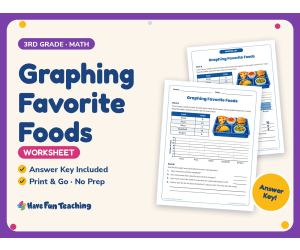
Graphing Favorite Foods Worksheet – 3rd Grade Math Practice
Math, Graphing, Grade 2, 3, 4, Worksheets & Printables, Worksheets
Looking for simple, effective graphing practice for third grade? The Graphing Favorite Foods Worksheet is a ready-to-print math resource that students can complete on their own after a short introduction. Learning objective: Students will practice graphing and apply the skill independently by completing each task on the page. Why it works: Each page targets one skill, so students get meaningful repetition without feeling overwhelmed. The layout is clean and uncluttered, which helps young learners focus on the task instead of the decorations. What's included: 1 printable worksheet page Clear, student-friendly directions 2 practice sections (Part A to Part B) Answer key (1 page) Cover page How it's organized: The page opens with these directions: "Read the table, and then draw a bar for every food." The practice is split into 2 parts, so students can work through it in clear steps. Grade level: Designed for third grade students. It also works well for second grade and fourth grade students who need extra practice or a fresh review. How to use it: It is a great fit for morning work, learning centers, intervention groups, test review, homeschool lessons, and take-home practice. Answer key: An answer key is included, so you can check work quickly or let students self-correct. Teaching tips and variations: Keep a few copies in your early finisher bin for independent review. Model the first item together, then let students finish the rest independently. Pair students to compare answers and talk through any differences. Skills covered: Graphing, Math Standards: Supports Common Core 3. MD.B.3. File type: PDF, ready to print. Number of pages: 3 (1 worksheet page, 1 answer key page, 1 cover page). This printable is part of the Have Fun Teaching collection of math resources for elementary classrooms and homeschools. Visit our shop for more practice pages on related skills. Have Fun Teaching on Teach Simple
Author Have Fun Teaching
Rating
Tags Graphing Worksheet, Graphing, 3rd Grade Math, 3rd Grade Worksheet, Answer Key, Math, Printable Worksheet, Graphing Practice, Math Worksheet, No Prep

Writing Workouts That Work: By the authors of Four Square Writing
ELA, Writing, Grade 2, 3, 4, 5, 6, Teacher Tools, Lesson Plans
Writing Workouts That Work: A Comprehensive Resource for Language Arts Educators By the authors of Four Square Writing, "Writing Workouts That Work" is a teaching resource specifically designed for grade 2 to grade 6 educators who focus on language arts, primarily writing. This product boasts of a wide array of writing strategies and practice exercises that will cultivate an energizing atmosphere of skillful writers in your class. The keys to successful writing are distilled into clear principles that aim to instill confidence and dexterity among young writers. The material encapsulated within this invaluable teaching guide elucidates different techniques promoting students' understanding and flair over numerous facets associating with both art and science of composition. An Exploration Through Narrative Samples In this manual, you'll encounter several fruitful written pieces by emerging authors. Serving as key interactive elements during group learning sessions where students can critically assess the narrative thereby honing their comprehension towards sentence structures, riveting narratives, engaging themes. Versatility in Lesson Planning & Practice Pages "Writing Workouts That Works" offers versatile lesson planning alternatives catering diverse teaching arrangements - be it whole-group instruction or small peer group settings down to individual homework assignments. A wide berth of practice pages is included inside the manual offering opportunities for reinforcement through application. No matter your educational context – public schools or dedicated homeschooling households striving for improved linguistic skills - 'Writing Workouts That Works' serves as a thorough coach propelling every student towards becoming confident independent authors! Digital Accessibility & Ease-of-Use This comprehensive guidebook is bundled conveniently in one digital file available in PDF format ensuring effortless accessibility regardless of your teaching location. Unearth the paramount factors guiding students towards commendable academic advancement by leveraging this focused manual aimed at enriching language arts proficiency especially in mastering the creative domain of writing!
Author Classroom Complete Press
Tags PDF

Health/ Homeschool Curricula: Can Eating Meat be Eco Friendly? (Digital & Print)
Science, Life Sciences, Biology, Grade 7, 8, 9, 10,
Health/ Homeschool Curricula: Can Eating Meat be Eco-Friendly? (Digital & Print) This is an educational resource that serves as a tool for stimulating conversations about environmental science and moral choices. The curriculum provides a full understanding of the correlation between diet, specifically meat consumption, and its impact on the environment. The focus of this course is an insightful article by PETA, which proposes that over 51% of worldwide greenhouse gas emissions are due to animal agriculture. Students are provided with this compelling text along with a reflective reading guide to help them understand the environmental impacts involved in raising animals for food. The resource caters both digital and print mediums, thus providing excellent versatility. Our package includes digitized fillable PDFs alongside printable versions plus a Google Slides Hyperdoc with fillable fields, making it accessible for all students no matter their technological capabilities. Note: As our curriculum presents primarily one viewpoint regarding the environmental effects of meat consumption, it offers incredible flexibility! Activities after reading can include: A class reflection: weighing pros and cons together Small group debates: strengthening critical thinking abilities Focusing on countering arguments from non-vegan stances as individual homework assignments - enhances research as well as superior writing skills We estimate that completing this lesson will take roughly 20 minutes – perfect for integrating into existing class schedules without upsetting full period plans. The target grades are 7-10 across subjects like Science, more specifically Biology will find this resource adaptable within their syllabus structure. All things considered - discussions about sustainability remain crucial in students' learning experiences today; hence "Health/ Homeschool Curricula: Can Eating Meat be Eco-Friendly? (Digital & Print)" is an investment that offers insight into current global issues while enhancing core academic skills. Available in a zip file format with three PDFs for facilitation.
Author Dynamic Earth Learning
Tags Environmental Science, Meat Consumption, Ethical Choices, Sustainability, Critical Thinking

Global Warming EFFECTS: Climate and Human Health - FLASH-PC
Science, Earth and Environmental Sciences, Environmental Science, Common Core, Grade 5, 6, 7, 8, Teacher Tools, Lesson Plans
Global Warming EFFECTS: Climate and Human Health - FLASH-PC This is a comprehensive teaching resource designed to equip educators with the necessary tools to guide students in understanding the intricate relationship between climate and human health, particularly within the context of global warming. Suitable for middle-school grades five through eight, this tool effectively integrates technology and pedagogical design to foster active learning and student engagement. Features: A computer-based software that provides curriculum-aligned content promoting deep comprehension of environmental science. Versatile teaching resources available in varied formats - from reading passages to interactive activities enriched with vibrant graphics. Inclusion of guiding questions before reading materials prepare students for new ideas. Similarly, post-reading questions help assess their grasp on initial understanding. Printable resources that offer teachers tangible material for classroom use or homework assignments, enhancing both on-screen educational activities as well as off-screen applications. In addition: This invaluable resource pack also includes vocabulary flashcards aiding key scientific terminologies instruction. To ensure complex topics are easily understood animated visuals have been incorporated alongside embedded audios offering detailed narratives which can be replayed by students anytime for mastering concepts better. Precisely aligned with Common Core State Standards for its readable content, it strictly adheres to Bloom's Taxonomy principles ensuring consistent intellectual rigor favoring cognitive development during classroom instructions or independent study periods. To summarize: 'Global Warming EFFECTS: Climate & Human Health - FLASH-PC' is an inclusive digital solution meeting diverse learning styles including visual aids, teacher-guided discussions & self-learning modules thus ensuring meaningful scientific education exploration during formative years.
Author Classroom Complete Press
Tags Software (PC)

Kansas: A Micro-Learning Deck | Digital Geography Lesson
Social Studies, Geography, Grade 4, 5, 6, 7, Teacher Tools, Lesson Plans
The Kansas: A Micro-Learning Deck digital geography lesson offers educators a 14-slide interactive PowerPoint resource to teach students about the state of Kansas. Through informative text, vivid images, video, audio, graphic organizers, and digital activities, learners will summarize details about Kansas's geography, economy, history, famouslandmarks, and more. This versatile lesson can be used for whole group instruction, small group review, or independent practice to bolster comprehension of key concepts. Whether supplementing a Kansas social studies unit or exploring an individual Midwestern state, the Kansas: A Micro-Learning Deck lesson provides engaging content for grades 4-7.
Author Teach Me This
Tags Digital Lesson Plan, Interactive Geography, States And Capitals, Learning Deck, Kansas Lesson Plan

Kindergarten Homework Kits
ELA, Reading, Reading Comprehension, Preschool, Activities, Projects
Kindergarten Homework Kits The Kindergarten Homework Kits provide teachers and homeschoolers with a unique and engaging way to integrate language arts activities into a child's home learning. This beneficial resource caters exclusively to kindergarten-grade students, offering an assortment of learning projects based on different themes. The kits are designed with interesting containers such as diaper bags, laundry baskets, and paint buckets that not only capture the child’s interest but also serve as sources of ingenuity for each themed activity. What's Inside Each Kit? Each kit is crafted meticulously; filled with storybooks and a variety of activities focused on enhancing language arts comprehension skills, as well as inspiring curiosity in mathematics. As these kits rotate among students every week, they present opportunities for the learners to engage in exciting new homework experiences while steadily building their academic confidence. User-friendly for Parents: With clear instructions within the kit accompanied by an activity list explaining how to utilize it effectively. Supportive Worksheets Included: Any worksheets that align cohesively with the curated kit theme are provided ensuring parents have all they need when supporting their child's learning at home. Versatility in Instructional Settings This teaching resource can be adapted for different instructional settings - whole group tasks during interactive sessions or small group activities emphasizing teamwork and collaborative problem-solving skills. They can equally prove valuable while planning individualized instruction or even assigning homework assignments structured around these versatile resources. Promoting Real-life Situations & Practical Problem-Solving Skills Hence these creative Kindergarten Homework Kits encourage young learners to embrace homework linked directly through daily objects they recognize. Above all, introducing real-life situations in early educational stages promotes practical problem-solving skills alongside academics. Beneficial PDF File Included Also included in this effective tool is 1 PDF file comprising 16 ready-to-print pages structured around three main subjects: Language Arts concentrating mainly on comprehension and Projects presented in an accessible manner catering especially towards active engagement from young learners making education at home more fun and productive.
Author Monaco Lane Curriculum for Early Literacy
Tags Language Arts, Comprehension Skills, Homework Kits, Kindergarten Learning, Interactive Activities

Expository Reading Comprehension Passage Sub Plan for 7th, 8th & 9th
ELA, Reading Comprehension, Reading, Grade 7, 8, 9, 10, Worksheets & Printables, Worksheets
Expository Reading Comprehension Passage Sub Plan for 6th - 10th Grades (India) What’s inside? I designed this resource with middle and high school students in my mind. It includes an engaging expository reading comprehension passage about India. Inside, you’ll find: A reading comprehension passage about India (unseen passage) 30 questions to test comprehension and critical thinking skills of your students Answer key for easy grading Marking scheme/Grading scale is also included in this set to help teachers save time Resource features: It contains informative and engaging text about India There are questions to assess reading comprehension, vocabulary, and analytical skills of middle and high school students It is also suitable for both ESL/EFL and native students Feel free to use it as an assessment or as a regular lesson It is useful for middle school and high school students How to use it? Teachers/Parents can use it as a reading comprehension exercise for students/children You can also incorporate it into a sub plan for a ready-made lesson It can also be used as a full reading comprehension lesson You may use it as a resource for research projects about India Feel free to share it with colleagues or other educators for collaborative teaching Resource usefulness: This resource helps teachers, homeschoolers, and parents assess reading comprehension skills It also supports student learning about India and its cultural, geographical, and historical context It is very flexible for classroom, homeschooling, or tutoring sessions This resource provides a structured way to evaluate comprehension, retention, and critical thinking of middle and high school kids This passage is ideal for 6th, 7th, 8th, 9th, and 10th grade students. It offers a detailed overview of India and its neighbors while giving educators a practical tool for assessing understanding and analytical skills. reading comprehension, India, Indian subcontinent, culture, landmarks, educational resource, teaching tool, learning
Author FlashKart
Rating
Tags Reading, Reading Comprehension Passage, Sub Plan, Middle School, High School, ELA, Language Arts, Unseen Passage, Reading Skills, India

Cactus Themed Bulletin Board
, Not Grade Specific, Bulletin Boards, Classroom Decor
This Cactus Themed Bulletin Board is perfect for your classroom bulletin board or even a hallway display. You will get the words "Life Lessons from a Cactus." There are 6 motivational posters. Extra decorations are included. All you have to do is print, cut and display.
Author Our Strange Class
Tags Graphics, Back To School, Class Decor, Cactus Themes, Bulletin Boards

North America
Social Studies, Geography, Not Grade Specific, Worksheets & Printables
North America stretches from the arctic zone in the North to the tropical zone in the South. Most of it is in the temperate zone. The lands located in the Arctic zone are highly fragmented with deep gulfs and many islands, while its southern part, which approaches the Equator, forms the bridge between North and South America. In this narrow section the Panama Canal connects the Atlantic Ocean with the Pacific Ocean. North America is connected to South America by a strip of land, which is called Central America and belongs to North America along with the islands of the Caribbean Sea. This ebook will take your students on a journey across lands of huge differences, be it cultural, social, or economic. From the mighty USA to the tiny Saint Kits & Nevis, the North American continent is a unique crossroads of people and civilizations. The 20 activities at the end will consolidate your students' knowledge of this part of the world.
Author Bright Classroom Ideas Marketplace
Tags America, North, Continent, Geography, History, Culture, Countries, Place, Flag, Central

Life Cycle Math Task Cards
Math, Time, Addition and Subtraction, Addition, Subtraction, Multiplication and Division, Division, Fractions, Geometry, Multiplication, Measurements, Place Value, Science, Life Sciences, Biology, Grade 3, 4, Task Cards, Worksheets & Printables
This set of math and science task cards is the perfect combination for your grade 3 and grade 4 learners. Two subjects combined into one engaging activity that can be used in multiple ways. Display task cards around the classroom (or outdoors) for learners to find and solve. If you need a small or large group work activity, this fits the bill also. Since each task card presents questions in a word problem format, a PowerPoint has also been included. Each slide corresponds with a task card, allowing you to display each full size card on the board. Word problems can be tricky for learners to work through individually. With the PowerPoint, you can use each task card as a guided lesson, walking your learners through each step as they gain the confidence to eventually solve them on their own. Or, use the PowerPoint and turn the task cards into a daily math warm-up, either for one week or one month. The possibilities are endless! With this product, mathematics and science standards are presented. Some skills your learners will practice include: multiplication, division, elapsed time, fractions, rounding, measurement, addition, and subtraction. Life cycle topics include mammals, birds, fish, and reptiles. Two sets of task cards are available in this product. One is a color version, the other is a black & white version. PLEASE NOTE: both versions are IDENTICAL. An answer recording page and answer key are also provided. The PowerPoint is COLOR only. When you purchase this product, you will receive: PAGE 1: goldfish life cycle/multiplication, cow life cycle/elapsed time, chicken and goose life cycle/greater than & less than, frog life cycle/2-digit addition PAGE 2: platypus life cycle/subtraction, cat life cycle/fractions, iguana life cycle/number patterns, crab life cycle/elapsed time PAGE 3: butterfly life cycle/area, blue whale life cycle/rounding, rabbit life cycle/multiplication, alligator life cycle/liquid volume PAGE 4: seahorse life cycle/measurement, hamster life cycle/multiplication, toucan life cycle/elapsed time, shark life cycle/measurement PAGE 5: sea turtle life cycle/subtraction, monkey life cycle/multiplication, duck life cycle/division, ladybug life cycle/fractions PAGE 6: Answer recording page (2 sheets per page to reduce number of copies and ink. ANSWER KEY POWERPOINT (20 SLIDES)
Author Quail Trail Products
Tags Task Cards, Life Cycle, Math, Science, PowerPoint, Word Problems, Multiplication, Time, Place Value, Fractions

A Midsummer Nights Dream Act 3, Scene 1 | Double Entry Journals
ELA, Literature, Grade 9, 10, 11, 12, Worksheets & Printables, Worksheets
This 1-page resource is a Double Entry Journal for A Midsummer Nights Dream Act 3, Scene 1. This comes in PDF so you can print and distribute to students. It also comes in an editable Word document so students can type into it on their devices. There are 2 different journal entries for students to respond to and indicate which lines from the play support their response. Students will summarize, reflect and analyze in their journal entries.
Author ELA Resources
Tags Literature, Shakespeare, Double Entry Journals, Dramatic Irony, Storytelling

Country Study Research Project - Kosovo - Social Studies - Balkans
Social Studies, Geography, History, History: Europe, Grade 7, 8, 9, 10, 11, 12, Worksheets & Printables, Writing Prompts
Country Study Research Project - Kosovo - Social Studies Report - Balkans This Kosovo Country Study Research Project can be a perfect teacher tool box activity for your Geography and Social Studies classes, designed specifically for Middle School and High School students (Grades 7–12) . Suitable for Country Study Activities , this printable, 2-page PDF teaching resource engages learners to explore and endeepen important aspects and facts of Kosovo (Southeastern Europe - Balkans). Use this Country Study Research Project on Kosovo to guide students through the process of building a comprehensive Country Study Report , while emproving their knowledge in areas such as geography, history, economy, language, and culture . Within this Kosovo Country Study Resource, Social Studies teachers can find the following geography activities: 🌍 Interactive Map Activity A QR code linking directly to Kosovo ’s location on Google Maps. 🏔️ Geography Questions Explore Kosovo ’s terrain, climate, and notable physical features. 📜 History Questions Investigate key events and historical figures that shaped Kosovo ’s past. 🗣️ Language Exploration Learn about the official languages spoken in Kosovo : Albanian + Serbian 💼 Economy Questions Analyze Kosovo ’s economic system, major industries, and current challenges. 🏙️ Capital City Focus Write about 7 important sights in Kosovo ’s capital city, Pristina 🏘️ Other Cities Identify and write about 5 additional cities across Kosovo 🎭 Culture Prompt Reflect on Kosovo ’s unique cultural identity within the Balkan region. This Social Studies, Geography Country Study on Kosovo (Southeastern Europe - Balkans) PDF Digital Teaching Resource (2 PDF Printable Slides) is ideal for Middle School and High School students from 7th grade to 12th grade to test Kosovo and its Culture At Social Studies with Alan , we’re committed to providing fun, high-quality resources that help teachers inspire curiosity and global awareness in the classroom. Because learning should always be engaging and memorable . ➡️ Explore more Social Studies & Geography teaching tools by clicking here: Learning with Alan
Author Learning with Alan
Rating
Tags Country Study, Social Studies, Report, Geography, Kosovo, Europe, Balkans, Worksheets, Printable, Activity

Hoodwink | Figurative Language Activity | Micro-Learning Deck
ELA, Reading, Reading Comprehension, Grade 4, 5, 6, 7, Teacher Tools, Lesson Plans
Hoodwink | A Micro-Learning Deck for Figurative Language This teaching resource allows students to explore the figurative language term "hoodwink" in an engaging way. Through a short video lesson, a reading passage with audio, and comprehension activities, learners will grasp the meaning of hoodwink and how it is used in writing. Teachers can utilize this self-paced activity for independent practice or small group instruction. The micro-learning format takes under 15 minutes for students to complete independently. As an supplemental ELA resource, this learning deck offers a focused way for upper elementary and middle school students to build skills analyzing and applying figurative language. With audio support and multiple chances for students to interact with new vocabulary in context, this resource promotes improved reading fluency and comprehension.
Author Teach Me This
Tags Comprehension Activity, Reading Lesson, Learning Deck, Figurative, Language

8th Grade Science Diagnostic Assessment & Review System
Science, Grade 8, Assessments, Teacher Tools, Lesson Plans, Worksheets & Printables
Start the year with a clear picture of student readiness using this 8th grade beginning of year science assessment and targeted skills system. With a 50-question diagnostic worth 114 points , scoring and analysis tools, instructional grouping support, 11 targeted follow-up practice pages , scientific reading passages, CER tasks, and complete explained answer keys, this resource helps teachers move from assessment results to focused instruction. Designed as a complete Assess → Analyze → Group → Review → Reteach system, this Grade 8 science resource emphasizes the reasoning demands students need as they prepare for high school science. Students analyze multi-step problems, real-world scenarios, data tables, experimental setups, scientific models, graphs, reading passages, and Claim-Evidence-Reasoning tasks across Life Science, Physical Science, Earth & Space Science, and Scientific Practices & Reading . What’s Included This 8th grade science assessment and review system includes: ✅ 50-question beginning-of-year science diagnostic ✅ 114 total assessment points ✅ Life Science questions ✅ Physical Science questions ✅ Earth & Space Science questions ✅ Scientific Practices & Reading questions ✅ Multiple-choice questions ✅ Short-answer questions ✅ Diagram and model interpretation ✅ Data tables ✅ Graph reading ✅ Multi-step reasoning tasks ✅ Scientific scenarios ✅ Vocabulary-in-context questions ✅ Claim-Evidence-Reasoning (CER) tasks ✅ 2 short scientific reading passages ✅ Evidence-based reading questions ✅ Pedigree interpretation ✅ Natural selection and adaptation analysis ✅ Finch selection data ✅ Cladogram interpretation ✅ Predator-prey data ✅ Periodic table patterns ✅ Chemical equation reasoning ✅ Conservation of mass data ✅ Velocity-time graph analysis ✅ Wave anatomy ✅ Transverse and longitudinal wave comparison ✅ Electromagnetic spectrum interpretation ✅ Seafloor-spreading model ✅ Spreading-rate calculation ✅ Star life-cycle model ✅ Atmospheric CO₂ graph analysis ✅ Experimental design and reliability ✅ Mean and outlier analysis ✅ Two-series graph interpretation ✅ Answer recording sheet ✅ Quick-reference answer key ✅ Skill-by-skill scoring chart ✅ Strand analysis tool ✅ Secure, Developing, and Needs Support performance bands ✅ Individual Student Performance Profile ✅ Whole-class data tracker ✅ Suggested instructional groups ✅ 11 targeted follow-up science practice pages ✅ “Key Concept” refresher on every follow-up page ✅ “Extension” task for students who are Secure ✅ All-new follow-up practice with no repeated assessment questions ✅ Reading-for-evidence follow-up practice ✅ CER writing follow-up practice ✅ Complete answer keys ✅ Suggested short-answer responses ✅ Suggested reading-response answers ✅ Completed visual and diagram answers ✅ Sample CER responses ✅ Short “why” explanation for every assessment item ✅ Partial-credit guidance Part 1 contains 50 rigorous mixed-format questions worth 114 total points . The Teacher Guide recommends two 45-minute sessions and explains that the diagnostic emphasizes multi-step reasoning, evidence-based conclusions, data tables, experimental setups, model interpretation, and reading scientific text for evidence. Part 2 turns student responses into actionable data with an answer recording sheet, quick-reference key, skill-by-skill scoring chart, strand analysis, performance bands, individual student profiles, a whole-class data tracker, and suggested instructional groups. Part 3 includes 11 ready-to-assign targeted follow-up pages with all-new practice. Every page includes a concise Key Concept refresher and an Extension task, and the set includes dedicated pages for Reading Science for Evidence and CER Writing . Part 4 provides correct answers for all 50 questions, explanations of why answers are correct, suggested responses for short-answer and reading tasks, completed diagrams, sample CER responses, and partial-credit guidance. How It Works in the Classroom Use this 8th grade beginning of year science assessment during the first weeks of school to identify what students retained from prior science learning, how well they reason through multi-step problems, and where instruction should begin. The resource follows a practical five-step system: 🔎 Assess — Students complete the 50-item mixed-format science diagnostic 📊 Analyze — Score by skill and strand to identify patterns and gaps 👥 Group — Form targeted instructional groups based on shared needs 📝 Review — Assign focused follow-up practice by strand or skill 🎯 Reteach — Use complete explanations, worked visuals, and model CER responses to support next steps The Assess → Reteach System chart on page 2 of Part 1 directly connects each stage to the matching component of the four-part resource. The same page summarizes the 50 questions, 114 points, broad format range, four reporting areas, two scientific reading passages, and suggested administration time. Use this resource for: ⭐ Beginning-of-year science assessment ⭐ 8th grade science diagnostic ⭐ Middle school science pre-assessment ⭐ Back-to-school science review ⭐ High school science readiness ⭐ Science readiness check ⭐ Formative assessment ⭐ Small-group planning ⭐ Science intervention ⭐ Targeted reteaching ⭐ Data-driven instruction ⭐ Skill-based grouping ⭐ Independent follow-up practice ⭐ Science stations ⭐ CER practice ⭐ Reading in science ⭐ Text-evidence practice ⭐ Graph and data interpretation ⭐ Multi-step science reasoning The Scoring at a Glance chart on page 2 of Part 2 breaks the assessment into four strand totals: Life Science /31, Physical Science /40, Earth & Space Science /24, and Scientific Practices /19 , for 114 total points . It also defines three performance bands: Secure (80%–100%) , Developing (50%–79%) , and Needs Support (below 50%) . The Student Performance Profile on page 15 of Part 2 gives teachers a one-page strand snapshot with space for strengths, focus areas, assigned Part 3 practice pages, and group placement. The Class Data Tracker on page 16 provides a whole-class view so teachers can scan columns for class-wide gaps and rows for individual grouping needs. Standards & Learning Goals This eighth grade science diagnostic assessment reviews foundational science concepts and advanced scientific reasoning across four major areas: 🌱 Life Science — levels of biological organization, homeostasis, interacting body systems, pedigrees, mutations, natural selection, evolution, adaptations, selection pressure, inheritance, cladograms, common ancestry, predator-prey relationships, biodiversity, ecosystem resilience, and evolution CER reasoning ⚛️ Physical Science — periodic table patterns, atomic number, protons, groups and periods, valence electrons, periodic trends, balancing chemical equations, conservation of mass, open and closed systems, exothermic and endothermic reactions, velocity-time graphs, Newton’s second law, kinetic energy, potential and kinetic energy transformations, wave anatomy, transverse and longitudinal waves, wavelength and frequency, electromagnetic spectrum, and wave-energy transfer 🌎 Earth & Space Science — seafloor spreading, magnetic stripes, evidence for plate tectonics, mantle convection, spreading-rate calculations, star life cycles, gravity and orbits, light-years, tides, atmospheric CO₂ trends, and Earth-and-space CER reasoning 🔬 Scientific Practices & Reading — reliable experimental design, repeated trials, control groups, identifying experimental flaws, graph analysis, comparing data series, calculating means, identifying outliers, reading scientific texts for evidence, connecting evidence to science concepts, drawing evidence-based conclusions, and reading-based CER Students demonstrate understanding through varied science tasks rather than one question type. The diagnostic includes a pedigree , finch beak-depth data , cladogram , natural-selection sequence , predator-prey table , periodic table model , Group 1 reactivity data , open-versus-sealed reaction mass data , velocity-time graph , wave anatomy model , wave-type comparison , electromagnetic spectrum , seafloor-spreading diagram , seafloor age data , Sun-like star life cycle , atmospheric CO₂ graph , bacteria-growth comparison graph , and repeated-trial data analysis. The Skill-by-Skill Scoring Chart on pages 11–13 of Part 2 helps teachers pinpoint specific gaps instead of relying only on one overall score. Skills include homeostasis, pedigrees, mutations, natural selection, selection data, cladograms, adaptation, biodiversity, periodic patterns, valence electrons, balancing equations, conservation of mass, exothermic and endothermic reactions, motion graphs, Newton’s second law, kinetic energy, wave anatomy, wave types, electromagnetic spectrum, seafloor spreading, tectonic evidence, spreading rates, star life cycles, gravity and orbits, experimental reliability, identifying flaws, mean and outlier analysis, reading for evidence, and reading-based CER. A particularly valuable feature is the integration of science literacy . Part 1 includes two short scientific texts with evidence-based questions. Students read “Why Antibiotics Can Stop Working” to connect mutation, survival, reproduction, and antibiotic resistance to natural selection, and “Healing the Ozone Layer” to analyze evidence connected to CFC reduction and ozone recovery. Why Teachers Love It ✨ Move beyond a single test score. Results can be analyzed by strand and individual skill, helping teachers see exactly where students are secure and where review is needed. ✨ Prepare students for high school science reasoning. The Teacher Guide explicitly emphasizes multi-step problems, evidence-based conclusions, data tables, experimental setups, model interpretation, and scientific reading—the kinds of demands students increasingly encounter in advanced science coursework. ✨ Turn assessment data into an instructional plan. The scoring tools connect results to performance bands, student profiles, instructional groups, and targeted follow-up practice instead of leaving teachers with a stack of completed tests. ✨ Measure both science knowledge and reasoning. Students do more than recall vocabulary. They interpret models, calculate rates, compare data, explain mechanisms, evaluate evidence, analyze graphs, and justify conclusions. ✨ Integrate science and reading skills. Two short scientific passages ask students to cite evidence, connect text details to science concepts, interpret measured changes, and construct evidence-based responses. ✨ Use relevant scientific topics for reading practice. Students analyze antibiotic resistance and ozone-layer recovery, connecting real scientific evidence to natural selection, environmental change, and evidence-based reasoning. ✨ Strengthen evolution and natural selection understanding. Students work with finch data, beetle camouflage, selection pressure, adaptation, inheritance, cladograms, mutations, and CER reasoning. ✨ Build readiness for chemistry concepts. Students interpret periodic table patterns, atomic numbers, valence electrons, reactivity trends, balanced equations, conservation of mass, and exothermic versus endothermic reactions. ✨ Strengthen physics reasoning. Students analyze velocity-time graphs, apply F = m × a , reason about kinetic energy, explain potential-to-kinetic energy transformations, interpret wave features, compare transverse and longitudinal waves, and analyze the electromagnetic spectrum. ✨ Connect Earth science models to quantitative reasoning. Students interpret seafloor spreading, use age-and-distance data to calculate a spreading rate, analyze magnetic-stripe evidence, and connect mantle convection to plate movement. ✨ Support data-driven small groups. Part 2 includes suggested instructional groups that help teachers sort students by shared gaps and connect them to matching Part 3 practice. ✨ Differentiate with clear performance bands. Use Secure, Developing, and Needs Support ranges to guide enrichment, targeted practice, or foundational small-group reteaching. ✨ Assign only the review students need. The 11 targeted follow-up pages include: Cells & Genetics Review Evolution & Adaptation Review Ecosystems Review Atoms & Reactions Review Forces, Energy & Motion Review Waves Review Plate Tectonics & Earth Systems Review Space Science Review Experimental Design & Data Review Reading Science for Evidence Review CER Writing Review The Practice Page Menu on page 2 of Part 3 directly matches common student difficulties to specific follow-up pages, making targeted assignment faster. ✨ Refresh key concepts before practice. Every targeted page includes a concise Key Concept section. For example, the Atoms & Reactions page reviews atomic number, groups, periods, conservation of mass, and exothermic versus endothermic reactions before students begin fresh practice. ✨ Extend learning for students who are already secure. Every follow-up page includes an Extension task that pushes students into explanation, application, prediction, argument, or investigation design. ✨ Use fresh follow-up practice instead of repeating the diagnostic. Part 3 explicitly provides all-new practice so students can demonstrate understanding with new examples and situations. ✨ Teach students how to read science for evidence. The dedicated Reading Science for Evidence Review page includes a new passage about a warming mountain lake and changing trout and bass populations. Students identify evidence, explain biological relationships using the text, connect the passage to life science, and generate a testable follow-up question. ✨ Build stronger Claim-Evidence-Reasoning responses. CER appears throughout the diagnostic and receives its own targeted follow-up page. At Grade 8, students are expected to connect specific evidence to a named scientific principle rather than simply restating the data. ✨ Make grading more manageable. Part 4 provides correct answers, short explanations of why, suggested responses for open-ended and reading items, completed diagrams, sample CER responses, and partial-credit guidance. ✨ Use completed diagrams for faster checking. The Completed Diagrams Quick View on page 2 of Part 4 points teachers to fully worked versions of the pedigree, cladogram, natural-selection model, periodic table, wave anatomy, wave types, electromagnetic spectrum, seafloor spreading, and star life cycle. ✨ Score open-ended work more consistently. Part 4 explains that multi-part items can receive point-by-point partial credit and that CER and reading items should be evaluated for a reasonable claim, specific text or data evidence, and reasoning that links them. ✨ Keep the instructional loop connected. Assessment, analysis, grouping, targeted review, science literacy practice, reteaching, and answer support are designed as one coordinated system rather than disconnected activities. Start the year knowing what students understand, how well they reason through complex science tasks, and what they need next with this 8th grade beginning of year science assessment . Download this complete middle school science diagnostic and targeted review system to assess readiness, analyze results by strand and skill, create focused instructional groups, assign specific follow-up practice, strengthen science reading and CER writing, and support reteaching with complete explained answer keys. Perfect for teachers searching for an 8th grade science diagnostic assessment , beginning-of-year science review, middle school science pre-assessment, back-to-school science assessment, eighth grade science review, high school science readiness, Life Science review, Physical Science review, Earth and Space Science review, Scientific Practices assessment, genetics, pedigrees, natural selection, evolution, cladograms, ecosystems, periodic table, chemical reactions, conservation of mass, Newton’s laws, forces and motion, energy transformations, waves, electromagnetic spectrum, plate tectonics, seafloor spreading, star life cycles, experimental design, graph analysis, reading science for evidence, CER practice, science intervention, small-group science planning, data-driven instruction, or targeted science reteaching.
Author Bright Classroom Ideas Marketplace
Rating
Tags Science, Assessment, Worksheet, Back To School, Review
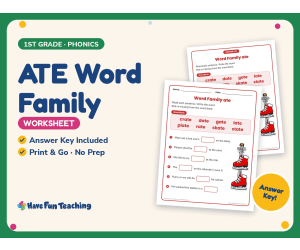
ATE Word Family Worksheet – 1st Grade Word Families Practice
ELA, Language Development, Phonics, Kindergarten, Grade 1, 2, Worksheets & Printables, Worksheets
Looking for simple, effective word families practice for first grade? The ATE Word Family Worksheet is a ready-to-print phonics resource that students can complete on their own after a short introduction. Learning objective: By the end of this activity, students will be able to use their word families skills accurately and explain their thinking. Why it works: Short, focused practice is one of the best ways to help first grade students remember a new skill. Clear directions mean students can get started quickly, and the simple format makes it easy for you to spot who needs more help. What's included: 1 printable worksheet page Clear, student-friendly directions Answer key (1 page) Cover page How it's organized: The page opens with these directions: "Read each sentence. Write the word that is missing from the word bank." Students then complete the practice items in order and check their work before turning it in. Grade level: Designed for first grade students. It also works well for kindergarten and second grade students who need extra practice or a fresh review. How to use it: It works well for whole-class lessons, small groups, early finishers, homework, review days, intervention time, and sub tubs. Answer key: An answer key is included, so you can check work quickly or let students self-correct. Teaching tips and variations: Model the first item together, then let students finish the rest independently. Pair students to compare answers and talk through any differences. Slip the page into a sheet protector so students can practice again with dry-erase markers. Skills covered: Word Families, Phonics Standards: Supports Common Core RF.1.3. File type: PDF, ready to print. Number of pages: 3 (1 worksheet page, 1 answer key page, 1 cover page). Have Fun Teaching creates classroom-tested resources for PreK through 6th grade. Follow our shop to find more phonics worksheets that pair well with this page. Have Fun Teaching on Teach Simple
Author Have Fun Teaching
Rating
Tags Word Families Worksheet, Word Families, 1st Grade Phonics, 1st Grade Worksheet, Answer Key, Phonics, Printable Worksheet, Word Families Practice, Phonics Worksheet, No Prep
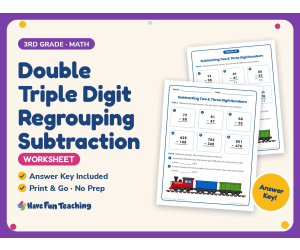
Double Triple Digit Regrouping Subtraction Worksheet – 3rd Grade
Math, Addition and Subtraction, Subtraction, Early Math, Place Value, Grade 2, 3, 4, Worksheets & Printables, Worksheets
Double Triple Digit Regrouping Subtraction Worksheet helps third grade learners practice subtraction with clear directions and a clean, kid-friendly layout. Print it and it is ready for class, homework, or homeschool lessons. Learning objective: Students will practice subtraction and apply the skill independently by completing each task on the page. Why it works: Students stay on task because the directions are short and the practice is the right size for one sitting. Teachers save time because the page is ready to print and easy to check. What's included: 1 printable worksheet page Clear, student-friendly directions 2 practice sections (Part A to Part B) Answer key (1 page) Cover page How it's organized: The page opens with these directions: "Subtract to find each answer. You will need to regroup in every problem." The practice is split into 2 parts, so students can work through it in clear steps. Grade level: Designed for third grade students. It also works well for second grade and fourth grade students who need extra practice or a fresh review. How to use it: Assign it after a mini-lesson, use it in a small group, send it home as homework, keep it in your sub folder, or use it as a quick formative check. Answer key: An answer key is included, so you can check work quickly or let students self-correct. Teaching tips and variations: Keep a few copies in your early finisher bin for independent review. Project the page and solve one or two items as a class before students work on their own. Use it as an exit ticket the day after a subtraction lesson to see who needs more support. Skills covered: Place Value, Subtraction, Math Standards: Supports Common Core 3. NBT.A.1, 3. NBT.A.2. File type: PDF, ready to print. Number of pages: 3 (1 worksheet page, 1 answer key page, 1 cover page). This printable is part of the Have Fun Teaching collection of math resources for elementary classrooms and homeschools. Visit our shop for more practice pages on related skills. Have Fun Teaching on Teach Simple
Author Have Fun Teaching
Rating
Tags Subtraction Worksheet, Subtraction, Place Value, 3rd Grade Math, 3rd Grade Worksheet, Answer Key, Math, Printable Worksheet, Subtraction Practice, Math Worksheet

Reading Comprehension Forest Animals | Grade 3 Reading Activities
Reading Comprehension, Reading, ELA, Grade 3, 4, Teacher Tools, Worksheets & Printables, Tests, Quizzes and Tests
Reading Comprehension Forest Animals | Grade 3 Get a reading comprehension resource for 3rd grade on the topic of Forest Animals. What does this resource include? This resource contains 10 reading passages on forest animals-related topics, each with 5 exercises. These include multiple-choice, true or false, vocabulary, and creative tasks. Each reading passage is unique. The forest animal topics were carefully selected and each passage is accompanied by appropriate graphics. Additionally, answers are provided at the end of the resource to facilitate its use in elementary school. What is it suitable for? The material is suitable for English language arts classes. It is ideally suited for 3rd grade. This material is also suitable for weaker 4th-grade classes or particularly strong 2nd-grade classes. It is suitable for teachers looking for teaching materials that can be used immediately. No tedious adapting or formatting required. Simply print it out and use it directly in class. It is suitable for various teaching formats: - Independent work - Literacy centers - Small group instruction - Homework - Reading workshops - Classroom literacy rotations What topics does the reading comprehension cover? 🦊 The Clever Fox 🦌 The Deer in the Forest 🐿 The Quick Squirrel 🦉 The Owl at Night 🐗 The Wild Boar 🦔 The Hedgehog in Fall 🐺 The Wolf in the Forest 🦡 The Badger 🐻 The Big Brown Bear 🐰 The Hare in the Meadow The material is provided as a PDF file to make it easy to print and use in class. It is part of a larger series. If you like this material, you can explore reading comprehension resources on a variety of other topics in my shop that will enrich your lessons. In addition to reading comprehension, I also offer creative writing, math word problems, informational texts, and reading tests.
Author Smart Learning Classroom
Rating
Tags Reading Comprehension, Grade 3 Reading, Informational Texts, Reading Activities, Reading Passages, Grade 4 Reading, Vocabulary Activities, Forest Animals, Forest, Animals

Math Rescue Series Book 1: Number - Written Calculations
Math, Numbers, Grade 5, 6, 7, 8,
The Math Rescue Series Book 1: Number - Written Calculations is a 58-page download geared toward middle school students. This book comes with student lifesavers, parent power, skill drills, and activity sheets. The first 3 things are meant to provide support to students, teachers and parents as students work through new or review math skills. Answer keys are included for the activity sheets.
Author Ready-Ed Publications
Tags Rounding Worksheets, Estimates Worksheet, Mental Math Worksheets, Addition Regrouping, Decimal Addition

Rorschach Poetry
ELA, Writing, Creative Writing, Grade 4, 5, 6, 7, 8,
"Rorschach Poetry" is a 14-page fun poetry writing activity to do with students in grades 4-8 while reinforcing poetic language and technique. Years ago, when I taught,Flowers for Algernon, by Daniel Keyes, the subject of Rorschach inkblots came up. My students had fun looking at the different inkblots and offering their impressions of what they saw. Then I decided to have them make their own inkblot paintings and write to them. From that, I created this lesson on having students write poetry based on their own Rorschach paintings. They enjoyed this so much that I continued this lesson even though, sadly, we no longer readFlowers for Algernon. In this lesson, students will write at least one poem using a Rorschach image that they or another student painted or that they found online. Students will identify various poetic techniques: rhyme scheme, internal and end rhymes, alliteration, repetition, similes, metaphors, personification, free verse, etc., and how they can use them in their poems. They will discuss how a poet’s choice of words creates a mood, tone, tension, suspense, humor, etc. They will participate in a revision group to work on revising their poems. They will present their poems, either in a small group or to the class.
Author Intentional Teaching and Learning
Tags Creative Writing, Poetry, Rorschach, Poetic Techniques, Imagination, Poetic Language And Techniques, Revision, Poetry Reading

Describing People and Places Worksheet
ELA, Grammar, Writing, Preschool, Grade 1, 2, Worksheets & Printables, Worksheets
The Describing People and Places Worksheet is a great way for students to learn how to describe people and places. This worksheet can be used to help students dictate, write, or draw about their best friend and classroom. This is a great way for students to learn how to describe people and places.
Author Have Fun Teaching
Tags Nouns, Prompts