


9,392 products added recently
Page 1023 - Newest Teaching Resources

 Show filters


Physics Google Form Test: Convex Mirror
Science, Physics, Grade 9, 10, 11, 12, Tests, Quizzes and Tests, Teacher Tools
Physics Google Form Test on Convex Mirrors This Physics Google Form Test on Convex Mirrors product, designed for educators, is an efficient and effective means of assessing student understanding on Convex Mirrors. The test comprises of a simple multiple-choice quiz featuring nine questions dealing with concepts and calculations associated with convex mirrors. Versatility The test caters to grades ninth to twelfth, focusing primarily on Science; Physical Science and Physics. Specifics for this Physics Google Form Test on Convex Mirrors Gauges students' ability in calculating image height and distance. Demonstrates understanding of the characteristics exhibited by images at different locations in front of a convex mirror. Critiques ability to interpret and identify labels on ray diagrams. Note: Google Forms’ auto-grading function provides instant data feedback upon submission. Editability Feature The product boasts an editability feature where you can add or remove questions or modify them according to your lesson outline. This enhances its flexibility as learning resource tool. Answers and solutions provided This makes it a key tool for science instructors keen in enhancing classroom engagement while easing grading procedures. In summary, this Google Form Test: Convex Mirror,, with its ability to explain science via digital platforms, fosters exploratory problem-solving skills among learners.
Author Schrim's Chem
Tags Physics, Convex Mirrors, Google Forms Test, Auto-Grading, Ray Diagrams

Physics Google Form Test: Dimensional Analysis
Science, Physics, Grade 9, 10, 11, 12, Tests, Quizzes and Tests, Teacher Tools
Dimensional Analysis Conversions Quiz on Google Forms The Dimensional Analysis Conversions Quiz is a comprehensive classroom resource, perfectly designed for educators teaching students in Grade 9 to Grade 12 levels exploring the fields of Physical Science and Physics. This digital assessment tool utilizes Google Forms to challenge physics concepts and dimensional analysis knowledge. With a focus on real-world applications and practical understanding, this multiple-choice quiz features thirteen questions that ask students to convert units of mass, time, volume, speed among others. The units used include meters/second (m/s) to miles/hour (mph), liters (L) to cups (c), and pounds (lbs.) to kilograms (kg). This provides an excellent opportunity for learners not only just knowing science but also contextualizing scientific concepts in our daily lives. This product can be helpful as a bellringer activity before diving into detailed lessons or as an exit slip after lectures that require comprehension check-up; it can also be utilized as a regular quiz or supplemental work during instruction. This resource offers the flexibility you need for various instructional situations while making sure learning goals are met consistently. This product's versatility allows you complete control over its content - you may add new questions or modify existing ones - aligning them with your specific curriculum goals. An automatic grading feature of Google Forms is used by both teachers and students can receive instant data feedback that informs instruction designs moving forward. Incorporation into an existing learning module digitally where desired is achievable because it comes in Google Forms format . Also creating answer keys becomes easy because answers are conveniently provided for all questions allowing quick turnaround when marking completed quizzes by learners. Make your teaching life hassle-free while enriching student's grasp on Physics with the Dimensional Analysis Conversions Quiz. Note: Revised version updated September 2021. -
Author Schrim's Chem
Tags Physics Education, Dimensional Analysis, Google Forms Quiz, Unit Conversions, Automatic Grading

Physics Google Form Test: Diverging (Concave) Lenses
Science, Physics, Grade 9, 10, 11, 12, Tests, Quizzes and Tests, Teacher Tools
Physics Google Form Test on Diverging (Concave) Lenses This educational resource is tailor-made for public educators and homeschoolers, offering a comprehensive digital quiz on diverging lenses. Appropriate for grades 9-12, this test employs the might of Google Forms. About the Test The test comprises of eight questions about theoretical concepts and mathematical calculations related to diverging lenses. An instant feedback feature allows teachers to promptly evaluate student performances, enhancing their overall understanding. The primary focus is on the calculation of image size ratio or magnification, object-image distance, as well as attributes of images developed by an object located at various positions before a concave lens. In addition to these elements, students get a chance to read ray diagrams which contribute significantly in optics mastery. Making Learning Easier and Effective "Principle facets associated with divergence (concave) lenses are taught via easily understood multiple-choice questions.". This approach has been proven effective in boosting knowledge recollection during timed tests or quizzes. Tailoring Lessons your way! We understand that every educator has a unique teaching style. Hence this quiz allows customization - you can add or modify questions according to your specific lesson plan requirements. Simplified Grading Process All grading concerns are addressed with an integrated auto-grading system that makes marking simple and efficient! The detailed answers & solutions provided along with points allocation guidelines ensure accurate scoring without any guesswork needed! The Physics Google Form Test: Diverging (Concave)Lenses encompass best practices in teaching material content using contemporary technology—for successful learning outcomes!
Author Schrim's Chem
Tags Physics, Diverging Lenses, Ray Diagrams, Google Forms Test, Auto-Grading System

Physics Google Form Test: Index of Refraction
Science, Physics, Grade 9, 10, 11, 12, Tests, Quizzes and Tests, Teacher Tools
Physics Google Form Test: Index of Refraction This educational assessment tool specializes on the concept of index of refraction in Physics. Crafted with educators' requirements in mind that does not delve into Snell's Law, it serves as an efficient testing instrument for use as a bellringer, exit slip, or quiz. Structure of the Quiz The test consists of five carefully tailored questions to challenge students' capacity to derive unknown variables such as speed and refractive index. Furthermore, learners are required to rank indices and identify substances based on their indices—a fundamental skill in grasping concepts like optics. Versatility & Feedback Mechanics The utilization of Google Forms affords this tool an edge courtesy its instant feedback capabilities. Automated grading fills in promptly post the completion by students—a time-saving feature whilst still furnishing accurate results for teachers. This enables quick lesson plan adjustments aligned with student performance data fetched instantly. Note: This resource proves handy for teachers engaged with Grade 9 - Grade 12 Science classes particularly those concerned with Physical Science topics and Physics. Homeschooling Efficiency & Easy Distribution Beyond regular classrooms, homeschooling parents find value in this resource. Composed as a Google Forms file type ensures simple distribution via several online platforms employed by schools globally; be it Learning Management Systems (LMS) such as Schoology or Blackboard or direct emails/chat threads—making assessments speedy and stress-free! In conclusion; The Physics Google Form Test: Index of Refraction stands synonymous with effective pedagogy synergized with technology—Cultivating comprehensive learning through modern teaching methodology!
Author Schrim's Chem
Tags Physics, Index Of Refraction, Google Forms Tests, Physical Science Assessment, Online Education

Physics Google Form Test: Kinematics (1-D)
Science, Physics, Grade 9, 10, 11, 12, Tests, Quizzes and Tests, Teacher Tools
Physics Google Form Test on 1-Dimensional Kinematics This resource is a carefully constructed Google form consisting of 12 multiple choice questions focusing primarily on kinematics in one dimension. Designed to assist Grade 9-12 students, particularly those studying Science or Physical Science. The questions largely involve solving for unknowns using key kinematic formulas such as d=vot + ½ at², Vf = Vi + at, Vf² = Vi² + 2ad. On top of these, the resource dives into more complex aspects like formula manipulation and concept ideas; effectively moving beyond simple memorisation. This Google Form is designed with an inbuilt feedback feature for each question which provides solutions alongside. This serves a two-fold purpose: facilitating self-learning for students and assisting teachers with performance tracking. The form rewards instant data feedback thanks to its auto-grading capability. This creates real-time insights into student comprehension levels which are incredibly helpful for both teacher oversight purposes and revamping student study targets. Acknowledging the differences between learners and education contexts like public school teachers or homeschooling parents/providers; this resource offers customisation options. Suitable as bellringers, exit slips or quizzes, it can also be used to supplement additional work requirements based on your curriculum specifics. In conclusion: Through its digital presence on the reliable Google Forms platform™,, this tool is conveniently portable and accessible from any location. The cloud-computing tech ensures that you can take your classroom/learning environment anywhere! Upgrade your Physics-focused teaching resources today!
Author Schrim's Chem
Tags Physics, Kinematics, Google Forms, Auto-grading, Customizable

Physics Google Form Test: Lens
Science, Physics, Grade 9, 10, 11, 12, Tests, Quizzes and Tests, Teacher Tools
Physics Google Form Test: Lens A comprehensive teaching resource designed for educators. This unique tool offers a interactive multiple-choice quiz of 10 questions focused on the concepts and calculations related to converging lenses. Designed for Grade 9, Grade 10, Grade 11, and Grade12 students . Educational Foundation: The quiz is based on real-life scientific principles, encouraging critical thinking and reinforcing classroom learning. User Interface: Utilizing Google Forms for delivery allows for effortless grading automation, providing instant feedback for students and teachers alike. Flexibility: With the option to edit according to individual lesson plans, teachers can make this resource even more valuable through customization. Suitable Subjects: Premier suitable subjects include Science with particular emphasis towards Physical Science or Physics. Redefining Your Teaching Experience: Physics Google Form Test: Lens has been designed keeping adaptability at its core. Not only will it provide educators a platform that will stimulate student engagement but also foster better conceptual understanding among learners! Bullet-Point Benefits: Promotes Critical Thinking Skills Versatile Educator Tool Listens to Classroom Feedback & Adapts Consequently Fosters Better Conceptual Understanding If you are part of a school or homeschooling, Physics Google Form Test: Lens serves as a pivotal addition towards your educational tools integrating technology into your curriculum planning process seamlessly!
Author Schrim's Chem
Tags Physics Quiz, Converging Lens, Ray Diagrams, Magnification Calculations, Interactive Learning

Physics Google Form Test: Snell's Law
Science, Physics, Grade 9, 10, 11, 12, Tests, Quizzes and Tests, Teacher Tools
Physics Google Form Test: Snell's Law This is an effective teaching resource designed specifically for quick concept checking and fine-tuning student understanding of Snell's Law (n1sinθ1=n2sinθ2). Suitable for students in grades 9 through 12, this resource neatly covers subjects of science including physical sciences and physics. About the Test The quiz consists of eight queries covering a range of topics related to Snell's Law. There are questions about the main concepts, calculations with unknown angles, identifying unique materials, utilizing a digitally drawn model (as exhibited in the product thumbnail) to define unfamiliar angles. The Tech Behind It Built using Google Forms™ technology, this tool can function as an exit slip or even be incorporated into regular class start-up activities. Its best feature is arguably its ability to act as a comprehensive quiz session that provides automatic data feedback via Google Forms' auto-grading capabilities. A Digital Approach Cutting down on paperwork and streamlining processes aside, what makes it stand out among assessment tools are its adaptability aspects – it can be used by public school teachers who want to actively gauge student understanding during lessons or by homeschooling parents wanting efficient evaluation tools. In conclusion, The Physics Google Form Test: Snell's Law is more than just a typical teaching aid. Its unique blend of intuitive design enriched with modern technological elements provides teachers with a powerful method for enhancing student grasp while firmly anchoring their understanding within relevant scientific concepts such as Snell’s law.
Author Schrim's Chem
Tags Physics, Snell's Law, Google Forms, Auto-grading, Digital Assessment

Physics Google Form Test: Wave Interaction
Science, Physics, Grade 9, 10, 11, 12, Tests, Quizzes and Tests, Teacher Tools
Product: Physics Google Form Test: Wave Interaction A Google Form quiz thoughtfully designed to scrutinize high school students' comprehension of wave interactions, shedding light particularly on constructive and destructive phenomena. It is all-encompassing, pertinent for 9th through 12th grades. Main Features: A sum total of 7 challenging questions that induce students to exercise both recalling and the application of ingrained concepts in varying circumstances. Covers diverse topics such as concluding resultant amplitude and recognizing the count of nodes and antinodes. The unique inclusion of digitized wave diagrams.(two problems contain this specialty). Tangible visualization not only engages students more but also assists their understanding by providing physical representations. Thus, fostering improved practical realization skills which are pivotal in Science subjects—especially within Physical Science or Physics syllabus. This astute tool can be utilized either as an entry or closing activity effectively assessing what your learners already apprehend about a topic before venturing into novel content or determining how well they've committed learnt material post-lesson. Additionally, it offers flexibility where teachers can use it as a pop quiz or for revision drill purposes. Digital Advantages: Incorporation with Google Forms ensures automatic grading, liberating additional time you could instead use effectively for other teaching obligations. The swift data feedback executed by Google Forms facilitates real-time insights into your student's learning journey helping you modify subsequent lessons tailored specifically to their requirements! No need for paper implies greener teaching practices while storage also becomes efficient since everything gets backed up securely online! Indeed, our product - 'Physics Google Form Test: Wave Interaction' seamlessly marries conventional pedagogy with modern technology cultivating user-friendly context learning experiences set within today's digital age yet remaining rich instructively.
Author Schrim's Chem
Tags Physics, Wave Interaction, Constructive Phenomena, Destructive Phenomena, Digital Learning
Physics Google Form Test: Waves
Science, Physics, Grade 9, 10, 11, 12, Tests, Quizzes and Tests, Teacher Tools
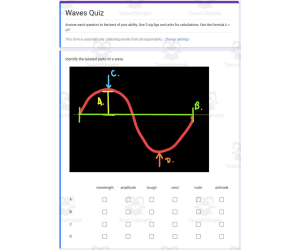
Physics Google Form Test: Waves An ingenious educational resource aimed at boosting knowledge in wave properties and calculations, tailored predominately for educators specializing in physical science or physics instruction from grade 9 up to grade 12. Quiz Composition: Skillfully crafted quiz that revolves around an 11-question layout dealing with a myriad wave properties and calculations topics, comprises of: The identification of parts of a wave, A comparison of frequency and period across various waves, Solving tasks for the unknown variables namely speed, wavelength, and frequency according to the formula λ = v/f. Digital Format via Google Forms: The tool is equipped with resilient features enabled by the digital format: - Auto-Grading- Made possible through an efficient auto-grading system through which feedback can be provided promptly upon submission. The feature presents multiple benefits such as time-efficiency when used as real-time assessment tactics during bellringer activities or exit slips sessions. - Visually Engaging Elements- Incorporating visually appealing elements via digitally designed images accompanying majority questions. This handy element proves effective in promoting deeper student engagement while also offering more tangible visualization for better comprehension. - Answers & Solutions Provided- To maximize teaching outcomes, correct answers are included along with their detailed solutions. This will be especially beneficial during full class discussions or individual follow-ups after self-study routines have been finished off by students. In Conclusion: The Physics Google Form Test: Waves resource package delivers promising innovation within its interactive platform all deliberately home-designed towards promoting efficiency not just among educators but - significantly - instilling progressive development among learners delving into physical sciences.
Author Schrim's Chem
Tags Physics, Wave Properties, Calculations, Google Forms, Autograde

Physics Google Form Test: Energy and Power
Science, Physics, Grade 9, 10, 11, 12, Tests, Quizzes and Tests, Teacher Tools
Product Overview: This is an evaluative tool designed for teachers to test students’ understanding of Energy and Power in physics. It is suitable for educators instructing grades 9 to 12, specifically in the fields of Science, Physical Science, and Physics. Key Concepts: Potential Energy (PE=mgh) Kinetic Energy (KE=1/2mv^2) Mechanical Energy (ME=PE+KE) Work (W=Fxd) Power (P=W/t) Evaluation Structure: The evaluation consists of a series of short-answer type questions that encompass both conceptual ideas and calculations within these areas. Although it requires hand grading by the educator, it promises to provide valuable insight into each student's knowledge-base. Simplicity & Challenge: The test has been structured using simple calculations that occasionally incorporate conversions and multiple steps. This ensures that students are intelligently challenged without being overwhelmed. Pictorial Question: The last part makes use a picture diagram for questioning which adds another dimension enhancing concept application skills. Ease Of Scoring: To assist educators with accurate grading, complete answers have been provided thereby making this process more efficient. Digital Convenience: Google Forms™ platform enables easy access - Teachers can conduct tests virtually supported on platforms like Google Classroom - Convenient online record-keeping option for homeschoolers Navigating Future Lesson Planning: This resource serves as an excellent means not just evaluating where students stand on these subjects but also helps inform future lesson plans based on their strengths or weaknesses indicated by their responses here.
Author Schrim's Chem
Tags Physics Test, Energy And Power, Google Forms™, Conceptual Questions, Real-World Scenarios

Physics Google Form Test: Force of Motion
Science, Physics, Grade 9, 10, 11, 12, Tests, Quizzes and Tests, Teacher Tools
Physics Google Form Test: Force of Motion A valuable tool for educators in the realm of science, especially physics. This teaching resource focuses on key concepts including: Simple force (F=ma) Simple net force Free-body diagrams Angular resultant forces (FR= √F1² + F2²) Note:This test is designed for students ranging from grade 9 to grade 12. Inclusive Learning Promoting Critical Thinking The product comprises comprehensive multiple choice questions promoting critical thinking, as they include multi-step problem-solving processes and conversions. Many questions come with neatly embedded, digitally drawn illustrations as visual aids for better understanding. Ease of Evaluation & Real-Time Feedback An exciting feature about this test is its auto-grading functionality and instant data feedback provision post submission. It saves teachers' time while maintaining accuracy and enabling students to understand where improvement is needed. Editability Gives Flexibility This editable form allows you tailor fit according to your lesson requirements; add or remove sections easily thus aligning each question perfectly with lectures given. Suitability & Usage Envisaged: This resource is perfect not only for high school learners in grade 9 through grade-12 but can be adapted by any educator managing physics subject such as public schools instructors or homeschoolers. A well-designed Physics Google Form Test offering value-addition without complexity — Grab it today!
Author Schrim's Chem
Tags Physics Test, Force Of Motion, Auto-Grading, Editable Form, Free-Body Diagrams

Physics Google Form Test: Inclined Planes and Force
Science, Physics, Grade 9, 10, 11, 12, Tests, Quizzes and Tests, Teacher Tools
Physics Google Form Test: A Comprehensive Assessment Tool If you're teaching a curriculum focused on Physics and are looking for an encompassing evaluation platform, consider the Physics Google Form Test. This tool is specifically designed to assess understanding in two key areas - inclined planes and force. It's suitable for students from grades 9-12. This comprehensive test comes as a google form file type, universally accessible and easy to integrate into any classroom workflow. With real-time data feedback provided, both teachers and students can swiftly gauge learning progress. Detailed Content with Illustrated Diagrams The Physics Google Form Test includes well-strategized content questions accompanied by five hand-drawn diagrams created using digital software. These diagrams help students practically apply the theories they've learned in class to calculate variables such as time, distance, velocity, acceleration within specified scenarios. Included Answers for Instant Grading A unique feature of this resource is the inclusion of answers allowing instant grading and offering immediate insight into student performance via real-time data feedback. Broad Subject Coverage: Physical Science Material: The Physics test forms part of broader subject materials covering Physical Science subjects amongst others related to Physics. Versatile Use Across Grades 9-12:The breadth covered by this assessment makes it highly relevant across all grade levels from grade 9-12. - Tech Infused Assessments - This physics google form not only challenges learners but fosters problem-solving skills while providing instantaneous growth-oriented feedback. Embrace assessments infused with technology that make physics enjoyable via engaging diagrammatic questions! - Improve Academic Results - Educators aiming at yielding improved academic results while streamlining their work processes – should strongly consider leveraging these resources in evaluating how students absorb learned material.
Author Schrim's Chem
Tags Physics Test, Inclined Planes, Force, Practical Application, Instant Feedback

Physics: 2-D Kinematics Test on Google Form
Science, Physics, Grade 9, 10, 11, 12, Tests, Quizzes and Tests, Teacher Tools
Introducing the Physics: 2-D Kinematics Test on Google Form This is an essential teaching resource for educators teaching Grades 9, 10, 11 and 12. It's a full multiple-choice test that focuses on the topic of two-dimensional kinematics. It falls under the subject of Science with a focus on Physical Science and Physics. The purpose of this tool is to measure students' understanding and knowledge of the subject. Test Highlights: The test covers questions related to unknown variables in range, height, angle, velocity etc.in two dimensions. Incorporates imperial to metric conversion problems for an extra layer of challenge. Aims at enhancing scholars equation handling abilities pushing them beyond simple number crunching into real world mathematics application. The primary appeal stems from its accessibility through Google Forms which drastically simplifies marking by auto-grading student responses instantly providing data feedback. An important feature about this resource is its flexibility. Each question can be custom-tailored according to your individual lesson or syllabus needs making it adaptable specific to your classroom demands. This version (2.0) has been updated following February,'23 enhancements ensuring validity within ever-evolving academic necessities. In your educational environment consider using Physics: 2-D Kinematics Test not simply as a measurement source but also as a guide for further course structuring regarding these core competencies!
Author Schrim's Chem
Tags Physics, 2-D Kinematics, Google Form Test, Auto-graded Assessment, Imperial-Metric Conversion

Physics:1-D Kinematic Test on Google Form
Science, Physics, Grade 9, 10, 11, 12, Tests, Quizzes and Tests, Teacher Tools
Physics: 1-Dimensional Kinematic Test on Google Forms This teaching resource, Physics: 1-Dimensional Kinematic Test on Google Forms, is tailored to evaluate your understanding of simple motion and one-dimensional (1-D) kinematics. It is a useful tool for educators in public schools and homeschooling parents, particularly for students from grades 9 to 12. Content Overview: A selection of thought-provoking multiple-choice questions covering the breadth and depth of rudimentary physics concepts. Diverse range of problems for varying difficulty levels— simpler computations (like velocity equals distance divided by time or v=d/t), to more challenging tasks using wider equations (vf² = vi² + 2ad). An accompanying answer sheet that enhances the self-learning experience for students outside classroom settings. Pointers: The test can be adjusted seamlessly into your individual lessons and catered towards unique learning curves. The 'Google Forms™ Advantage': -Ease-of-use during administration due to interactive online format. -Featuring an auto-grading system which provides immediate feedback about student performance— a beneficial trait both in terms saving grading time significantly while identifying focus areas swiftly. In all, if you're aiming towards physical science education or going deeper into physics knowledge—the "Physics:1-Dimensional Kinematic Test on Google Form" teaching resource will certainly prove invaluable in fostering comprehension among young learners eager to explore the countless physical constants that shape our universe!
Author Schrim's Chem
Tags Physics, Kinematics, Motion Concepts, Online Assessment, Problem-Solving

Physics: Mirror and Lens Test on Google Form
Science, Physics, Grade 9, 10, 11, 12, Tests, Quizzes and Tests, Teacher Tools
Physics: Mirrors and Lens Test on Google Forms Our product, the Physics: Mirrors and Lens Test on Google Forms, is an all-inclusive teaching resource specifically designed to help students excel in optics; a critical component of physics studies. Aimed at secondary school students from grades 9 through 12, its main goal is to simplify understanding complex subjects like lens and mirror calculations. Multiple-Choice Format & Topics Covered An engaging multiple-choice test format covers essential optical topics such as convex and concave mirrors, enabling interpretation of ray diagrams, calculation of magnification factors, determining image distance & height, along with interpreting image characteristics formed by varying lenses and mirrors. Innovative Digital Diagrams A standout feature that differentiates this tool from traditional tests is the innovative use of digitally drawn diagrams. These realistic portrayals offer learners a more contextual understanding when labelling components or interpreting results. Versatility & Personalization The design assures strong adaptability as each question can be personalized according to lesson plans or specific subject areas educators want to emphasize on. This versatile tool operates within Google Forms™ – a superior digital platform accessible across various devices providing seamless learning experience. It not only automates grading but also provides immediate data feedback about student performance assisting teachers gauge areas that may require re-teaching or review. Catering towards Science-based curricula with Physical Sciences: Physics as sub-subjects; this comprehensive worksheet simplifies science learning while delivering top-notch pedagogic value using cutting-edge tech aids available today!
Author Schrim's Chem
Tags Physics Education, Optics, Mirrors And Lens, Auto-Graded Tests, Digital Learning

Physics Google Form Test: Doppler Effect
Science, Physics, Grade 9, 10, 11, 12, Tests, Quizzes and Tests, Teacher Tools
Physics Google Form Test: Doppler Effect The Physics Google Form Test: Doppler Effect is a comprehensive teaching resource aimed at assessing students' understanding on the topic. Designed for grades 9 through 12, it works well with physics and physical science lessons, emerging as an exceptional intermediate or advanced level educational tool. This product consists of an automated multiple-choice quiz with seven questions, all pertaining to the fascinating realm of the Doppler Effect (fo = f (V + Vo / V + Vs)). The test can be graded seamlessly in real-time, saving you precious time. The range of questions involves conceptual understanding and calculations related to frequencies and distances linked to the Doppler Effect. This versatile test can serve as a brief "bellringer" activity at class commencement, an 'exit slip' task before learners leave your room after completing their lesson or function as a regular quiz- depending on your immediate tutoring needs. User-friendly Features: Built in Google Forms format, it offers remarkable flexibility by letting you modify the questions according to your specific needs- accommodating subtly different lesson plans smoothly. This characteristic adds immensely to its user-friendliness: You can add or remove questions based on your requirements. Digital drawings are embedded into some of these questions for better visual guidance while answering them. Pedagogical Benefits: Leveraged correctly this assessment doesn't only enable teachers obtain vital data about individual student's performance in real-time but also allows alterations based on pedagogical demands thereby transforming traditional 'assessments' into interactive ones when deployed through known platforms like Google Forms. If you're convening classes schools or homeschooling students independently - this resource will prove beneficial if topics like the Doppler Effect fall under physical science/physics subjects in your syllabus; Applying this handy test could simplify your tasks remarkably while enhancing student participation!
Author Schrim's Chem
Tags Physics, Doppler Effect, Interactive Teaching, Assessment Tool, Google Forms
Physics Google Form Test:Circuits
Science, Physics, Grade 9, 10, 11, 12, Teacher Tools, Assessments
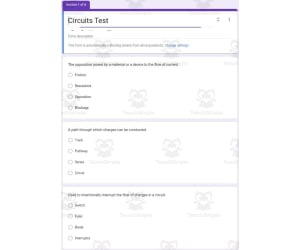
Introducing the Physics Google Form Test: Circuits A valuable teaching resource targeted at educators of high school students, spanning grades 9 to 12. Designed to enhance your physics or physical science curriculum, this tool is honed specifically on practical application concepts related to electric circuits. Strategically Crafted Questions This multiple-choice assessment includes a well-structured set of 13 questions crafted in an engaging manner. The content particularly covers essential formulae such as: The electrical power calculation (P=IV) Kilowatt per hour costing mechanism. Intriguingly, these questions extend beyond theoretical knowledge towards real-life application scenarios, like calculating power and understanding the cost factors associated with different electrical devices. Versatility for Various Learning Situations & Automatic Grading System The versatile nature of this assessment allows it to be utilized either as a short quiz at the start/end of lessons or as a study guide for independent studying efforts outside classroom hours. With automatic grading capabilities via google forms, educators can track student performance effortlessly and get real-time feedback on class comprehension levels. Catering Flexibility for Different Teaching Styles Favorably, this tool also leaves room for modification according to individual lesson requirements without any drop in effectiveness or credibility. Hence paving way for fitting into various pedagogical styles seamlessly. A Diverse Tool Toping Your Toolbox! Make learning about electricity engaging and effective by incorporating the smart and accessible Physics Google Form Test: Circuits into your everyday teaching practice!
Author Schrim's Chem
Tags Physics, Circuits, Google Forms, Automatic Grading, Real-life Applications

The Class System
Social Studies, History, Psychology, Grade 7, 8, 9, 10, Teacher Tools, Presentations
The Class System: A Comprehensive Teaching Resource This teaching resource, The Class System, is specially designed for learners from grades 7 to 10. Combining activities, discussions, slides and assignments, it encourages curious exploration while expanding their knowledge base. A Focus on Occupational Prestige The initial activity urges students to analyze different American occupations in terms of prestige and recognition. The goal is to stimulate thoughtful debates among the students regarding how they perceive these occupations. Detailed Slides Class slides included in this resource are meticulously made keeping key content relevant for grades 7-10 curriculum in mind. Each slide effectively covers important ideas under discussion using time-tested academic strategies. Interactive Assignments: Class Notes Assignment: A complementary assignment that captures essential points discussed about societal structures ensuring greater comprehension. Main Topics of Discussion include: Social Stratification: Categorization based on economic status or occupation Occupational Prestige: Your perception tied to different jobs Wealth: Influence due to monetary advantage Power: Control gained through wealth or position Generational Advantages : Cumulative benefits due societal positioning over generations. This teaching resource covers serious topics within Social Studies & Psychology that are highly relevant today making itself excellent for any school class handling these subject areas at the specified grade level! Lastly, you find everything structured neatly within a Google Drive™ folder—prioritizing accessibility and usefulness. Get ready to embark on an enlightening journey with 'The Class System'!
Author Pygmalion Ed
Tags Social Stratification, Occupational Prestige, Wealth And Power, Generational Advantages, Social Mobility

Sports Sociology
Social Studies, History, Psychology, Grade 7, 8, 9, 10, Teacher Tools, Presentations
Sports and Sociology Interactive Slides and Unit Notes This product provides a comprehensive educational resource for teachers introducing the intriguing concept of sports sociology to students, particularly suitable for Grades 7 through 10. This teaching tool comprises well-designed content slides that delve into the role of sports in culture and everyday life. The varied included materials make it easy for teachers to present this unit either synchronously or asynchronously. Within this Google Drive folder, educators will discover a class slide deck enriched with embedded videos. These materials offer vivid examples, foster discussion, and pose thought-provoking questions pertaining to several specific topics within sports sociology. The variety of covered topics includes: The Sociology of Sports Structural Functionalism within Sports Symbolic Interactionism in Sports Conflict Theory's relevance to Sports/li> Socialization and Identity formed through sports Power dynamics, Inequality issues & notable Social Issues surrounding sport Note: In depth coverage of Instances of Deviance & stirring Controversies found in the sporting world plus Globalization factors impacting sports along with International perspectives are also included. A notable highlight: One particular highlight is how these slides explore the facets of entertainment and distraction aspects brought forth by sports. Additionally featured is a succinct yet effective follow-along worksheet that complements the slide deck well. Teachers can assign these worksheets typically during or post-class as per their teaching agenda or preferences. In conclusion, this product ensures an engaging lesson plan connecting social studies; more specifically psychology - which helps create robust discussions about societal roles as reflected in sporting scenarios. Any feedback or queries are welcome via tristanjbernhard@gmail.com; we aim at constantly evolving based on your valuable input.
Author Pygmalion Ed
Rating 5
Tags Sports Sociology, Structural Functionalism, Symbolic Interactionism, Deviance In Sports, Sports Globalization

Sociocultural Diversity
Social Studies, History, Psychology, Grade 7, 8, 9, 10, Teacher Tools, Presentations
Sociocultural Diversity: An Educational Resource This comprehensive teaching tool is designed to guide discussions on some of the most significant social issues confronting our society today. It explores societal and implicit biases, their roots and impacts, and how they shape people’s daily interactions. Content Focus Specially developed for students in grades 7 through 10, Sociocultural Diversity delicately navigates topics which include: Racial bias Gender bias Class bias Age bias Sexual orientation bias. In addition to these primary areas, it delves into psychology-based concepts such as the Pygmalion Effect and expectation biases that further perpetuate these social problems. Educational Format & Features The format of Sociocultural Diversity includes a full class slide deck with clear visuals appropriate for grasping complex topics effectively. One of its distinctive features is an embedded crash course psychology video accompanied by pertinent questions. Note:This interactive feature serves to supplement classroom discussions while facilitating comprehension through audio-visual inputs - an effective method known to enhance information retention among younger learners. Auxiliary Learning Components : A manageable student worksheet for reflecting upon personal understanding and practising critical thinking skills outside class hours. This invaluable educational resource forms part of the social studies syllabus under the psychology sub-category, modeling empathetic perspectives towards differences between individuals because it doesn't just teach - it instills values! Inclusive education has never been more fundamental than now when schools aim to raise well-rounded thinkers who can navigate our multifaceted world without prejudice or discrimination. Educating about diversity today fosters respect tomorrow!
Author Pygmalion Ed
Tags Diversity Education, Social Biases, Psychology, Empathy Training, Interactive Learning

Socialization
Social Studies, History, Sociology, Grade 7, 8, 9, 10, Teacher Tools, Presentations
Socialization and Social Groups Learning Module The 'Socialization and Social Groups Learning Module' is a comprehensive teaching resource, thoughtfully designed to spark intellectual curiosity in the young minds of students. Developed specifically for grades 7 through 10, this product is rich with factual information and engaging activities addressing sociology—a fascinating segment of social studies. Main Features: Content Slides: The module equips educators with valuable content slides that delve into both broad categories of socialization and the more detailed constituents within. Teachers can guide classroom discussions on key facets such as Primary Groups, Secondary groups, Reference groups, In-groups, and Out-groups to ensure enriched understanding. Sociology Immersion: An expansive intelligence journey awaits your pupils as they get introduced to different Leadership Styles along with various kinds of group interactions such as Cooperation or Conflict. Redefining Agents: Understanding how agents like Family, School, Peers Media or Religion impact our behavior forms an essential pillar in the study of Sociology - A thought process beautifully captured using well-prepared slides within our module's contents; Catch Up With Crash Course: The product includes stimulating worksheets covering Crash Course Sociology's 16th episode "Social Groups", offering insightful questions for students' thorough immersion in content review; Additionally, We have included an additional digital worksheet specially curated to facilitate students deeper exploration into specific agents of socialization—an often overlooked but critical aspect when studying sociology through practical application instances rather than mere theoretical acquaintance alone. Friendly File Type & Compatibility This learning module comes prepared in Google Drive™ folder format—a versatile file type compatible across most devices—providing teachers the flexibility needed today’s diverse teaching environments demand. The Importance Of Sociology Sociology helps us configure individual roles within societal structures while cultivating understanding around group dynamics that shape our world. An essential foundation required by tomorrow's citizens taking responsibility today can appreciate it better through this product's deliverance. Whether you are facilitating public school classes or steering homeschool sessions; Let your next lesson be hitched by this enriching teaching resource—the 'Socialization and Social Groups Learning Module'.
Author Pygmalion Ed
Tags Sociology, Socialization, Social Groups, Leadership Styles, Group Interactions

Social Institutions
Social Studies, History, Sociology, Grade 7, 8, 9, 10, Teacher Tools, Presentations
Social Institutions and Societal Change Teaching Resource Welcome to a teaching resource grounded deeply in the foundations of Sociology; the study of social behavior or society - Social Institutions and Societal Change. Designed with flexibility, this product can be used across a wide range of grade levels - from 7 to 10, making it an excellent tool for both public school teachers and homeschoolers who teach social studies. A core focus of this particular resource is aimed at examining societal change and how it impacts human needs, as well as introducing students to various forms of society. Thoroughly imbued with important aspects drawn from sociology—like Maslow's Hierarchy of Needs—this teaching tool could help kindle young minds' interest in how our societies evolve. The educational material comes as a clear Google Drive™ Folder containing interactive presentations touching on each main subject matter thoroughly: Various types of Social institutions Historical changes in societies Different Human needs across changing times Detailed explanation: Maslow's Hierarchy Of Needs A study into five major societal formations Note: You will also get access to a viewer's guide for Crash Course Sociology episode #12: Society and Social Change. These interactive presentation slides allow you easy sharing or presenting capability no matter if your students are learning remotely or within traditional classroom setups. The slide decks not only carry key content but also includes verification tools like work sheets which can help gauge student comprehension rates for each topic introduced. This hands-on learning resource provides multiple methods to engage your audience by linking theoretical points with realistic applications thus offering a window into real-world contexts. An emphasis on immersive presentation techniques throughout each slide deck & simple GUIs makes 'Social Institutions' an essential product when aiming at invoking intellectual curiosity among students about society & human behaviour.
Author Pygmalion Ed
Tags Sociology, Social Institutions, Societal Change, Maslow's Hierarchy Of Needs, Crash Course Sociology

Rigged Monopoly
Social Studies, History, Sociology, Grade 7, 8, 9, 10, Teacher Tools, Presentations
Rigged Monopoly The Rigged Monopoly is an authentic teaching resource focusing on social stratification and social mobility. It's designed for students in Grades 7 to 10 and is a perfect fit for the Social Studies curriculum, especially as a Sociology subtopic. This resource offers a unique blend of theoretical and practical learning experiences. About the Package: A comprehensive slide deck discussing all the aspects of social stratification- from its introduction to interpretations through videos, charts, and analogies. The materials are created for simplicity making it easy for students from Grade 7 up to Grade 10 to understand. Specially designed worksheet with a game - the Rigged Monopoly where students record their observations while playing the game focused on highlighting socio-economic differences in society. The Gameplay: In this adapted monopoly setup, participants represent different classes (upper-middle or upper class versus lower class). Some enjoy privileges over others subtly representing real-life scenarios where certain classes face more structural difficulties than others though everyone has a shot at success. Note: This product compatibility; tailored specifically for Google Drive processing mediums including Google Slides and Docs hence are ideal matches if you use Google Classroom as your primary teaching platform. The Rigged Monopoly, provides educators and homeschoolers an engaging educational method to understand society's inherent stratifications through gameplay enhancing effective retention among young learners!
Author Pygmalion Ed
Tags Social Studies, Sociology, Stratification, Educational Game, Socioeconomic Inequality

Lesson: Power, Obedience, and Conformity
Social Studies, History, Sociology, Grade 7, 8, 9, 10, Lesson Plans, Teacher Tools
Teaching Resource: Power, Obedience, and Conformity This teaching resource is a comprehensive lesson on power, obedience, and conformity, aimed at students ranging from grade 7 to grade 10. Well-suited for public school teachers and homeschoolers, it enhances deep understanding within the Social Studies' subdomain of Sociology. Engaging Slides The core of this resource comprises engaging content slides that simplify complex concepts. It includes historical events such as: The Stanford Prison Experiment The Milgram Shock Experiment Studying these intriguing experiments aids learners in comprehending societal obedience and conformity within contemporary contexts. Broad Spectrum Topics Furthermore, it covers a range of essential topics fostering an analysis of broad human behaviour. Some integral concepts include: Conformity Fundamental Attribution Error Learner-Centric Worksheet This resource comes with an interactive worksheet compatible with Google Classroom platform - beneficial for tracking student progress while evaluating comprehension levels. Distribution Details & Ease-of-Access Distributed through a Google Drive™ folder for easy storage across multiple devices. Also complies easily with remote learning needs by utilizing cloud-based distribution. Pedagogical Balance Maintains a balanced approach delivering dense knowledge without sacrificing engagement – uses real-world case studies aligning beautifully with academic theory aiming at stimulating interest among young sociology learners. For similar and engaging resources, visit my store!
Author Pygmalion Ed
Tags Social Studies, Sociology Education, Power Structures, Conformity Studies, Obedience Analysis