



5,590 products added recently
Page 146 - Newest Teaching Resources

 Show filters

ESL Vocabulary Flashcards - Sports - Pictures
ELA, Language Development, Vocabulary, Middle School, Not Grade Specific, High School, Adult Education, Worksheets & Printables, Flashcards, Worksheets
ESL Vocabulary Flashcards - Sports - Pictures This high quality English language teaching resource is designed for students learning English as a second or foreign language . It includes 4 printable PDF pages featuring vocabulary flashcards and worksheets centered around the theme of "Sports" This ESL Vocabulary Flashcards on "Sports" Worksheets Activity can be ideal for Beginner level ESL - EFL - TESOL learners, including newcomers and English language learners of all ages. 🌟 What's Included? In this ESL Vocabulary Flashcards Activity on " Sports ", there are provided: ✅ 40 Printable Flashcards (4 Printable PDF worksheets) ✅ Essential vocabulary and phrases in English ✅ Engaging icons and emojis on select flashcards to support comprehension and vocabulary retention (not all flashcards) 🏫 Who Can Benefit from This Resource? 📌 Beginner ESL - EFL students looking to improve their English vocabulary 📌 Newcomers & English Language Learners (ESL - EFL - TESOL -TEFL) in schools, tutoring sessions, or self-study 📌 Teachers and tutors looking for fun and engaging vocabulary building activities 📌 Language centers, homeschool educators, and ESL programs 🎯 How Does this ESL Teaching Resource Help you and your Students? ✨ Strengthens essential English communication skills ✨ Provides English vocabulary (ESL - EFL - TESOL - TEFL) for better understanding ✨ Encourages engaging learning with printable flashcards that can be used in various ESL - EFL (English Second or Foreign Language) class activities Whether you're an ESL teacher or an English tutor these ESL Vocabulary Flashcards on " Sports " are a valuable and fun resource to improve basic conversation skills in English. Start learning today and make English introductions simple, engaging, and effective ! ESL with Alan is a Teaching Resources Store whose aim is to help English as a Second or foreign Language (ESL EFL TESOL) Teachers, Educators and Tutors around the world (be it online or offline) to achieve their teaching objectives while creating an enjoyable and stimulating learning environment. Learning is fun, So should English! Always If you want to browse more of my ESL, EFL, TESOL Teaching Resources, click here right ESL with Alan!
Author Learning with Alan
Rating
Tags ESL, English Second Language, English, Flashcards, Vocabulary, Sports, Activity, Worksheets, Printable, Pictures
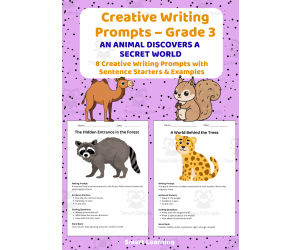
Creative Writing Prompts Grade 3 | An Animal Discovers a Secret World
Creative Writing, Writing, ELA, Grade 2, 3, 4, Writing Prompts, Worksheets & Printables
Creative Writing Prompts Grade 3 | An Animal Discovers a Secret World Get a creative writing prompt resource for 3rd grade on the topic of animals. What does this resource include? This resource contains 8 creative writing prompts on animal-related topics, each with sentence starters for each task, guiding questions to support ideas, word banks with helpful vocabulary, separate writing pages with plenty of space, “How to Write a Story” guide (beginning, middle, end), 3 example stories. Each reading passage is unique. The animal topics were carefully selected and each passage is accompanied by appropriate graphics. What is it suitable for? The material is suitable for English language arts classes. It is ideally suited for 3rd grade. This material is also suitable for weaker 4th-grade classes or particularly strong 2nd-grade classes. It is suitable for teachers looking for teaching materials that can be used immediately. No tedious adapting or formatting required. Simply print it out and use it directly in class. It is suitable for various teaching formats: - writing workshop - literacy centers - independent work - early finishers - homework What topics does the reading comprehension cover? 1 The Hidden Entrance in the Forest 2 A World Behind the Trees 3 The World Inside the Tree 4 A Secret Underwater World 5 The Secret in the Sand 6 The Cave by the Lake 7 The Secret Night World 8 The Secret in the River In addition, there are two advanced-level problems (easy and hard). The material is provided as a PDF file to make it easy to print and use in class. It is part of a larger series. If you like this material, you can explore creative writing prompt resources on a variety of other topics in my shop that will enrich your lessons. In addition to creative writing prompts, I also offer reading comprehension, math word problems, informational texts, and reading tests.
Author Smart Learning Classroom
Rating
Tags Creative Writing, Writing, Pet, Animal, Writing Prompts, Grade 3, Writing Workshop, Story Writing, Animals, Secret World

Reading Comprehension Insects | Grade 3 Reading Activities
Reading Comprehension, Reading, ELA, Grade 3, 4, Teacher Tools, Worksheets & Printables, Tests, Quizzes and Tests
Reading Comprehension Worksheets – Insect Theme | Grade 3 Get a reading comprehension resource for 3rd grade on the topic of Insects. What does this resource include? This resource contains 10 reading passages on insect-related topics, each with 5 exercises. These include multiple-choice, true or false, vocabulary, and creative tasks. Each reading passage is unique. The Insect topics were carefully selected and each passage is accompanied by appropriate graphics. Additionally, answers are provided at the end of the resource to facilitate its use in elementary school. What is it suitable for? The material is suitable for English language arts classes. It is ideally suited for 3rd grade. This material is also suitable for weaker 4th-grade classes or particularly strong 2nd-grade classes. It is suitable for teachers looking for teaching materials that can be used immediately. No tedious adapting or formatting required. Simply print it out and use it directly in class. It is suitable for various teaching formats: - Independent work - Literacy centers - Small group instruction - Homework - Reading workshops - Classroom literacy rotations What topics does the reading comprehension cover? 🐝 1 The Busy Bee 🦋 2 The Colorful Butterfly 🪲 3 The Crawling Beetle 🪶 4 The Fast Dragonfly 🐜 5 The Hardworking Ant 🐞 6 The Lucky Ladybug 🦗 7 The Jumping Grasshopper 🌿 8 The Quick Grasshopper 🐝 9 The Buzzing Bumblebee 🦟 10 The Little Mosquito The material is provided as a PDF file to make it easy to print and use in class. It is part of a larger series. If you like this material, you can explore reading comprehension resources on a variety of other topics in my shop that will enrich your lessons. In addition to reading comprehension, I also offer creative writing, math word problems, informational texts, and reading tests.
Author Smart Learning Classroom
Rating
Tags Reading Comprehension, Grade 3 Reading, Informational Texts, Reading Activities, Reading Passages, Grade 4 Reading, Vocabulary Activities, Animals, Insects, Insect
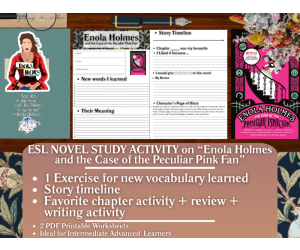
ESL Novel Study - Enola Holmes and the Case of the Peculiar Pink Fan
ELA, Language Development, ESL, Vocabulary, Writing, Creative Writing, Formal Writing, Grade 7, 8, 9, 10, 11, 12, Worksheets & Printables, Novel Studies, Worksheets, Writing Prompts
ESL Novel Study - Enola Holmes and the Case of the Peculiar Pink Fan - Nancy Springer This ESL - EFL - TESOL (English Second or Foreign Language) teaching resource is a comprehensive novel study worksheet activity (2 printable PDF pages; Worksheets) focused on the novel "Enola Holmes and the Case of the Peculiar Pink Fan" (Nancy Springer's novels portraying Sherlock Holmes' sister's adventures in Victorian England). This Novel Study worksheets on "Enola Holmes and the Case of the Peculiar Pink Fan" (Nancy Springer's novels portraying Sherlock Holmes' sister's adventures in Victorian England) is tailored for middle and high school ESL students (7th – 12th grade) and provide a variety of thought provoking and language building activities. Whether you're teaching English as a Second Language (ESL), English as a Foreign Language (EFL), or in a TESOL context, this resource is classroom-ready and easy to use. Within this ESL Novel Study on "Enola Holmes and the Case of the Peculiar Pink Fan" (Nancy Springer's novels portraying Sherlock Holmes' sister's adventures in Victorian England) (2 printable PDF worksheets pages), English Second or Foreign Language (ESL - EFL - TESOL - TEFL) teachers can find the following activities: General information activity (author, genre, publishing date) Vocabulary building section – new words from the novel 1 Story timeline Personal reflection on a favorite chapter Student novel review and rating Creative writing task : pretending being a character you personally liked and writing 3 diary pages for 3 scenes as if you were this character This English Second or Foreign Language (ESL - EFL - TESOL - TEFL) Novel Study Activity Worksheets on the "Enola Holmes and the Case of the Peculiar Pink Fan" (Nancy Springer's novels portraying Sherlock Holmes' sister's adventures in Victorian England) can be ideal for learners from 7th grade to 12th grade to study this Novel (middle school + High School Students + Adult learners + University Students) ESL with Alan is a high-quality ESL teaching resources that inspire both teachers and students. Our goal is to make learning English fun, interactive, and meaningful. Discover more English Second or Foreign Language activities by visiting our store – because learning English should always be fun! If you want to browse more of my English Language and Literature Novel Study Activity Teaching Resources, click here ESL with Alan!
Author Learning with Alan
Rating
Tags ESL, English Second Language, English, Sherlock Holmes, Enola Holmes, Arthur Conan Doyle, Detective, Novel Study, Activity, Worksheets

Country Study Presentation - Eritrea - Geography - East Africa
Social Studies, Economics, Geography, History: African, History, Grade 7, 8, 9, 10, 11, 12, Presentations, Teacher Tools
Country Study Presentation - Eritrea - Geography + Social Studies - East Africa Try this Teaching Resource on Eritrea (Introductory Presentation Lesson - PDF Printable), designed for Geography + African History (East Africa) + Social Studies lessons. Suitable for Grades 7–12 (Middle school and High School students), this Introductory PDF Presentation offers a ready to use lesson that requires little to no preparation. Geography and Social Studies students will learn about Eritrea ’s geography, history, culture, language and economy — making it perfect for classroom instruction, homeschooling, or online learning. 📘 Teachers can find the following topics in this Social Studies and Geograhy Teaching resource ✅ Greetings in Tigrinya ✅ Geography of Eritrea (East Africa) – Key facts, borders, and an interactive Google Maps link to its location. ✅ Quick Facts – Population, capital city, currency and other essential details. ✅ Languages of Eritrea : Tigrinya - introduction in the languages spoken + basic vocabuary ✅ History Overview – A concise summary of the most important events in the history of Eritrea (East Africa) ✅ Geography & Environment – Details about the country’s land area, regions, and climate zones. ✅ Eritrea's Economy – paragraph on Eritrea ’s industries, exports, currency and economic strengths (East Africa) ✅ Asmara – Explore the capital city of Eritrea , its famous landmarks, and cultural highlights. ✅ Other Major Cities – A map showcasing additional important cities in Eritrea (Eritrea Africa) ✅ Eritrea's Culture & Traditions – A look at the customs and values that define Eritrea (East Africa) ✅ Farewell in Tigrinya 🎯 This Geography and Social Studies Teaching Resource can be perfect for: Geography classes Social Studies lessons World cultures units Country study projects Substitute teacher toolbox Digital learning In-class or online teaching 📂 Resource Details Format: PDF Digital Presentation Grade Levels: 7th–12th Grade (Middle School and High School students) Learning with Alan is an educational resource store created to help teachers, educators, and tutors reach their teaching goals while building a fun, engaging, and stimulating learning environment . Because learning should always be meaningful—and fun! 🎓✨ If you want to browse more of my Teaching Resources, click here Learning with Alan!!
Author Learning with Alan
Rating
Tags Country Study, Social Studies, Geography, History, Africa, Tigrinya, Eritrea, East Africa, Lesson, Introduction

Square Root and Cube Root Mental Math Matching Game Estimating 8th 9th
Math, Algebra, Number Lines, Multiplication and Division, Grade 8, 9, Activities, Games, Worksheets & Printables, Worksheets
Here's a fun and hands-on way for your students to practice estimating square roots & cube roots using logical mental math strategies and known benchmarks. It's a simple matching game for students in 8th & 9th grade when they are learning about square roots & cube roots in math class. How to Use: Print a worksheet for each of your students along with a set of 24 matching cards for each group of two to four students. First, students need to complete their Square and Cube Roots Cheat Sheet. Give them time in class to do this in pairs or small groups. They should hold on to this sheet for the whole unit as it will be a useful resource. Let them practice estimating square and cube roots with the five practice questions. Go over mental math strategies as a class (use the answer key for ideas). When it’s time for the game, give groups of students one set of 24 cards. They need to shuffle the cards and match them up. They could do this several ways: Play as a memory matching game : spread cards facedown, flip 2 cards, see if they match, flip them back if they don’t. Play like Go Fish - ask the other players for certain cards. Or just spread all the cards out face-up, match up a pair, and explain why it’s a match . Grades to Use With: This game is designed to target 8th grade math learning outcomes about square roots, cube roots, mental math, and estimation. It could be used in 9th grade as a review activity. It could be used in high school special education classes where appropriate. What's Included: 6-Page PDF Ready to Print and Use! Teacher Instructions Square Root and Cube Root Cheat Sheet Answer Key for Square Root and Cube Root Cheat Sheet 3 pages (24 cards) for the Matching Game
Author Grace Under Pressure
Rating
Tags Square Root, Cube Root, Estimate Square Root, Estimate Cube Root, Square Root Game, Cube Root Game, Root Game, Perfect Square, Perfect Cube, Square Roots
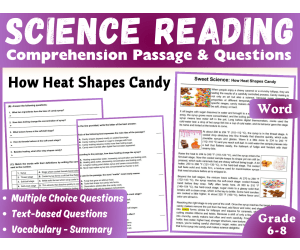
Science Reading Comprehension Passage: Making Candy (Word)
Science, ELA, Reading, Reading Comprehension, Strategies, Resources for Teachers, Chemistry, Grade 6, 7, 8, 9, Writing Prompts, Worksheets & Printables, Centers, Activities, Teacher Tools, Assessments, Quizzes and Tests, Quizzes, Tests
Science Reading Comprehension Passage and Questions: Making Candy (Word) This very engaging science reading passage is about how heat changes sugar syrup into different kinds of candy . It explains that candy making depends on temperature, water loss, and sugar concentration . As sugar syrup boils, water evaporates, the syrup becomes more concentrated, and different temperature ranges create different textures, such as thread, soft-ball, firm-ball, hard-ball, soft-crack, and hard-crack stages. It also explains how candy makers use molds, pulling, stretching, or cutting to shape the candy after heating. This passage is designed to bridge the gap between science and literacy through strengthening reading comprehension and sparking scientific curiosity in middle school students. The passage blends English Language Arts skills with accurate science content that supports NGSS classroom practice. Ideal for interdisciplinary learning in ELA and Science. Suitable for Grade 9 review, too! Student Tasks for The Passage: 5 multiple-choice questions targeting main idea, key details, inference, vocabulary in context, and use of evidence 5 vocabulary matching items with clear, student-friendly definitions 5 text-based questions that require citing specific lines or facts 1 summary prompt that asks students to condense central ideas accurately Full answer key for every section Available Formats for this Resource PDF Fillable PDF Google Docs Product Details Length: 4 pages total Grades: 6–8, also suitable for Grade 9 review Use cases: close reading, stations, homework, intervention, test prep, and sub plans Standards support: reinforces informational-text skills and supports NGSS-style sense making through observation, modeling, and clear use of claim, evidence, and reasoning Why Teachers Choose This Set Authentic science content paired with rigorous literacy practice Consistent task structure across all passages for easier planning and smoother student routines Clear, age-appropriate writing that builds confidence without oversimplifying Other Science Reading Collections you May find in the store: 1. Astronomy & Space Science 2. Volcanoes, Rocks, & Mountains 3. Rock Cycle, Soil, & Sinkholes 4. Mars, Glaciers, & Antarctica 5. Water Cycle, Acid Rain, & Wastewater 6. Insects, Animals, & Ecosystems 7. Bioluminescence & Insects 8. Animal Skin, Cats, & T. Rex 9. Human Body and Senses 10. Health & Applied Bioscience 11. Waves, Light, & Imaging 12. Electricity & Energy 13. Motion & Materials 14. Chemistry and Materials Science Use this set to reinforce ELA skills in science, to add literacy to your lessons, and to support independent work. The passages strengthen main idea, evidence use, vocabulary in context, inference, cause and effect, and summary writing. With ready-to-use assessments and complete answer keys, you can provide focused practice that is simple to run and fast to review.
Author EduNation Creative Store
Rating
Tags Middle School, Reading Comprehension, Reading Strategies, ELA, Centers, Reading Passage, Assessments, Vocabulary, Making Candy
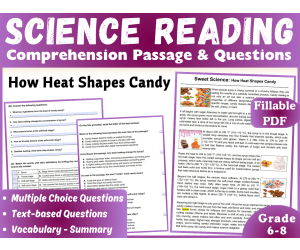
Science Reading Comprehension Passage: Making Candy (Fillable PDF)
Science, ELA, Reading, Reading Comprehension, Strategies, Resources for Teachers, Chemistry, Grade 6, 7, 8, 9, Writing Prompts, Worksheets & Printables, Centers, Activities, Teacher Tools, Assessments, Quizzes and Tests, Quizzes, Tests
Science Reading Comprehension Passage and Questions: Making Candy (Fillable PDF) This very engaging science reading passage is about how heat changes sugar syrup into different kinds of candy . It explains that candy making depends on temperature, water loss, and sugar concentration . As sugar syrup boils, water evaporates, the syrup becomes more concentrated, and different temperature ranges create different textures, such as thread, soft-ball, firm-ball, hard-ball, soft-crack, and hard-crack stages. It also explains how candy makers use molds, pulling, stretching, or cutting to shape the candy after heating. This passage is designed to bridge the gap between science and literacy through strengthening reading comprehension and sparking scientific curiosity in middle school students. The passage blends English Language Arts skills with accurate science content that supports NGSS classroom practice. Ideal for interdisciplinary learning in ELA and Science. Suitable for Grade 9 review, too! These worksheets are designed as fillable PDFs , which means students can type their answers directly into the document on any computer or tablet . Each page includes highlighted text fields that show them exactly where to type! Student Tasks for The Passage: 5 multiple-choice questions targeting main idea, key details, inference, vocabulary in context, and use of evidence 5 vocabulary matching items with clear, student-friendly definitions 5 text-based questions that require citing specific lines or facts 1 summary prompt that asks students to condense central ideas accurately Full answer key for every section Available Formats for this Resource PDF Word Docs Google Docs Product Details Length: 4 pages total Grades: 6–8, also suitable for Grade 9 review Use cases: close reading, stations, homework, intervention, test prep, and sub plans Standards support: reinforces informational-text skills and supports NGSS-style sense making through observation, modeling, and clear use of claim, evidence, and reasoning Why Teachers Choose This Set Authentic science content paired with rigorous literacy practice Consistent task structure across all passages for easier planning and smoother student routines Clear, age-appropriate writing that builds confidence without oversimplifying Other Science Reading Collections you May find in the store: 1. Astronomy & Space Science 2. Volcanoes, Rocks, & Mountains 3. Rock Cycle, Soil, & Sinkholes 4. Mars, Glaciers, & Antarctica 5. Water Cycle, Acid Rain, & Wastewater 6. Insects, Animals, & Ecosystems 7. Bioluminescence & Insects 8. Animal Skin, Cats, & T. Rex 9. Human Body and Senses 10. Health & Applied Bioscience 11. Waves, Light, & Imaging 12. Electricity & Energy 13. Motion & Materials 14. Chemistry and Materials Science Use this set to reinforce ELA skills in science, to add literacy to your lessons, and to support independent work. The passages strengthen main idea, evidence use, vocabulary in context, inference, cause and effect, and summary writing. With ready-to-use assessments and complete answer keys, you can provide focused practice that is simple to run and fast to review.
Author EduNation Creative Store
Rating
Tags Middle School, Reading Comprehension, Reading Strategies, ELA, Centers, Reading Passage, Assessments, Vocabulary, Making Candy
Science Reading Comprehension Passage: Making Candy (PDF)
Science, ELA, Reading, Reading Comprehension, Strategies, Resources for Teachers, Chemistry, Grade 6, 7, 8, 9, Writing Prompts, Worksheets & Printables, Centers, Activities, Teacher Tools, Assessments, Quizzes and Tests, Quizzes, Tests
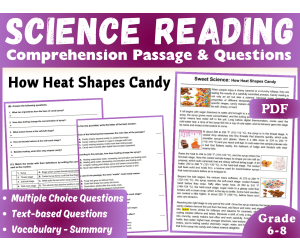
Science Reading Comprehension Passage and Questions: Making Candy (PDF) This very engaging science reading passage is about how heat changes sugar syrup into different kinds of candy . It explains that candy making depends on temperature, water loss, and sugar concentration . As sugar syrup boils, water evaporates, the syrup becomes more concentrated, and different temperature ranges create different textures, such as thread, soft-ball, firm-ball, hard-ball, soft-crack, and hard-crack stages. It also explains how candy makers use molds, pulling, stretching, or cutting to shape the candy after heating. This passage is designed to bridge the gap between science and literacy through strengthening reading comprehension and sparking scientific curiosity in middle school students. The passage blends English Language Arts skills with accurate science content that supports NGSS classroom practice. Ideal for interdisciplinary learning in ELA and Science. Suitable for Grade 9 review, too! Student Tasks for The Passage: 5 multiple-choice questions targeting main idea, key details, inference, vocabulary in context, and use of evidence 5 vocabulary matching items with clear, student-friendly definitions 5 text-based questions that require citing specific lines or facts 1 summary prompt that asks students to condense central ideas accurately Full answer key for every section Available Formats for this Resource Fillable PDF Word Docs Google Docs Product Details Length: 4 pages total Grades: 6–8, also suitable for Grade 9 review Use cases: close reading, stations, homework, intervention, test prep, and sub plans Standards support: reinforces informational-text skills and supports NGSS-style sense making through observation, modeling, and clear use of claim, evidence, and reasoning Why Teachers Choose This Set Authentic science content paired with rigorous literacy practice Consistent task structure across all passages for easier planning and smoother student routines Clear, age-appropriate writing that builds confidence without oversimplifying Other Science Reading Collections you May find in the store: 1. Astronomy & Space Science 2. Volcanoes, Rocks, & Mountains 3. Rock Cycle, Soil, & Sinkholes 4. Mars, Glaciers, & Antarctica 5. Water Cycle, Acid Rain, & Wastewater 6. Insects, Animals, & Ecosystems 7. Bioluminescence & Insects 8. Animal Skin, Cats, & T. Rex 9. Human Body and Senses 10. Health & Applied Bioscience 11. Waves, Light, & Imaging 12. Electricity & Energy 13. Motion & Materials 14. Chemistry and Materials Science Use this set to reinforce ELA skills in science, to add literacy to your lessons, and to support independent work. The passages strengthen main idea, evidence use, vocabulary in context, inference, cause and effect, and summary writing. With ready-to-use assessments and complete answer keys, you can provide focused practice that is simple to run and fast to review.
Author EduNation Creative Store
Rating
Tags Middle School, Reading Comprehension, Reading Strategies, ELA, Centers, Reading Passage, Assessments, Vocabulary, Making Candy
Science Reading Comprehension Passage: Baseball Science (Word)
Science, ELA, Reading, Reading Comprehension, Strategies, Resources for Teachers, Physics, Grade 6, 7, 8, 9, Writing Prompts, Worksheets & Printables, Centers, Activities, Teacher Tools, Assessments, Quizzes and Tests, Quizzes, Tests
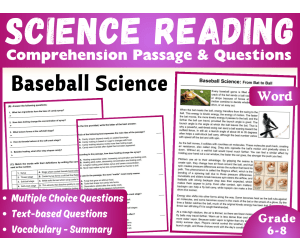
Science Reading Comprehension Passage and Questions: Baseball Science (Word) This very engaging science reading passage is about the physics of baseball , especially how forces and energy affect the way a baseball moves after it is hit or pitched. It explains how kinetic energy transfers from the bat to the ball, how launch angle affects distance, how air resistance/drag slows the ball, and how spin creates the Magnus effect, which can make pitches curve or make batted balls carry farther. It also explains how weather and location, such as high altitude, warm air, and humidity, can affect how far a ball travels. This passage is designed to bridge the gap between science and literacy through strengthening reading comprehension and sparking scientific curiosity in middle school students. The passage blends English Language Arts skills with accurate science content that supports NGSS classroom practice. Ideal for interdisciplinary learning in ELA and Science. Suitable for Grade 9 review, too! Student Tasks for The Passage: 5 multiple-choice questions targeting main idea, key details, inference, vocabulary in context, and use of evidence 5 vocabulary matching items with clear, student-friendly definitions 5 text-based questions that require citing specific lines or facts 1 summary prompt that asks students to condense central ideas accurately Full answer key for every section Available Formats for this Resource PDF Fillable PDF Google Docs Product Details Length: 4 pages total Grades: 6–8, also suitable for Grade 9 review Use cases: close reading, stations, homework, intervention, test prep, and sub plans Standards support: reinforces informational-text skills and supports NGSS-style sense making through observation, modeling, and clear use of claim, evidence, and reasoning Why Teachers Choose This Set Authentic science content paired with rigorous literacy practice Consistent task structure across all passages for easier planning and smoother student routines Clear, age-appropriate writing that builds confidence without oversimplifying Other Science Reading Collections you May find in the store: 1. Astronomy & Space Science 2. Volcanoes, Rocks, & Mountains 3. Rock Cycle, Soil, & Sinkholes 4. Mars, Glaciers, & Antarctica 5. Water Cycle, Acid Rain, & Wastewater 6. Insects, Animals, & Ecosystems 7. Bioluminescence & Insects 8. Animal Skin, Cats, & T. Rex 9. Human Body and Senses 10. Health & Applied Bioscience 11. Waves, Light, & Imaging 12. Electricity & Energy 13. Motion & Materials 14. Chemistry and Materials Science Use this set to reinforce ELA skills in science, to add literacy to your lessons, and to support independent work. The passages strengthen main idea, evidence use, vocabulary in context, inference, cause and effect, and summary writing. With ready-to-use assessments and complete answer keys, you can provide focused practice that is simple to run and fast to review.
Author EduNation Creative Store
Rating
Tags Middle School, Reading Comprehension, Reading Strategies, ELA, Centers, Reading Passage, Assessments, Vocabulary, Making Candy, Physics

Science Reading Comprehension Passage: Baseball Science (Fillable PDF)
Science, ELA, Reading, Reading Comprehension, Strategies, Resources for Teachers, Physics, Grade 6, 7, 8, 9, Writing Prompts, Worksheets & Printables, Centers, Activities, Teacher Tools, Assessments, Quizzes and Tests, Quizzes, Tests
Science Reading Comprehension Passage and Questions: Baseball Science (Fillable PDF) This very engaging science reading passage is about the physics of baseball , especially how forces and energy affect the way a baseball moves after it is hit or pitched. It explains how kinetic energy transfers from the bat to the ball, how launch angle affects distance, how air resistance/drag slows the ball, and how spin creates the Magnus effect, which can make pitches curve or make batted balls carry farther. It also explains how weather and location, such as high altitude, warm air, and humidity, can affect how far a ball travels. This passage is designed to bridge the gap between science and literacy through strengthening reading comprehension and sparking scientific curiosity in middle school students. The passage blends English Language Arts skills with accurate science content that supports NGSS classroom practice. Ideal for interdisciplinary learning in ELA and Science. Suitable for Grade 9 review, too! These worksheets are designed as fillable PDFs , which means students can type their answers directly into the document on any computer or tablet . Each page includes highlighted text fields that show them exactly where to type! Student Tasks for The Passage: 5 multiple-choice questions targeting main idea, key details, inference, vocabulary in context, and use of evidence 5 vocabulary matching items with clear, student-friendly definitions 5 text-based questions that require citing specific lines or facts 1 summary prompt that asks students to condense central ideas accurately Full answer key for every section Available Formats for this Resource PDF Word Docs Google Docs Product Details Length: 4 pages total Grades: 6–8, also suitable for Grade 9 review Use cases: close reading, stations, homework, intervention, test prep, and sub plans Standards support: reinforces informational-text skills and supports NGSS-style sense making through observation, modeling, and clear use of claim, evidence, and reasoning Why Teachers Choose This Set Authentic science content paired with rigorous literacy practice Consistent task structure across all passages for easier planning and smoother student routines Clear, age-appropriate writing that builds confidence without oversimplifying Other Science Reading Collections you May find in the store: 1. Astronomy & Space Science 2. Volcanoes, Rocks, & Mountains 3. Rock Cycle, Soil, & Sinkholes 4. Mars, Glaciers, & Antarctica 5. Water Cycle, Acid Rain, & Wastewater 6. Insects, Animals, & Ecosystems 7. Bioluminescence & Insects 8. Animal Skin, Cats, & T. Rex 9. Human Body and Senses 10. Health & Applied Bioscience 11. Waves, Light, & Imaging 12. Electricity & Energy 13. Motion & Materials 14. Chemistry and Materials Science Use this set to reinforce ELA skills in science, to add literacy to your lessons, and to support independent work. The passages strengthen main idea, evidence use, vocabulary in context, inference, cause and effect, and summary writing. With ready-to-use assessments and complete answer keys, you can provide focused practice that is simple to run and fast to review.
Author EduNation Creative Store
Rating
Tags Middle School, Reading Comprehension, Reading Strategies, ELA, Centers, Reading Passage, Assessments, Vocabulary, Making Candy, Physics
Science Reading Comprehension Passage: Baseball Science (PDF)
Science, ELA, Reading, Reading Comprehension, Strategies, Resources for Teachers, Physics, Grade 6, 7, 8, 9, Writing Prompts, Worksheets & Printables, Centers, Activities, Teacher Tools, Assessments, Quizzes and Tests, Quizzes, Tests
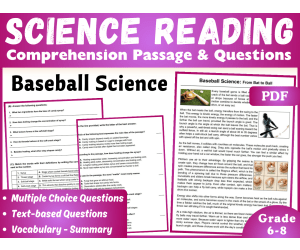
Science Reading Comprehension Passage and Questions: Baseball Science (PDF) This very engaging science reading passage is about the physics of baseball , especially how forces and energy affect the way a baseball moves after it is hit or pitched. It explains how kinetic energy transfers from the bat to the ball, how launch angle affects distance, how air resistance/drag slows the ball, and how spin creates the Magnus effect, which can make pitches curve or make batted balls carry farther. It also explains how weather and location, such as high altitude, warm air, and humidity, can affect how far a ball travels. This passage is designed to bridge the gap between science and literacy through strengthening reading comprehension and sparking scientific curiosity in middle school students. The passage blends English Language Arts skills with accurate science content that supports NGSS classroom practice. Ideal for interdisciplinary learning in ELA and Science. Suitable for Grade 9 review, too! Student Tasks for The Passage: 5 multiple-choice questions targeting main idea, key details, inference, vocabulary in context, and use of evidence 5 vocabulary matching items with clear, student-friendly definitions 5 text-based questions that require citing specific lines or facts 1 summary prompt that asks students to condense central ideas accurately Full answer key for every section Available Formats for this Resource Fillable PDF Word Docs Google Docs Product Details Length: 4 pages total Grades: 6–8, also suitable for Grade 9 review Use cases: close reading, stations, homework, intervention, test prep, and sub plans Standards support: reinforces informational-text skills and supports NGSS-style sense making through observation, modeling, and clear use of claim, evidence, and reasoning Why Teachers Choose This Set Authentic science content paired with rigorous literacy practice Consistent task structure across all passages for easier planning and smoother student routines Clear, age-appropriate writing that builds confidence without oversimplifying Other Science Reading Collections you May find in the store: 1. Astronomy & Space Science 2. Volcanoes, Rocks, & Mountains 3. Rock Cycle, Soil, & Sinkholes 4. Mars, Glaciers, & Antarctica 5. Water Cycle, Acid Rain, & Wastewater 6. Insects, Animals, & Ecosystems 7. Bioluminescence & Insects 8. Animal Skin, Cats, & T. Rex 9. Human Body and Senses 10. Health & Applied Bioscience 11. Waves, Light, & Imaging 12. Electricity & Energy 13. Motion & Materials 14. Chemistry and Materials Science Use this set to reinforce ELA skills in science, to add literacy to your lessons, and to support independent work. The passages strengthen main idea, evidence use, vocabulary in context, inference, cause and effect, and summary writing. With ready-to-use assessments and complete answer keys, you can provide focused practice that is simple to run and fast to review.
Author EduNation Creative Store
Rating
Tags Middle School, Reading Comprehension, Reading Strategies, ELA, Centers, Reading Passage, Assessments, Vocabulary, Making Candy, Physics

4th Grade Math Workbook, Back to school / Printable Math worckbook
Math, Addition and Subtraction, Elementary, Worksheets & Printables
This workbook was made to help students practice the math skills they need for grade. The things to do in this book are about place value adding, subtracting and word problems. The worksheets start with things and get harder so students can feel good about themselves as they get better at math. The workbook covers these topics: • 3-Digit Place Value • 5-Digit Place Value • Place Value Challenge Activities • Triple-Digit Addition • 4-Digit Addition • Addition with Regrouping • Word Problems • Double-Digit Subtraction • 3-Digit Subtraction • 4-Digit Subtraction • Answer Keys You can use this workbook for students to work on their own for homework in math groups or for help in class. The worksheets are made to help students practice the skills many times so they can get better at math and do it more quickly. Here are the details about this workbook: * Grade Level: Grade * Subject: Mathematics * Format: PDF * Answer Key Included * Print-and-Go Resource This math workbook is good, for teachers, parents, tutors and homeschool teachers who want to give their students practice with the math skills they need to know for upper-elementary school.
Author Kind Minds Classroom Tech
Rating
Tags 4th Grade Math Workbook, Place Value Worksheets, Addition With Regrouping, Multi Digit Addition, Printable Math Worksheets, Homeschool Math Grade 4, Back To School Math Review, Summer Math Review, Morning Work Math, Elementary Math Workbook

Summer Road Trip Math Project | End of Year Activities | Real World
Addition and Subtraction, Math, Addition, Subtraction, Basic Operations, Early Math, Measurements, Grade 4, 5, Word Problems, Worksheets & Printables, Projects, Activities
Engaging and Educational! Take students on an exciting Summer Road Trip adventure while strengthening essential real-world math skills. This project-based learning activity encourages students to plan a trip, calculate distances and travel times, create budgets, analyze expenses, and make thoughtful financial decisions using practical math applications. Throughout the project, students will work through a variety of engaging activities that involve route planning, distance calculations, travel time estimation, budgeting for gas, food, lodging, and attractions, graphing expenses, and reflecting on their overall trip experience. These hands-on tasks help students connect classroom math concepts to real-life situations while building confidence in problem-solving and critical thinking. Perfect for end-of-year activities, summer learning, math centers, independent work, fast finishers, enrichment projects, and homeschool learning. The student-friendly format keeps learners engaged while reviewing important math skills in a meaningful and enjoyable way. The ready-to-print PDF format requires no preparation and is easy to implement in any learning environment. File type: PDF Number of Pages: 13 Grade Levels: 4th–5th Grade
Author Sadigitalart
Rating
Tags Road Trip Math, Math Project, End Of Year, Budgeting Math, 4th Grade Math, Summer Activity, Project Based, Real World Math

subject verb agreement exercises for class 9
Grammar, Language Development, ELA, Not Grade Specific, Worksheets & Printables
Introduction Subject-verb agreement is one of those grammar concepts that students seem to "get" in theory but then struggle with the moment they sit down to write. I put this resource together for my own Grade 9 classes after watching students who clearly understood the rule still second-guess themselves mid-sentence — or worse, not notice their errors at all. What they needed wasn't another explanation. They needed reps. A lot of them. Objective Students build accuracy and confidence with subject-verb agreement through repeated, varied practice — moving from recognition to application at a comfortable pace. What's Included 9 exercise sections, no prep required on your end: Singular vs. plural subject practice Circle or choose the correct verb form Fill-in-the-blank sentences Spot and correct the error exercises Verb form practice (is/are, has/have, do/does, etc.) Sentence completion Multiple choice Matching Full answer key Grades / Ages Grade 9 or intermediate English learners — also works well as a remediation tool for higher grades. Format Printable PDF, non-editable. Print and go — works for classwork, homework, grammar centers, tutoring, or a quick whole-class warm-up.
Author MultiLingual Grammar Lab
Rating
Tags Subject Verb Agreement Exercises , Class 9
ESL Vocabulary Flashcards - Leisure & Entertainment - Pictures
ELA, Language Development, ESL, Vocabulary, Not Grade Specific, Middle School, High School, Adult Education, Worksheets & Printables, Flashcards, Worksheets
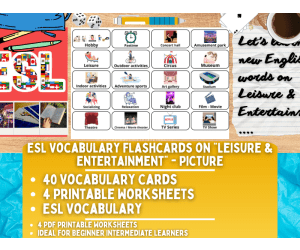
ESL Vocabulary Flashcards - Leisure & Entertainment - Pictures This high quality English language teaching resource is designed for students learning English as a second or foreign language . It includes 4 printable PDF pages featuring vocabulary flashcards and worksheets centered around the theme of "Leisure & Entertainment" This ESL Vocabulary Flashcards on "Leisure & Entertainment" Worksheets Activity can be ideal for Beginner level ESL - EFL - TESOL learners, including newcomers and English language learners of all ages. 🌟 What's Included? In this ESL Vocabulary Flashcards Activity on " Leisure & Entertainment ", there are provided: ✅ 40 Printable Flashcards (4 Printable PDF worksheets) ✅ Essential vocabulary and phrases in English ✅ Engaging icons and emojis on select flashcards to support comprehension and vocabulary retention (not all flashcards) 🏫 Who Can Benefit from This Resource? 📌 Beginner ESL - EFL students looking to improve their English vocabulary 📌 Newcomers & English Language Learners (ESL - EFL - TESOL -TEFL) in schools, tutoring sessions, or self-study 📌 Teachers and tutors looking for fun and engaging vocabulary building activities 📌 Language centers, homeschool educators, and ESL programs 🎯 How Does this ESL Teaching Resource Help you and your Students? ✨ Strengthens essential English communication skills ✨ Provides English vocabulary (ESL - EFL - TESOL - TEFL) for better understanding ✨ Encourages engaging learning with printable flashcards that can be used in various ESL - EFL (English Second or Foreign Language) class activities Whether you're an ESL teacher or an English tutor these ESL Vocabulary Flashcards on " Leisure & Entertainment " are a valuable and fun resource to improve basic conversation skills in English. Start learning today and make English introductions simple, engaging, and effective ! ESL with Alan is a Teaching Resources Store whose aim is to help English as a Second or foreign Language (ESL EFL TESOL) Teachers, Educators and Tutors around the world (be it online or offline) to achieve their teaching objectives while creating an enjoyable and stimulating learning environment. Learning is fun, So should English! Always If you want to browse more of my ESL, EFL, TESOL Teaching Resources, click here right ESL with Alan!
Author Learning with Alan
Rating
Tags ESL, English Second Language, English, Flashcards, Vocabulary, Leisure, Entertainment, Worksheets, Activity, Printable

Health & Nutrition – Balanced Meal Planning Pack
Science, Life Sciences, Human Body, Nature & Plants, Basic Science, Inventors, Theories, Resources for Teachers, Classroom Management, Community Building, Homeschool Curriculum, Homeschool Templates, Grade 6, 7, 8, 9, 10, Worksheets & Printables, Workbooks, Worksheets, Word Searches, Teacher Tools, Assessments, Lesson Plans, Quizzes and Tests, Quizzes, Tests
Revolutionize the way your students think about nutrition from simple concepts to hard-core biochemistry using my: Complete Health & Nutrition – Balanced Meal Planning Pack. This isn't just a lesson on the food pyramid. This customized, no prep curriculum will provide middle & high school (Grades 7-10) with the scientific knowledge and practical application of this knowledge to create solid lifelong healthy eating habits. This resource is suitable for health classes, biology classes, life skills classes, or physical education classes, consists of 48 pages and is divided into three phases: Phase 1: Core Content & Theory (12 Pages) *) Go beyond simply understanding calories in and calories out and have an in-depth understanding of the biochemical make-up of macronutrients (carbohydrates, proteins, lipids) and the role of essential micronutrients (vitamins and minerals). *) Understanding energy expenditure was never made so simple! Understand your BMR, TDEE, Digestive Physiology, Hidden Hunger, the modern-day balanced plate scienced *) Utilize Real Life Case Studies like "The Marathon Runner's Collapse" and "Examination Week Protocol" to make science come to life for students. Phase 2: Student Workbook (21 pages) * 10 detailed worksheets that link theory to practice. No simple fill in the blanks! * Activities include Macronutrient Mastery, Decoding Food Labels, Caloric vs Nutrient Density, Dietary Diagnostics, Meal Planning Logistics, Grocery Pricing, and Modifying Recipes. * Critical thinking scenarios challenge students' ability to solve real-world problems like planning meals for a budgeted vegan, an athlete, or a family with various dietary restrictions. Phase 3: Visual/Aids/Teacher's Resources (15 pages) * Answer keys that make it easier for you to help your students, giving you save time in preparing. * Each of the three high contrast professional visual aids include: Macronutrient Synergy Map, Balanced Plate Paradigm, Glycemic Volatility Graph. Perfect for use as a presentation or handout or for poster size in the classroom. This digital and printed resource is the only unit you will need to teach students how to fuel both their bodies and brains, ultimately setting them up to have success. They will learn how to function in the modern food world while creating a foundation that allows them to discern marketing myths; and to empower themselves to take control of their metabolic health. Keywords: Nutrition lesson plans, health science, meal planning, high school health class, middle school health class, biology, macronutrients, food labels, becoming a healthy eater (lifestyle), digital workbook, printable workbook, life skills, physical education, nutrition unit, project-based learning. What Parents/Schools Appreciate Most About It: More Than Just Study Materials: This is not your standard guide of food pyramid style based information that provides answers to "why" food is important rather than just teaching them about "what" food is by incorporating real biochemically based research that gives students leadership skills through critical thinking about applying appropriate nutrients in their daily diets. No Need To Create New Lessons: It is a comprehensive, ready-to-teach resource that contains all the lessons needed for instructing students, including student learning materials (worksheets), student-directed interactive media, and an answer key for each lesson; which allows teachers to reduce their lesson planning and preparation time by several hours. Teaching Students Skills For Today And Tomorrow: Students will acquire real-world skills that they can apply throughout their lives, including, reading confusing food labels and budgeting for groceries, as well as creating meal plans based upon their own individual physical demands and/or mental needs (i.e., studying for exams, participating in sports). Based On Research And Up-to-date Information: The curriculum provides students with current scientifically valid information by disproving current myths and focusing on scientifically verified, up-to-date information (e.g., nutrient density, the body's hormonal response to food, and the importance of the body's microbiome). Audience For This Poster: From examining the content, language, and references in the text (i.e. two references to "grade 8 students," two references to "9th grade students," and teacher reference to "middle years (grades 7-9)"), I am using the following criteria to define my audience? Primary Target: Advanced Middle School Students (Grades 7-8) and regular High School Students (Grades 9-10) Justification: The vocabulary is appropriate for students of this age and demonstrates a high level of abstract thinking (i.e. biochemistry, paradigm shifts, phospholipid bilayers, anaphylaxis). This will serve as an excellent core unit for a Health or Biology class in high school or as a challenging, extensive science unit for an advanced middle school science class. This Book © by Syed Hammad Rizvi This item is intended for private use and classroom use by one owner. No part may be altered, shared, or sold. You may not post this resource on the web where it may be found and downloaded by others. If you wish to share this resource, you need to purchase additional licenses through Teachsimple. Thank you for following these guidelines. Created by: Syed Hammad Rizvi
Author Creative Book Store
Rating
Tags Nutrition, Health, HealthyEating, Wellness, MealPlanning, MealPrep, HealthScience, Biology, Science, PhysicalEducation
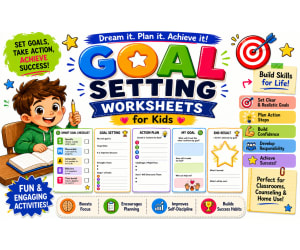
SMART Goals and Motivation Activities | Goal Setting Worksheets
Life Skills, Special Resources, Social Emotional Learning (SEL), Social Skills, Not Grade Specific, Worksheets & Printables, Worksheets
SMART Goals and Motivation Activities | Goal Setting Worksheets ⭐ Students don't spontaneously pick up goal-setting skills; most require a structured approach to practice. This bundle is intended for that purpose. Motivation, self-awareness, organization, perseverance, and confidence are the five things that truly important to pupils and are the foundation of this collection of worksheets and activities. Not as conversation starters. One page at a time, pupils truly work through the material. When life skills are on the agenda, homeschooling parents reach for these, teachers use them in the classroom, and counselors keep them on hand for one-on-one sessions. They work well in SEL classes, study skills units, morning assignments, and advising sessions—any situation where you want students to have a clear understanding of their goals and how to get there. ⭐ Every worksheet takes students step-by-step through the procedure. Students put their goals in writing, divide them into manageable steps, and consider potential obstacles. They are reflective. They fix problems. They create a plan that truly is theirs. The pieces of introspection are crucial. This is often overlooked in goal-setting materials, yet in the absence of reflection, kids complete a worksheet and forget about it by Thursday. Growth truly sticks when students are asked to reflect on what worked, what didn't, and what they would attempt differently. ⭐ Everything is printed straight from the PDF. No preparation is necessary. Both individual pupils and entire groups can benefit from it. This resource deals with the situation where a student sets a goal and gives up by day three because they don't know how to complete it. Instead of just having excellent intentions, students depart with actual tools.
Author life skills learning store
Rating
Tags Life Skills, Social Emotional Learning, School Counseling Sessions, Mental Health, Building Confidence, Social Skills, Goal Setting, Motivation Activities, SMART Goals

Creative Writing Prompts Grade 3 | Exciting School Day
Creative Writing, Writing, ELA, Grade 2, 3, 4, Writing Prompts, Worksheets & Printables
Creative Writing Prompts Grade 3 | Animals School Day Get a creative writing prompt resource for 3rd grade on the topic of animals. What does this resource include? This resource contains 8 creative writing prompts on animal-related topics, each with sentence starters for each task, guiding questions to support ideas, word banks with helpful vocabulary, separate writing pages with plenty of space, “How to Write a Story” guide (beginning, middle, end), 3 example stories. Each reading passage is unique. The animal topics were carefully selected and each passage is accompanied by appropriate graphics. What is it suitable for? The material is suitable for English language arts classes. It is ideally suited for 3rd grade. This material is also suitable for weaker 4th-grade classes or particularly strong 2nd-grade classes. It is suitable for teachers looking for teaching materials that can be used immediately. No tedious adapting or formatting required. Simply print it out and use it directly in class. It is suitable for various teaching formats: - writing workshop - literacy centers - independent work - early finishers - homework What topics does the reading comprehension cover? 1 The Fox in the Classroom 2 A Cold Visitor in the Classroom 3 A Wise Owl Helps the Class 4 Jumping Like a Kangaroo 5 Everything Goes Slowly 6 A Flamingo at Recess 7 Watch Out for Spikes! 8 The Fast Little Lizard In addition, there are two advanced-level problems (easy and hard). The material is provided as a PDF file to make it easy to print and use in class. It is part of a larger series. If you like this material, you can explore creative writing prompt resources on a variety of other topics in my shop that will enrich your lessons. In addition to creative writing prompts, I also offer reading comprehension, math word problems, informational texts, and reading tests.
Author Smart Learning Classroom
Rating
Tags Creative Writing, Writing, Pet, Animal, Writing Prompts, Grade 3, Writing Workshop, Story Writing, School Day, School

Reading Comprehension Guinea Pigs | Grade 3 Informational Texts
Reading Comprehension, Reading, ELA, Grade 3, 4, Teacher Tools, Worksheets & Printables, Tests, Quizzes and Tests
Reading Comprehension Guinea Pigs | Grade 3 Informational Texts Get a reading comprehension resource for 3rd grade on the topic of Guinea Pigs. What does this resource include? This resource contains 5 informational texts on guinea pig-related topics, each with 5 exercises. These include multiple-choice, true or false, vocabulary, and creative tasks. Each reading passage is unique. The Guinea Pig topics were carefully selected and each passage is accompanied by appropriate graphics. Additionally, answers are provided at the end of the resource to facilitate its use in elementary school. This material helps students develop their reading comprehension skills while also allowing them to gain a deeper understanding of a specific topic through short informational texts. What is it suitable for? The material is suitable for English language arts classes. It is ideally suited for 3rd grade. This material is also suitable for weaker 4th-grade classes or particularly strong 2nd-grade classes. It is suitable for teachers looking for teaching materials that can be used immediately. No tedious adapting or formatting required. Simply print it out and use it directly in class. It is suitable for various teaching formats: - Independent work - test preparation - Literacy centers - Small group instruction - Homework - Reading workshops - Classroom literacy rotations What topics does the reading comprehension cover? 🧭 1 A Guinea Pig Comes Home 🚢 2 Living in Groups 🗺 3 Eating and Chewing 🌎 4 Movement and Space 🚢 5 Understanding Guinea Pigs The material is provided as a PDF file to make it easy to print and use in class. It is part of a larger series. If you like this material, you can explore informational texts on a variety of other topics in my shop that will enrich your lessons. In addition to reading comprehension, I also offer creative writing, math word problems, reading comprehension and reading tests.
Author Smart Learning Classroom
Rating
Tags Reading Comprehension, Grade 3 Reading, Informational Texts, Reading Activities, Reading Passages, Grade 4 Reading, Vocabulary Activities, Animals, Guinea Pigs, Guinea Pig

Reading Comprehension Zoo Animals | Grade 3 Reading Activities
Reading Comprehension, Reading, ELA, Grade 3, 4, Teacher Tools, Worksheets & Printables, Tests, Quizzes and Tests
Reading Comprehension Worksheets – Zoo Animals Theme | Grade 3 Get a reading comprehension resource for 3rd grade on the topic of Dinosaur. What does this resource include? This resource contains 10 reading passages on zoo-related topics, each with 5 exercises. These include multiple-choice, true or false, vocabulary, and creative tasks. Each reading passage is unique. The zoo topics were carefully selected and each passage is accompanied by appropriate graphics. Additionally, answers are provided at the end of the resource to facilitate its use in elementary school. What is it suitable for? The material is suitable for English language arts classes. It is ideally suited for 3rd grade. This material is also suitable for weaker 4th-grade classes or particularly strong 2nd-grade classes. It is suitable for teachers looking for teaching materials that can be used immediately. No tedious adapting or formatting required. Simply print it out and use it directly in class. It is suitable for various teaching formats: - Independent work - Literacy centers - Small group instruction - Homework - Reading workshops - Classroom literacy rotations What topics does the reading comprehension cover? 🐘 1 The Big Elephant 🐒 2 The Playful Monkeys 🐆 3 The Fast Cheetah 🦜 4 The Colorful Parrots 🦁 5 The Big Lion 🦒 6 The Tall Giraffes 🐧 7 The Funny Penguins 🦏 8 The Heavy Rhinoceroses 🐼 9 The Calm Pandas 🦩 10 The Colorful Flamingos The material is provided as a PDF file to make it easy to print and use in class. It is part of a larger series. If you like this material, you can explore reading comprehension resources on a variety of other topics in my shop that will enrich your lessons. In addition to reading comprehension, I also offer creative writing, math word problems, informational texts, and reading tests.
Author Smart Learning Classroom
Rating
Tags Reading Comprehension, Grade 3 Reading, Informational Texts, Reading Activities, Reading Passages, Independent Work, Grade 4 Reading, Vocabulary Activities, Animals, Zoo

Find Your Why: Self-Discovery & Purpose Worksheets | SEL Activities
Life Skills, Special Resources, Social Emotional Learning (SEL), Social Skills, Not Grade Specific, Worksheets & Printables
Find Your Why: Self-Discovery & Purpose Worksheets | SEL Activities ⭐ After graduation, some students can tell you exactly what they want to do. To be honest, it's okay that most people can't. However, it is beneficial to allow them time to genuinely consider it before life compels them to ask. This worksheet set is intended for that purpose. These exercises guide students through the kind of introspection that is uncommon during a typical class period: What genuinely matters to you? How do you get out of bed? What kind of person are you attempting to develop into? The true question, not the abstract, essay-prompted variant. The type that requires several attempts to provide a good response. ⭐ The pack is suitable for upper elementary through middle school and works well in counseling sessions, advisory times, life skills classes, or any SEL block where you want students to do more than just fill in the spaces. The prompts are intended to progress from journaling to practical decision-making practice, and from values inquiry to goal-setting. Not only do students determine what important to them, but they also begin to devise solutions. ⭐ What's included is as follows: Questions for reflection that go beyond simple responses Setting goals that are connected to one's values rather than just academic achievements For children who require structure before they can open themselves, journaling prompts Activities for exploring values Life-mapping and visualization tasks Exercises for motivation and purpose ⭐ A few things to be aware of: these are not worksheets that you distribute and gather. They serve as discussion starters. In small groups, one-on-ones, or simply between a student and their journal, the reflection questions in particular often spark conversation. That's intentional. When you're trying to establish classroom culture at the beginning of a semester or when students feel stuck in the middle of the year, this works effectively. For older kids who need to make the connection between their "why" and what follows next, it also works well with college and career readiness programs.
Author life skills learning store
Rating
Tags Life Skills, Social Emotional Learning, School Counseling Sessions, Mental Health, Building Confidence, Social Skills, Self Reflection, Self-Discovery, SEL Activities

ESL Novel Study - Enola Holmes and the Case of the Bizarre Bouquets
Language Development, ELA, ESL, Vocabulary, Writing, Creative Writing, Formal Writing, Grade 7, 8, 9, 10, 11, 12, Worksheets & Printables, Novel Studies, Worksheets, Writing Prompts
ESL Novel Study Worksheets - Enola Holmes and the Case of the Bizarre Bouquets - Nancy Springer This ESL - EFL - TESOL (English Second or Foreign Language) teaching resource is a comprehensive novel study worksheet activity (2 printable PDF pages; Worksheets) focused on the novel "Enola Holmes and the Case of the Bizarre Bouquets" (Nancy Springer's novels portraying Sherlock Holmes' sister's adventures in Victorian England). This Novel Study worksheets on "Enola Holmes and the Case of the Bizarre Bouquets" (Nancy Springer's novels portraying Sherlock Holmes' sister's adventures in Victorian England) is tailored for middle and high school ESL students (7th – 12th grade) and provide a variety of thought provoking and language building activities. Whether you're teaching English as a Second Language (ESL), English as a Foreign Language (EFL), or in a TESOL context, this resource is classroom-ready and easy to use. Within this ESL Novel Study on "Enola Holmes and the Case of the Bizarre Bouquets" (Nancy Springer's novels portraying Sherlock Holmes' sister's adventures in Victorian England) (2 printable PDF worksheets pages), English Second or Foreign Language (ESL - EFL - TESOL - TEFL) teachers can find the following activities: General information activity (author, genre, publishing date) Vocabulary building section – new words from the novel 1 Story timeline Personal reflection on a favorite chapter Student novel review and rating Creative writing task : pretending being a character you personally liked and writing 3 diary pages for 3 scenes as if you were this character This English Second or Foreign Language (ESL - EFL - TESOL - TEFL) Novel Study Activity Worksheets on the "Enola Holmes and the Case of the Bizarre Bouquets" (Nancy Springer's novels portraying Sherlock Holmes' sister's adventures in Victorian England) can be ideal for learners from 7th grade to 12th grade to study this Novel (middle school + High School Students + Adult learners + University Students) ESL with Alan is a high-quality ESL teaching resources that inspire both teachers and students. Our goal is to make learning English fun, interactive, and meaningful. Discover more English Second or Foreign Language activities by visiting our store – because learning English should always be fun! If you want to browse more of my English Language and Literature Novel Study Activity Teaching Resources, click here ESL with Alan!
Author Learning with Alan
Rating
Tags ESL, English Second Language, English, Novel Study, Worksheets, Enola Holmes, Detective, Sherlock Holmes, Arthur Conan Doyle, Activity

Science Reading Comprehension Passage: Eel Power (Word)
Science, ELA, Reading, Reading Comprehension, Strategies, Resources for Teachers, Physics, Grade 6, 7, 8, 9, Writing Prompts, Worksheets & Printables, Centers, Activities, Teacher Tools, Assessments, Quizzes and Tests, Quizzes, Tests
Science Reading Comprehension Passage and Questions: Eal Power (Word) This very engaging science reading passage is about electric eels and how their natural electrical pulses can make holiday lights flicker . More specifically, it explains how electric eels use special cells called electrocytes to produce electricity for sensing, communication, hunting, and defense. It then describes how aquariums in Japan and Utah use safe equipment, such as aluminum panels and wires, to collect the eel’s brief pulses and make Christmas tree lights flicker. The passage also introduces the broader idea of bioelectricity , or electricity made by living things. This passage is designed to bridge the gap between science and literacy through strengthening reading comprehension and sparking scientific curiosity in middle school students. The passage blends English Language Arts skills with accurate science content that supports NGSS classroom practice. Ideal for interdisciplinary learning in ELA and Science. Suitable for Grade 9 review, too! Student Tasks for The Passage: 5 multiple-choice questions targeting main idea, key details, inference, vocabulary in context, and use of evidence 5 vocabulary matching items with clear, student-friendly definitions 5 text-based questions that require citing specific lines or facts 1 summary prompt that asks students to condense central ideas accurately Full answer key for every section Available Formats for this Resource PDF Fillable PDF Google Docs Product Details Length: 5 pages total Grades: 6–8, also suitable for Grade 9 review Use cases: close reading, stations, homework, intervention, test prep, and sub plans Standards support: reinforces informational-text skills and supports NGSS-style sense making through observation, modeling, and clear use of claim, evidence, and reasoning Why Teachers Choose This Set Authentic science content paired with rigorous literacy practice Consistent task structure across all passages for easier planning and smoother student routines Clear, age-appropriate writing that builds confidence without oversimplifying Other Science Reading Collections you May find in the store: 1. Astronomy & Space Science 2. Volcanoes, Rocks, & Mountains 3. Rock Cycle, Soil, & Sinkholes 4. Mars, Glaciers, & Antarctica 5. Water Cycle, Acid Rain, & Wastewater 6. Insects, Animals, & Ecosystems 7. Bioluminescence & Insects 8. Animal Skin, Cats, & T. Rex 9. Human Body and Senses 10. Health & Applied Bioscience 11. Waves, Light, & Imaging 12. Electricity & Energy 13. Motion & Materials 14. Chemistry and Materials Science Use this set to reinforce ELA skills in science, to add literacy to your lessons, and to support independent work. The passages strengthen main idea, evidence use, vocabulary in context, inference, cause and effect, and summary writing. With ready-to-use assessments and complete answer keys, you can provide focused practice that is simple to run and fast to review.
Author EduNation Creative Store
Rating
Tags Middle School, Reading Comprehension, Reading Strategies, ELA, Centers, Reading Passage, Assessments, Vocabulary, Physics, Electricity