World War I: Methods of Warfare Gr. 5-8
Teach middle-grade students about World War I, focused on the 'Methods of Warfare' chapter, through a leveled reading-comprehension passage plus supporting vocabulary, puzzle, quiz, and research activities.
2,772 resources
Explore sub-categories
3 sub-categories · 2,772 resources
Teach middle-grade students about World War I, focused on the 'Methods of Warfare' chapter, through a leveled reading-comprehension passage plus supporting vocabulary, puzzle, quiz, and research activities.
A reading-comprehension chapter slice on the outcomes/aftermath of World War I, with supporting vocabulary, comprehension quiz, puzzles and mini posters for grades 5-8.
A reading-comprehension chapter slice on why and how the United States entered World War I, with supporting vocabulary, comprehension quiz, puzzles and mini posters for grades 5-8.
A reading-comprehension chapter slice on Woodrow Wilson's Fourteen Points, with supporting vocabulary, comprehension quiz, puzzles and mini posters for grades 5-8.
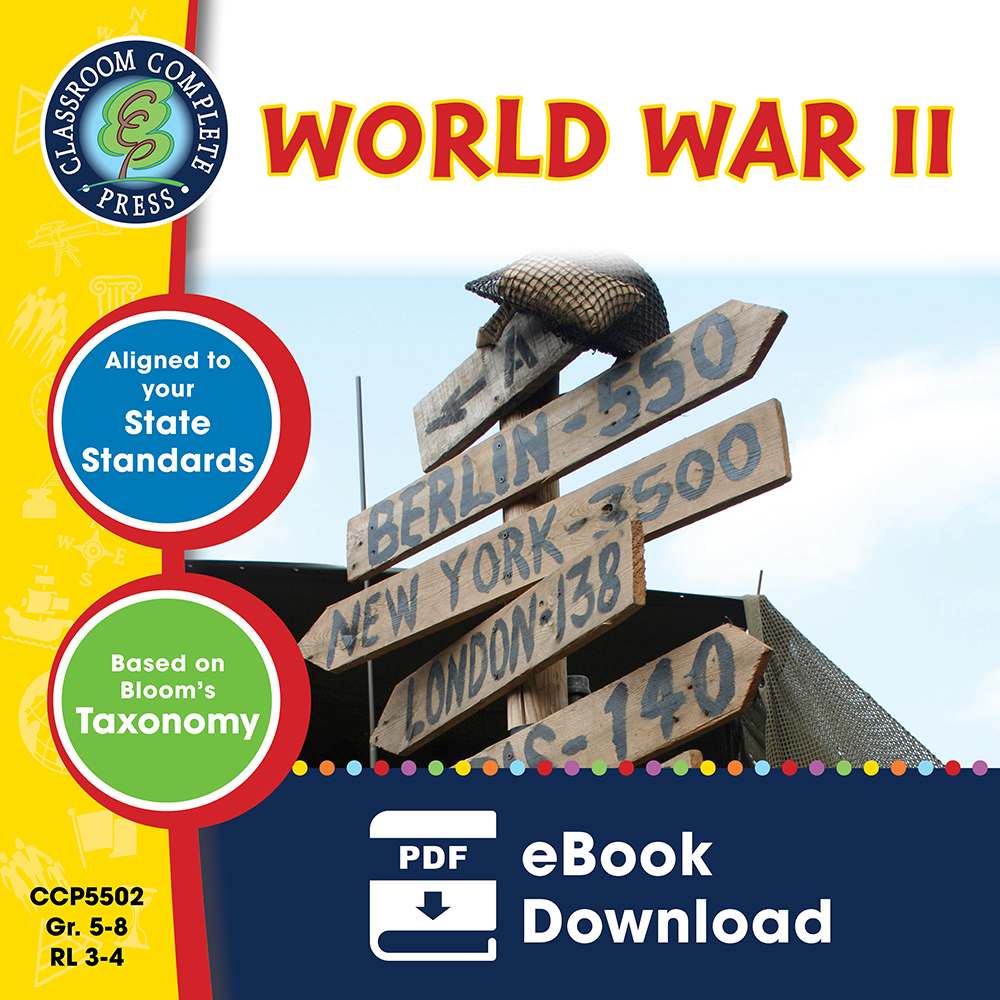
A full 6-chapter reading-comprehension unit on World War II (1939-1945) covering why we remember WWII, background and causes, Germany's role, major battles, new weapons of war, and the end of the war, with vocabulary, puzzles, quiz, answer key and mini posters for grades 5-8.
A reading-comprehension chapter slice on the background and causes of World War II, with before/after-reading activities, an assessment rubric, and an answer key for grades 5-8.
A reading-comprehension chapter slice on Germany's role in World War II, beginning with the invasion of Poland on September 1, 1939, with before/after-reading activities, an assessment rubric, and an answer key for grades 5-8.
A reading-comprehension chapter slice on the major battles of World War II, beginning with Germany's invasion of Poland on September 1, 1939, with before/after-reading activities, an assessment rubric, and an answer key for grades 5-8.
A reading-comprehension chapter slice on the new weapons and technology used in World War II, with before/after-reading activities, an assessment rubric, and an answer key for grades 5-8.
A reading-comprehension chapter slice on the end of World War II, including Germany's role in the final phase and D-Day/Normandy, with before/after-reading activities, an assessment rubric, and an answer key for grades 5-8.
A social studies unit that helps students understand the causes, key events, and lasting significance of World War II.
The multiple-choice worksheet mixes everyday statements with expressions that use être or avoir. Students select a conjugated form for each sentence, considering both agreement and meaning. Use it for practice or a short quiz, then discuss why an expression such as avoir peur needs a different verb from a direct English translation.