search
user.png
vertical menu

100 English Idioms You Need To Know - Book Three

100 English Idioms You Need To Know - Book Three preview
100 English Idioms You Need To Know - Book Three preview 2
100 English Idioms You Need To Know - Book Three preview 3

Look Inside · 10 pages · answer key included

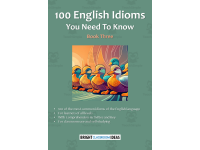
Cover of 100 English Idioms You Need To Know - Book Three, listing comprehension activities and a key
Front cover of the third idiom book
Idiom book contents: introduction on page 3, 100 idioms on page 5, activities on page 15, and key on page 19
Contents guide to the book's four sections
Introduction to idioms covers cultural insight, communication skills, listening comprehension, and vocabulary
First page of the introduction to idioms
Idiom introduction continues with everyday speech, contextual reading, and personal and professional advantages
Second page completes the introduction
Idiom entries 1–11 begin the reference section, from 'A fish out of water' to 'Between a rock and a hard place'
Reference section begins with idioms 1–11
Idiom 11's example continues, followed by entries 12–22, from 'Big cheese' to 'Cost an arm and a leg'
Continuation of idiom 11 and entries 12–22
Idiom entries 23–32 give definitions and examples, from 'Crocodile tears' through 'Face the music'
Reference entries 23–32, covering C through F
Idiom entries 33–43 give definitions and examples, from 'Feather your own nest' to 'Go out on a limb'
Reference entries 33–43, continuing F and G
Idiom entries 44–53 give definitions and examples, from 'Go the extra mile' through 'In the red'
Reference entries 44–53, covering G through I

Answer key included

Answer key included
Attributes
Add To Collection
Add to collection Add to collection

About This Product

We have spoken about the importance of idioms in the previous two books of this series.Idioms improve communication by enabling you to communicate subtleties and deeper meanings that plain language cannot. When idioms are used effectively, communication becomes more captivating, engaging, and successful.

Idioms reveal a person's familiarity with English-speaking culture. Acquiring knowledge of idioms demonstrates a respect for the culture and principles inherent in the language. For instance, the expression "to pull yourself up by your bootstraps" was first used in America in the 19th century and still refers to bettering your circumstances on your own.

Idioms are a fundamental component of language. Idioms having metaphorical connotations are genuinely present in many commonplace English expressions. Acquiring knowledge of idioms is essential to mastering the English language.

In this third book of the Idioms series you will find 100 more idioms to teach your students, followed by 40 exercises and their answers as usual. Enjoy!

0 Reviews

Explore related searches
you may also like...

Check out these other great products