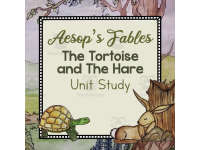
Tortoise and the Hare – Aesop's Fable Unit



- Grades
- Grades 1–3, Elementary
- Pages
- 27
- File type
- Preparation
- Print ready


- Subject
- ELA, Reading
- Topic
- The Tortoise and the Hare, sequencing
- Resource types
- Worksheets & Printables, Worksheets
- Preparation
- Print ready
- Standards
- CCSS.RL.1.4 CCSS.RL.1.5 +22
About this resource
What's inside this resource
You'll love this comprehensive resource for “The Tortoise and the Hare” Fable. This resource is best suited for 1st – 3rd grade students. This Unit has a few versions of the story, a readers theatre so you can act it out with your students, crafts, and worksheets to help expand your learning experience. You can pick and choose which resources you want to use to make the best unit possible!
How To Use This:
Look through all the versions and options and choose which to print. Laminate the resources that will be handled by many students or that you want to reuse year after year. I've tried to include enough resources here that you can personalize and create a meaningful fable unit!
What You Get:
- "Fable" Anchor Chart defining a fable
- "Who Was Aesop" non-fiction article
- Coloring Page of The Tortoise and The Hare
- Color illustration of The Tortoise and The Hare
- Modern Day Version of the story of "The Tortoise and The Hare"
- Original Story of "The Tortoise and the Hare" by Aesop
- Comprehension question worksheet
- Readers Theater of the Fable (3 scripts, one for each character with highlighted lines)
- 2 pages of cut out characters to make into puppets
- Sequencing Story Cards (With and without sequential titles)
- Worksheet with character traits and vocabulary words
- Writing template to write your own version of the fable
- Writing template with question "How Would You Run A Race?"
- Writing template with character topper for story summary or story response.
Here are links to similar resources in my store:
Check out other resources from my store: Simply Schoolgirl!
I can be contacted for questions and concerns at simplyschoolgirl1@gmail.com
Related resources
More resources teachers may find useful
24 related resources were found using this product's title, contributor, categories and tags.



No reviews yet
Downloaded this resource? Tell other teachers how it went.
Curriculum
Standards, concepts & topics
Standards
 Standards
- CCSS.RL.1.4 — Identify words and phrases in stories or poems that suggest feelings or appeal to the senses.
- CCSS.RL.1.5 — Explain major differences between books that tell stories and books that give information, drawing on a wide reading of a range of text types.
- CCSS.RL.1.6 — Identify who is telling the story at various points in a text.
- CCSS.RL.2.4 — Describe how words and phrases (e.g., regular beats, alliteration, rhymes, repeated lines) supply rhythm and meaning in a story, poem, or song.
- CCSS.RL.2.5 — Describe the overall structure of a story, including describing how the beginning introduces the story and the ending concludes the action.
- CCSS.RL.2.6 — Acknowledge differences in the points of view of characters, including by speaking in a different voice for each character when reading dialogue aloud.
- CCSS.RL.3.4 — Determine the meaning of words and phrases as they are used in a text, distinguishing literal from nonliteral language.
- CCSS.RL.3.5 — Refer to parts of stories, dramas, and poems when writing or speaking about a text, using terms such as chapter, scene, and stanza; describe how each successive part builds on earlier sections.
- CCSS.RL.3.6 — Distinguish their own point of view from that of the narrator or those of the characters.
- CCSS.RL.1.7 — Use illustrations and details in a story to describe its characters, setting, or events.
- CCSS.RL.1.9 — Compare and contrast the adventures and experiences of characters in stories.
- CCSS.RL.2.7 — Use information gained from the illustrations and words in a print or digital text to demonstrate understanding of its characters, setting, or plot.
- CCSS.RL.2.9 — Compare and contrast two or more versions of the same story (e.g., Cinderella stories) by different authors or from different cultures.
- CCSS.RL.3.7 — Explain how specific aspects of a text’s illustrations contribute to what is conveyed by the words in a story (e.g., create mood, emphasize aspects of a character or setting)
- CCSS.RL.3.9 — Compare and contrast the themes, settings, and plots of stories written by the same author about the same or similar characters (e.g., in books from a series).
- CCSS.RL.1.1 — Ask and answer questions about key details in a text.
- CCSS.RL.1.2 — Retell stories, including key details, and demonstrate understanding of their central message or lesson.
- CCSS.RL.1.3 — Describe characters, settings, and major events in a story, using key details.
- CCSS.RL.2.1 — Ask and answer such questions as who, what, where, when, why, and how to demonstrate understanding of key details in a text.
- CCSS.RL.2.2 — Recount stories, including fables and folktales from diverse cultures, and determine their central message, lesson, or moral.
- CCSS.RL.2.3 — Describe how characters in a story respond to major events and challenges.
- CCSS.RL.3.1 — Ask and answer questions to demonstrate understanding of a text, referring explicitly to the text as the basis for the answers.
- CCSS.RL.3.2 — Recount stories, including fables, folktales, and myths from diverse cultures; determine the central message, lesson, or moral and explain how it is conveyed through key details in the text.
- CCSS.RL.3.3 — Describe characters in a story (e.g., their traits, motivations, or feelings) and explain how their actions contribute to the sequence of events.
Core concepts
 Core concepts
Reading comprehension
the tortoise and the hare
 Topics
Explore more
Categories this resource belongs to
Explore related searches
More to explore
You may also like