AI Literacy & Digital Citizenship, Grades 4-8



About This Product
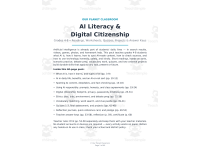
AI is already in your students' pockets, feeds, and homework — teach them to understand it, question it, and use it honestly. This 60-page, print-and-go pack for grades 4-8 builds durable AI literacy and digital citizenship skills that work with any tool, present or future. No student accounts or devices required; every activity works on paper.
WHAT'S INSIDE
• What Is AI? (pp. 3-9): What AI is, AI vs. human intelligence comparison, how AI learns (data, patterns, training, models), machine-learning steps, and types of AI (chatbots, image generators, voice assistants, recommendation systems) with a matching activity.
• AI in Daily Life (pp. 10-12): AI scavenger hunt, a 20-item AI-or-not sorting activity, and a reading on the benefits of AI.
• Spotting AI Content (pp. 13-18): Clues in AI text and images, eight Real-or-AI scenario pages, deepfakes explained in age-appropriate language, misinformation and fact-checking (Stop, Investigate, Find better coverage, Trace the original — including lateral reading), and a source-check worksheet.
• Using AI Responsibly (pp. 19-24): Prompt basics with practice rewrites, helper-vs.-doer homework scenarios, honesty, plagiarism, and citing AI help, a fill-in classroom AI agreement to sign, and a teacher/parent permission checklist.
• Digital Citizenship (pp. 25-31): Digital footprint mapping, what never to share, passwords and account safety, kindness online (THINK test), cyberbullying response steps, screen-time balance, and copyright basics for students.
• Ethics and the Future (pp. 32-38): Bias in AI with detective scenarios, jobs and AI, AI and the environment, two debate-prep pages ('Should robots...?'), and a future-of-AI writing prompt.
• Vocabulary (pp. 39-41): Matching, word search, and crossword-style clue puzzle for 12 key terms: algorithm, data, model, prompt, bias, privacy, copyright, footprint, chatbot, generate, verify, source.
• Quizzes, Assessment, and Projects (pp. 42-48): Quizzes 1-3, a two-part final assessment, 'Design a Helpful AI,' and 'Teach a Younger Student' poster planning.
• Reflect and Review (pp. 49-52): Two reflection journals, a quick-reference 'Think Before You Tap' card, and an AI literacy pledge.
• Teacher Answer Keys (pp. 53-58): Complete keys for all closed-answer pages, including quizzes, sorts, matching, scenarios, vocabulary, word-search placements, and a final-assessment scoring guide. Print separately from student copies.
• Reflection (p. 59) and Certificate of Achievement (p. 60).
STANDARDS ALIGNMENT
Aligns with the ISTE Standards for Students, including Digital Citizen (1.2: managing digital identity, privacy, and respectful online behavior), Knowledge Constructor (1.3: evaluating accuracy and credibility of information), and Creative Communicator (1.6: responsible communication and copyright awareness). Also supports media-literacy and character-education goals in technology and computer science classes.
HOW TO USE
Teach in order as a 2-3 week unit, or pull single pages for advisory, homeroom, library/media, or computer-science lessons. Start with a reading, follow with the linked worksheet or sort, discuss scenarios in pairs, assess with Quizzes 1-3 and the final assessment, and finish with a project and reflection. All AI examples are generic (chatbots, image generators, voice assistants, recommendation systems) so lessons stay current as tools change; no commercial product is endorsed. Follow your school and district policy on student AI use.
DETAILS
60 pages, US Letter, print-ready PDF. Answer keys pp. 53-58; certificate p. 60. © Our Planet Classroom. For single-classroom use.
Resource Tags
0 Reviews
Check out these other great products