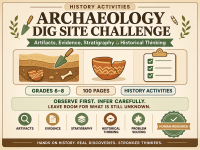
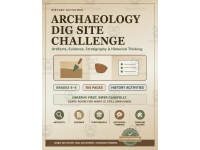
Archaeology Dig Site Challenge | History | Grades 6–8 | 100 Pages



About This Product
Archaeology Dig Site Challenge | History Workbook | Grades 6–8| 100 Pages
100-Page Middle School Archaeology, Historical Evidence & Critical Thinking Resource
Bring archaeology and historical investigation into your classroom with Archaeology Dig Site Challenge!
Designed for Grades 6–8, this 100-page history resource introduces students to archaeological methods, artifact interpretation, historical evidence, stratigraphy, and evidence-based reasoning through 12 themed learning units.
Students take on the role of archaeological investigators as they explore excavation grids, study artifacts, examine historical layers, interpret data, compare competing explanations, and develop conclusions supported by available evidence.
The resource emphasizes careful observation, historical thinking, and an understanding of the difference between evidence and inference.
What's Included?
100 total pages
12 archaeology-themed learning units
84 student activity pages (Pages 5–88)
10 answer key pages (Pages 89–98)
Teacher Extension (Page 99)
Curriculum & Skills Guide (Page 100)
Excavation grid and coordinate activities
Artifact catalog and classification tasks
Stratigraphy and dating investigations
Pottery reconstruction challenges
Historical data and graph analysis
Evidence interpretation and problem-solving
12 Learning Units
1. Archaeologist Training Lab (Pages 5–10)
Introduces archaeological investigation skills, observation, and evidence-based thinking.
2. Dig Grid Coordinates (Pages 11–17)
Develops spatial reasoning and coordinate interpretation through excavation-themed tasks.
3. Artifact Catalog (Pages 18–25)
Explores artifact documentation, classification, and the interpretation of archaeological objects.
4. Dating the Layers (Pages 26–33)
Introduces stratigraphy and the use of archaeological layers to investigate relative chronology.
5. Pottery Reconstruction (Pages 34–40)
Uses pottery-themed challenges to encourage observation, comparison, and interpretation.
6. Ancient Trash Investigation & Data Graphs (Pages 41–47)
Connects archaeological evidence with data analysis and graph interpretation.
7. Burial Evidence & Interpretation (Pages 48–54)
Encourages careful reasoning about archaeological findings and the limitations of historical evidence.
8. Building Remains & Structure Analysis (Pages 55–62)
Investigates structural remains and possible interpretations of ancient buildings.
9. Trade Artifacts, Graphs & Route Analysis (Pages 63–70)
Explores trade-related objects, routes, and graphical evidence.
10. Environment, Food Evidence & Data Analysis (Pages 71–77)
Examines environmental and food-related evidence using data interpretation.
11. Competing Interpretations (Pages 78–83)
Develops critical thinking by examining alternative explanations and evidence limitations.
12. Final Excavation Mission (Pages 84–88)
Brings together archaeological investigation, historical reasoning, and evidence evaluation in a final themed unit.
Key Skills Developed
Archaeological inquiry
Historical thinking
Artifact interpretation
Observation and classification
Stratigraphy and relative chronology
Coordinate and grid reading
Evidence analysis
Graph and data interpretation
Critical thinking and problem-solving
Comparing competing explanations
Drawing evidence-based conclusions
Recognizing uncertainty and evidence limitations
Suggested Classroom Uses
This resource is suitable for:
Middle school history lessons
Grades 6–8 social studies
Archaeology-themed units
Ancient history enrichment
Historical inquiry activities
Independent classroom practice
Small-group investigations
Cross-curricular history and data analysis
Critical thinking lessons
Project-based learning
Homework and review activities
Teachers can assign individual units to support specific historical inquiry skills or organize the activities into a longer archaeology investigation project.
Answer Key & Teacher Resources
Pages 89–98 are designated for the answer key.
Page 99 contains the Teacher Extension, and Page 100 provides the Curriculum & Skills Guide.
Resource Information
Grade Levels: Grades 6–8
Subject: Social Studies / History / Archaeology
Format: Printable PDF
Total Pages: 100
Activity Pages: 84
Learning Units: 12
Answer Key: 10 pages
Teacher Resources: Teacher Extension and Curriculum & Skills Guide
Help students observe carefully, investigate archaeological evidence, evaluate competing interpretations, and develop stronger historical reasoning skills.
Observe first. Infer carefully. Leave room for what is still unknown.
Resource Tags
0 Reviews
Check out these other great products