Balancing Equations Practice – 35 Chemistry Problems
- Grades
- Grades 9–12
- File type
- Microsoft Word
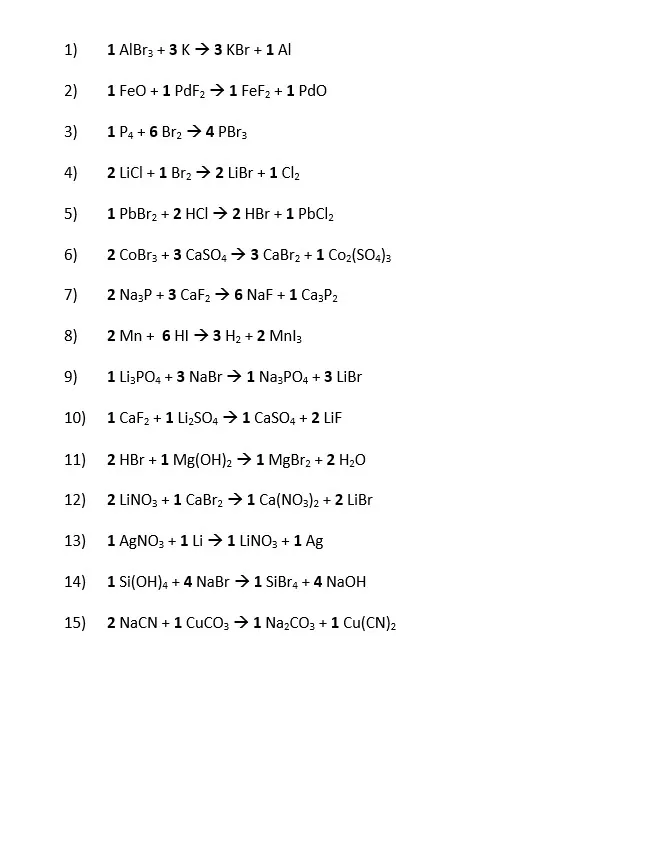
- Answer key
- Included


- Subject
- Science, Chemistry
- Topic
- Balancing equations, Chemical equations
- Resource types
- Worksheets
- Answer key
- Included
Product description
From the author
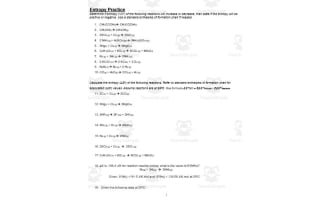
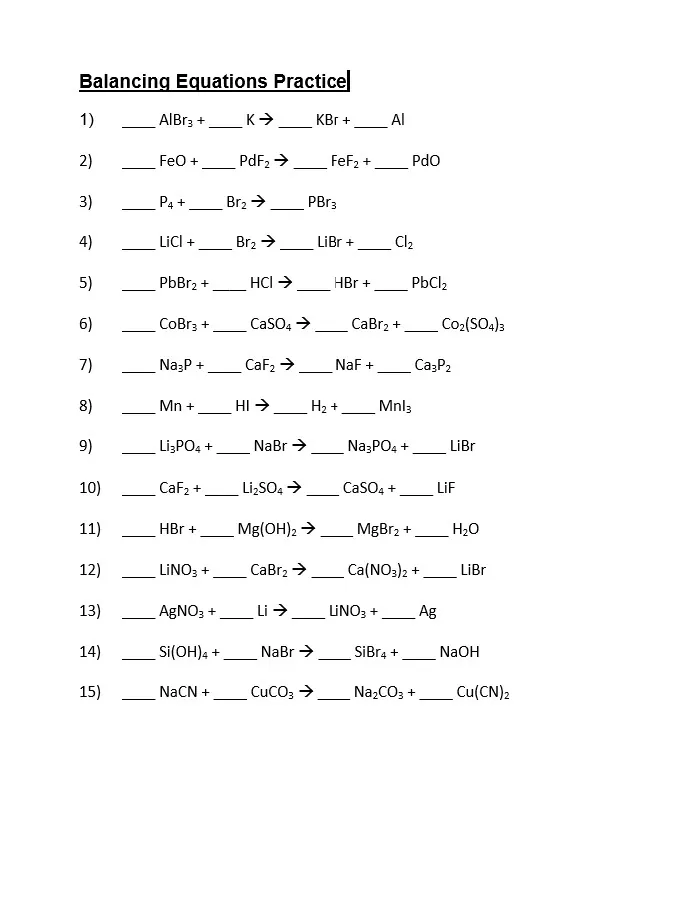
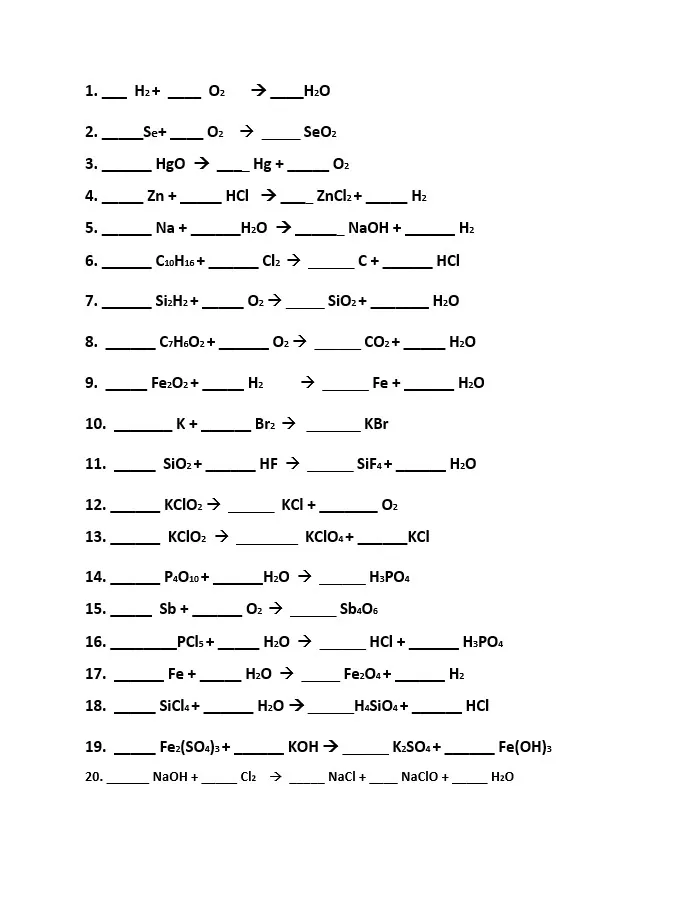
With these 35 practice problems, students will be able to put into practice their knowledge of balancing the reactant atoms to product atoms of various reactions.
Questions are of different difficulty levels.
Teacher can edit these according to their lessons.
Related resources
More resources teachers may find useful
24 related resources were found using this product's title, contributor, categories and tags.


In the classroom
Teaching tips & learning objectives

Learning objectives
Balance chemical equations by adjusting coefficients so atoms are conserved.
Apply the law of conservation of mass to reaction equations.
Identify reactants and products in synthesis, replacement, and combustion reactions.

Teaching tips
Model balancing by counting atoms and changing coefficients, never subscripts.
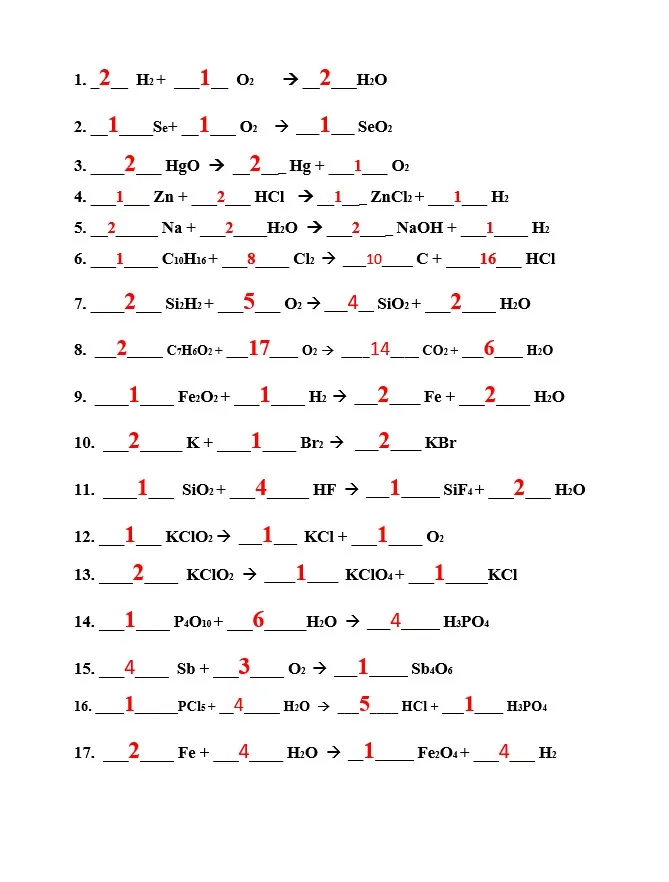
Correct Set 2 question 8 to coefficients 2, 15, 14, 6; question 9 needs a coefficient of 2 before H2 for the printed Fe2O2 formula.
Check the unusual Fe2O2 and Fe2O4 formulas and reaction plausibility before using these as chemistry examples. A balanced symbolic equation does not establish that a reaction occurs.

Skills covered
Chemical equation balancing — students determine coefficients so atom counts match on both sides of 35 reaction equations.
Conservation of mass application — students apply the law of conservation of mass to single/double replacement, synthesis, and combustion reactions.
Chemical formula reading — students interpret polyatomic-ion formulas (e.g., Ca(NO3)2, K2SO4) while balancing equations.
Good to know
Questions teachers ask about this resource
What should students check as they balance each equation?
Count atoms of each element on both sides and adjust coefficients until the totals match. Remind students to change coefficients rather than the subscripts in chemical formulas.

No reviews yet
Downloaded this resource? Tell other teachers how it went.
Resource details
Concepts & topics
Core concepts
 Core concepts
Chemical equation balancing
Conservation of mass
Stoichiometry basics
 Topics
Explore related searches
More to explore
You may also like