California CAASPP Math Practice Test for Grade 4


- Grades
- Grade 4
- Pages
- 19
- File type
- Answer key
- Included


- Subject
- Math
- Topic
- CAASPP, Grade 4 math
- Resource types
- Worksheets, Teacher Tools
- Answer key
- Included
- Standards
- 4.NBT.B.5
Product description
From the author
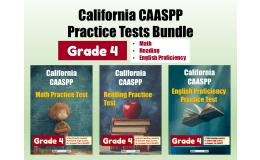
Review grade 4 math with thirty multiple-choice and written-response questions across operations, base-ten computation, fractions, measurement and geometry.
The download contains three PDFs: an eight-page student test including the cover, a four-page answer key with explanations and scoring notes, and a seven-page teacher guide. Five written questions ask students to show work.
Use selected items for classroom practice or review. The guide provides suggested administration, teaching follow-ups and publisher-created score bands; these are not official CAASPP scores or proof of full standards coverage.
Related resources
More resources teachers may find useful
24 related resources were found using this product's title, contributor, categories and tags.

In the classroom
Teaching tips & learning objectives

Learning objectives
Multiply and divide multi-digit whole numbers in word-problem contexts, including a two-step problem that needs multiplication then subtraction
Read place value to millions and compare and round six-digit numbers, and subtract across consecutive zeros
Convert within customary and metric measurement systems and find a missing rectangle dimension from a given perimeter

Teaching tips
The guide sets the administration: one single-sided copy per student so the written questions have room, two pencils and scratch paper, no calculators or reference charts, and 60 to 75 minutes
The guide includes suggestions for time, read-aloud, print size and setting. Choose classroom supports that fit the individual student’s established plan
Questions 15, 17, 18 and 20 include a combined-choice option. Model how to read such options before assigning the practice

Skills covered
Multi-step problem solving - questions 6 and 7 chain two operations, and question 7 asks students to show both steps.
Multi-digit computation fluency - the base ten section runs 56,847 + 38,965, 200,000 - 84,375 and 463 x 7, with the key pinpointing regrouping and carrying as the usual failure points.
Written mathematical explanation - the five open-response items are scored against a rubric that requires shown work, all parts addressed, and answers labelled with the right units.
Good to know
Questions teachers ask about this resource
How are the five written questions scored?
On a three-level rubric worth one point each. Full credit needs a complete correct response with the work shown, every part addressed and the answer labelled with appropriate units; half a point covers a correct method with one arithmetic or labelling slip; zero covers a blank, off-task or faulty-reasoning answer. Model answers and partial-credit notes are printed for questions 7, 14, 21, 27 and 30.
What does the teacher's guide add beyond the correct responses?
For every one of the thirty questions it names the aligned standard, states the skill in a line, lists the errors students typically make, and gives a teaching move - area models and partial products for question 1, factor rainbows for question 3, a Sieve of Eratosthenes for primes, the metric staircase for litres to millilitres. It also carries the test-structure table, the administration rules and remediation and enrichment lists tied to the four score bands.

No reviews yet
Downloaded this resource? Tell other teachers how it went.
Curriculum
Standards, concepts & topics
Standards
 Standards
- 4.NBT.B.5
Core concepts
 Core concepts
Multi-digit operations
Place value
Fractions
Measurement conversion
Geometry
 Topics
Explore more
Categories this resource belongs to
Explore related searches
More to explore
You may also like