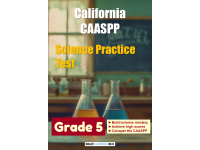
California CAASPP Science Practice Test for Grade 5

- Grades
- Grade 5, Elementary
- Pages
- 24
- File type
- Answer key
- Included


- Subject
- Science
- Topic
- california, caaspp
- Resource types
- Assessments, Teacher Tools, Tests, Quizzes and Tests, Worksheets & Printables
- Answer key
- Included
About this resource
What's inside this resource
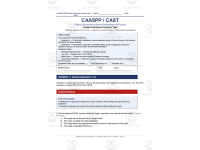
This 5th Grade CAASPP Science Practice Test is the perfect way to help students build confidence and master NGSS standards before the CAST exam. With rigorous, test-aligned questions and a full performance task, this resource prepares students for real testing conditions.
What’s Included
✅ Full-length Grade 5 CAASPP/CAST Science Practice Test
✅ 34 questions covering all science domains
✅ Segment A: Physical, Life, and Earth Science questions
✅ Segment B: Performance Task on ocean acidification
✅ Constructed response questions with rubrics
✅ Detailed Answer Key with explanations
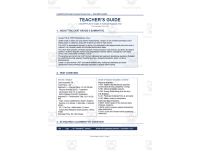
✅ Comprehensive Teacher’s Guide with standards alignment and pacing
✅ Printable, student-friendly format
How It Works in the Classroom
This 5th grade science test prep resource is flexible and easy to implement:
Use as a full-length practice test before CAASPP
Assign sections for spiral review or weekly assessments
Perfect for test prep centers or independent practice
Ideal for sub plans or benchmark assessments
Great for small group reteaching using data-driven instruction
Standards & Learning Goals
Aligned to CA NGSS Grade 5 Performance Expectations, including:
5-PS1: Matter & its interactions
5-PS2 & 5-PS3: Motion and energy
5-LS1 & 5-LS2: Life science and ecosystems
5-ESS1–3: Earth systems, space, and human impact
Students will:
✔ Analyze data and scientific scenarios
✔ Explain phenomena using evidence
✔ Apply crosscutting concepts and reasoning
✔ Practice multi-step, higher-order thinking
Why Teachers Love It
⭐ Test-aligned format mirrors real CAASPP expectations
⭐ Saves prep time with ready-to-use materials
⭐ Covers ALL domains in one resource
⭐ Includes answer explanations for easy grading
⭐ Builds student confidence before testing
⭐ Supports differentiation with multiple question types
Make CAASPP prep simple and effective with this 5th grade science practice test—your students will feel prepared, confident, and ready to succeed!
Related resources
More resources teachers may find useful
24 related resources were found using this product's title, contributor, categories and tags.


In the classroom
Teaching tips & learning objectives

Learning objectives
Students explain conservation of matter across physical and chemical changes (e.g., dissolving sugar, a burning candle) using evidence rather than assumption.
Students describe how energy and matter move through food chains and ecosystems, including trophic energy loss and decomposer cycling.
Students explain interactions among Earth's four spheres (atmosphere, hydrosphere, biosphere, geosphere) using a real-world ocean acidification scenario.

Teaching tips
Pre-teach key performance-task vocabulary before Segment B — acidification, carbonate, hydrosphere, geosphere, biosphere, atmosphere, criterion, constraint, trade-off — as the teacher's guide recommends.
Use the provided sentence frames for the two constructed-response questions to scaffold struggling writers and English learners.
Score the objective items with the answer key, hand-score the two constructed-response items with the included rubrics, and log results on the class tracking sheet to spot domain-level gaps before the spring CAST.

Skills covered
Conservation of matter reasoning — students use particle-model evidence to explain where matter goes during dissolving, burning, and chemical reactions.
Multi-source evidence synthesis — students read four sources on ocean acidification and combine evidence to answer selected-response, multi-select, and constructed-response questions.
Data interpretation — students read a pH-versus-shell-thickness data table to identify patterns and make quantitative predictions.
Good to know
Questions teachers ask about this resource
How does the demand on Grade 5 students differ from Grade 3, according to the teacher's guide?
Grade 5 requires quantitative proof that matter is conserved, interactions among all four Earth spheres instead of two, more complex matter-cycling system models, explicit engineering trade-off analysis, and more demanding data analysis than Grade 3.
What supports does the teacher's guide suggest for English learners completing the constructed-response questions?
It recommends pre-teaching vocabulary with labeled diagrams, walking through the data table as a class before independent work, providing sentence frames for both constructed-response items, and allowing students to annotate sources in their home language before writing in English.

No reviews yet
Downloaded this resource? Tell other teachers how it went.
Resource details
Concepts & topics
Core concepts
 Core concepts
Conservation of matter
Earth's spheres
Matter cycling in ecosystems
Ocean acidification
Energy transfer in food webs
Topics
 Topics
More to explore
You may also like