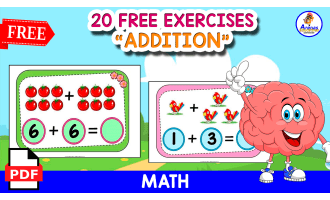
CAPYBARA ADDITION | 20 FREE EXERCISES


- Grades
- Pre-K–1, Elementary
- Pages
- 9
- File type
- Preparation
- Print ready


- Subject
- Math, Addition, Addition and Subtraction
- Topic
- Single-digit addition, Addition within 20
- Resource types
- Worksheets, Worksheets & Printables
- Preparation
- Print ready
- Standards
- 1.OA.C.6
Product description
From the author
Practice twenty single-digit addition problems with capybara illustrations. Four boxed equations appear on each of five activity pages, with space to write each sum.
The problems include zero facts and sums that cross ten, reaching fourteen. The nine-page color PDF includes five activity pages, a cover and publisher pages. Print pages 4–8 for student practice; no answer key is supplied.
Related resources
More resources teachers may find useful
24 related resources were found using this product's title, contributor, categories and tags.



In the classroom
Teaching tips & learning objectives

Learning objectives
- Add two single-digit numbers with sums up to 14.
- Practice zero facts and addition that crosses ten.
- Record sums in horizontal equations.

Teaching tips
- Use one four-problem page as a brief warm-up.
- Ask students to explain a strategy for sums that cross ten.
- Print the exercise pages, which appear on pages 4–8 of the file.

Skills covered
- Single-digit addition in horizontal form
- Counting on and making ten
- Recording numerical answers
Good to know
Questions teachers ask about this resource
How difficult do the problems get?
The set starts with zero facts and small sums (5 + 0, 1 + 3) and builds to sums in the teens such as 9 + 3, 7 + 4, and 8 + 6, so it spans beginning addition through crossing ten.

No reviews yet
Downloaded this resource? Tell other teachers how it went.
Curriculum
Standards, concepts & topics
Standards
 Standards
- 1.OA.C.6 — Add and subtract within 20, demonstrating fluency for addition and subtraction within 10. Use strategies such as counting on; making ten (e.g., 8 + 6 = 8 + 2 + 4 = 10 + 4 = 14); decomposing a number leading to a ten (e.g., 13 – 4 = 13 – 3 – 1 = 10 – 1 = 9); using the relationship between addition and subtraction (e.g., knowing that 8 + 4 = 12, one knows 12 – 8 = 4); and creating equivalent but easier or known sums (e.g., adding 6 + 7 by creating the known equivalent 6 + 6 + 1 = 12 + 1 = 13).
Core concepts
 Core concepts
Addition
Math fact fluency
Sums within 20
 Topics
Explore more
Categories this resource belongs to
Explore related searches
More to explore
You may also like