Combining Like Terms Color by Number – 10 Questions

- Grades
- Grade 9, High School
- File type
- Preparation
- Print ready


- Subject
- Math, Algebra
- Topic
- algebra, math center
- Resource types
- Worksheets & Printables, Worksheets
- Preparation
- Print ready
About this resource
What's inside this resource
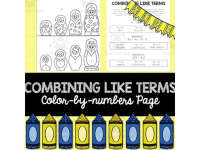
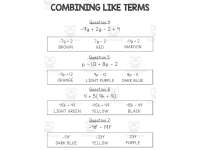
Combining Like Terms Color by Number is a 4-page printable to give students practice in an engaging way.
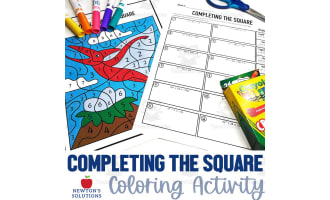
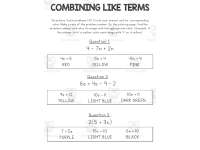
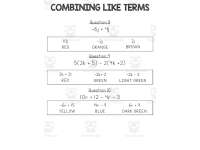
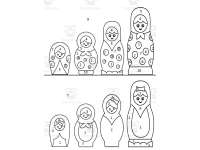
Students will answer 10 questions. The answer to each question will reveal the color they will use to color the picture.
When they finish, they will have a complete picture.
Answer key included.
Related resources
More resources teachers may find useful
24 related resources were found using this product's title, contributor, categories and tags.


In the classroom
Teaching tips & learning objectives

Learning objectives
Combine like terms in linear expressions, including those requiring the distributive property first.
Simplify expressions containing both positive and negative coefficients.
Self-check simplification work by comparing a finished picture's colors against the intended design.

Teaching tips
Each problem offers three plausible-looking answer choices (typically a sign error, a distribution error, and the correct answer), so this doubles as error-analysis practice — have students explain why the two incorrect options are common mistakes.
Hand out the answer key pages separately so students self-check by comparing their colored picture rather than copying answers directly.
Problems mix straightforward combining (questions 1, 2) with distributive-property expansion (questions 3, 6, 9), so sequence review accordingly if using it as a warm-up rather than all at once.

Skills covered
Combining like terms — students simplify linear expressions such as 6s + 4s − 9 − 2 into a single simplified term.
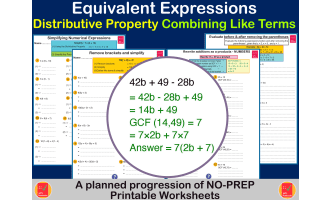
Distributive property — problems such as 2(5 + 3x) and 5(2k + 5) – 2(4k + 2) require expanding before combining terms.
Negative-coefficient arithmetic — several problems (e.g., −9g + 2g − 2 + 4, −4f − 19f) require correctly tracking negative signs through simplification.
Good to know
Questions teachers ask about this resource
How does the coloring page confirm whether a simplification is correct?
Each problem's three answer choices are each tied to a different color, so a student's finished picture only matches the intended design when every simplification was solved correctly.

No reviews yet
Downloaded this resource? Tell other teachers how it went.
Curriculum
Standards, concepts & topics
Standards
 Standards
- 7.EE.A.1 — Apply properties of operations as strategies to add, subtract, factor, and expand linear expressions with rational coefficients.
- 6.EE.A.3 — Apply the properties of operations to generate equivalent expressions. For example, apply the distributive property to the expression 3 (2 + x) to produce the equivalent expression 6 + 3x; apply the distributive property to the expression 24x + 18y to produce the equivalent expression 6 (4x + 3y); apply properties of operations to y + y + y to produce the equivalent expression 3y
Core concepts
 Core concepts
Combining like terms
Distributive property
Algebraic expressions
Negative coefficients
 Topics
Explore more
Categories this resource belongs to
Explore related searches
More to explore
You may also like