Comparing Fractions Worksheet

- Grades
- Grades 3–5, Elementary
- File type
- Preparation
- Print ready


- Subject
- Math, Fractions
- Topic
- Have Fun Teaching
- Resource types
- Worksheets & Printables, Worksheets
- Preparation
- Print ready
About this resource
What's inside this resource
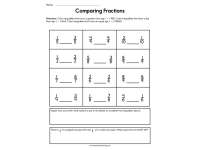
This Comparing Fractions Worksheet is a great way for students to practice identifying the size of fractions. By filling in the blanks with symbols, they will be able to show their understanding of the concept. This is a great resource for any teacher looking to help their students practice this skill.
Related resources
More resources teachers may find useful
24 related resources were found using this product's title, contributor, categories and tags.


In the classroom
Teaching tips & learning objectives

Learning objectives
Students will compare pairs of fractions and correctly identify each pair as greater than, less than, or equal to one another (page 1).
Students will explain in writing the reasoning behind a fraction comparison, such as attending to numerators when denominators match (page 1-2).
Students will apply fraction comparison to a real-world word problem to determine which of two quantities is larger (page 1).

Teaching tips
Have students complete the color-coding first, then check their own inequality symbols against the answer key before writing the explanation, since the key models one accepted style of reasoning.
Use the pizza word problem as a discussion starter about comparing fractions in everyday contexts before assigning the rest of the page independently.
Because the page uses pictorial fraction models rather than written fractions, review the visual models as a class first if students are not yet comfortable reading fraction pictures. Revisit the comparison symbols with whole numbers to ten before comparing fractions.

Skills covered
Fraction size comparison -- students judge twelve pairs of pictorial fractions and mark each with the correct greater-than, less-than, or equal-to symbol.
Mathematical reasoning and explanation -- students write out how they determined each comparison, building the habit of justifying a math answer in words.
Applying fraction comparison to context -- the pizza word problem asks students to translate a real-world scenario into a fraction comparison.
Good to know
Questions teachers ask about this resource
What kind of comparison symbols does this worksheet practice?
All three: greater than (>), less than (<), and equal to (=). Students color-code each of the twelve fraction pairs by which symbol applies, then write the correct symbol for each pair.

No reviews yet
Downloaded this resource? Tell other teachers how it went.
Curriculum
Standards, concepts & topics
Standards
 Standards
- 3. NF.A.3 — Explain equivalence of fractions in special cases, and compare fractions by reasoning about their size. a. Understand two fractions as equivalent (equal) if they are the same size, or the same point on a number line. b. Recognize and generate simple equivalent fractions, e.g., 1/2 = 2/4, 4/6 = 2/3). Explain why the fractions are equivalent, e.g., by using a visual fraction model. c. Express whole numbers as fractions, and recognize fractions that are equivalent to whole numbers. Examples: Express 3 in the form 3 = 3/1; recognize that 6/1 = 6; locate 4/4 and 1 at the same point of a number line diagram. d. Compare two fractions with the same numerator or the same denominator by reasoning about their size. Recognize that comparisons are valid only when the two fractions refer to the same whole. Record the results of comparisons with the symbols >, =, or <, and justify the conclusions, e.g., by using a visual fraction model.
- 4.NF.A.2 — Compare two fractions with different numerators and different denominators, e.g., by creating common denominators or numerators, or by comparing to a benchmark fraction such as 1/2. Recognize that comparisons are valid only when the two fractions refer to the same whole. Record the results of comparisons with symbols >, =, or <, and justify the conclusions, e.g., by using a visual fraction model.
Core concepts
 Core concepts
comparing fractions
greater than and less than
fraction models
Topics
 Topics
Explore more
Categories this resource belongs to
Explore related searches
More to explore
You may also like