Counting Groups of 10 Activity

- Grades
- Grades 1–2, Elementary
- Pages
- 8
- File type
- Preparation
- Print ready


- Subject
- Math, Early Math, Counting
- Topic
- Groups of Ten, Base Ten
- Resource types
- Activities
- Preparation
- Print ready
- Standards
- 1.NBT.B.2
Product description
From the author
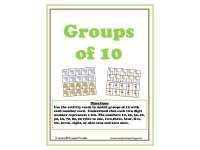
This activity is perfect for helping students learn to count by 10s. By using the ten frames, students will be able to see the patterns in our number system and count all the way to 120. This is a great way to build number sense!
Related resources
More resources teachers may find useful
24 related resources were found using this product's title, contributor, categories and tags.
In the classroom
Teaching tips & learning objectives

Learning objectives
Match a two-digit multiple of ten to the correct number of ten-groups.
State that a number like 50 represents five tens and zero ones.

Teaching tips
- Have students count the ten-groups aloud before choosing a number card.
- Check a match by explaining the number of tens and the total number of objects.

Skills covered
- Counting objects in groups of ten
- Matching a numeral to its quantity
- Describing multiples of ten as tens and zero ones
Good to know
Questions teachers ask about this resource
Which number cards are supplied?
The cards cover multiples of ten from 10 through 100, plus 120. There is no 110 card in the supplied set.

No reviews yet
Downloaded this resource? Tell other teachers how it went.
Curriculum
Standards, concepts & topics
Standards
 Standards
- 1.NBT.B.2 — Understand that the two digits of a two-digit number represent amounts of tens and ones. Understand the following as special cases: a. 10 can be thought of as a bundle of ten ones — called a “ten.” b. The numbers from 11 to 19 are composed of a ten and one, two, three, four, five, six, seven, eight, or nine ones. c. The numbers 10, 20, 30, 40, 50, 60, 70, 80, 90 refer to one, two, three, four, five, six, seven, eight, or nine tens (and 0 ones).
Core concepts
 Core concepts
Place value
Tens and ones
Skip counting
Topics
 Topics
More to explore
You may also like