24 related resources

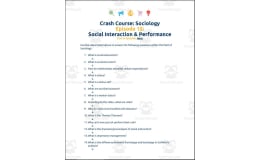
Crash Course Sociology #1: What is Sociology? Digital Student Worksheet

Fifteen video-comprehension questions tied to the Crash Course Sociology episode 'What is Sociology?' cover the sociological perspective, social location, and marginalization, with a full answer key provided.
Grades
Grades 7–12, Middle School, High School
Pages
2
File type
Zip

Updated Feb 21, 2024

Subject
Social Studies, Sociology
Topic
sociology video worksheet, sociology concepts questions
Resource types
Worksheets & Printables, Worksheets

About this resource

What's inside this resource

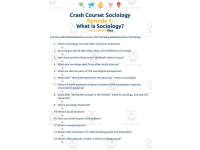
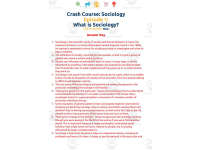
Fifteen comprehension questions guide students through watching the Crash Course Sociology episode 'What is Sociology?', asking them to define sociology and trace its origin with Auguste Comte, explain the two-part 'sociological perspective' (seeing the general in the particular and the strange in the familiar), and define key terms including social location, marginalization, and power and inequality. Each question is provided in a blank worksheet format (with a lettered answer line beneath each item) as both a Word document and matching PDF, alongside a fully completed answer key in the same two formats giving a full paragraph response for every question, such as explaining that social location classifies a person by race, class, gender, and other social groupings. The set is built as a video-response worksheet for an assigned watch-and-answer activity rather than in-class discussion questions.

Product description

From the author

Crash Course Sociology Digital Student Worksheet - What is Sociology? provides students with a scaffolded note-taking experience to accompany the first video in the acclaimed Crash Course sociology series. With this supplemental resource, educators can seamlessly integrate the popular YouTube video into their lesson to give students critical thinking questions that dig deeper into key concepts. Over 15 stand-alone questions formatted as a digital worksheet guide learners to analyze topics like the definition of sociology, seeing patterns in society, understanding marginalization, and more. Detailed answer keys are included so teachers can provide actionable feedback. This accessible resource works for in-class videos, substitute plans, homework, or catch-up work.

In the classroom

Teaching tips & learning objectives

Learning objectives

  • Define sociology and explain its historical origin, including Auguste Comte's role

  • Explain the two-part sociological perspective: seeing the general in the particular and the strange in the familiar

  • Define social location and explain how it can limit an individual's choices

  • Define marginalization and describe its relationship to power and inequality in society

Teaching tips

  • Assign the video and worksheet as a flipped-classroom or homework task, then use the answer key to lead a follow-up discussion rather than simply collecting it for a grade

  • Focus discussion on questions 5-8, since they cover the more abstract 'sociological perspective' concept that students are more likely to need help articulating in their own words

  • Have students compare their own worded answers to the answer key's paragraph responses to practice academic writing, not just memorize facts

  • Use question 10-12 (social location and marginalization) as a bridge into a broader discussion of current social issues relevant to your students

Skills covered

  • Video-based note-taking and comprehension — students extract and record definitions and explanations directly from a Crash Course video episode.

  • Sociological perspective application — students explain 'seeing the general in the particular' and 'seeing the strange in the familiar' as sociological thinking tools.

  • Key-term definition — students define social location, marginalization, and forms of power and inequality in their own words.

Good to know

Questions teachers ask about this resource

What is the difference between 'seeing the general in the particular' and 'seeing the strange in the familiar' as used in this worksheet?

'Seeing the general in the particular' means looking for broad social patterns behind individual choices, while 'seeing the strange in the familiar' means examining everyday, normal-seeming behavior as if encountering it for the first time to reveal the larger societal patterns shaping it.

No reviews yet

Downloaded this resource? Tell other teachers how it went.

Resource details

Concepts & topics

More to explore

You may also like