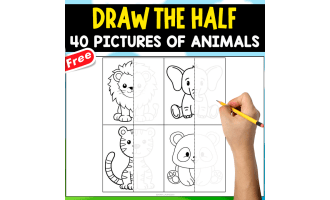
DRAW THE HALF - Developing Attention and Concentration

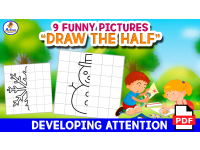


About This Product
1. Introduction
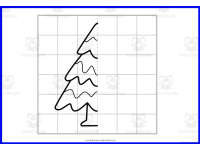
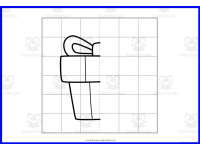
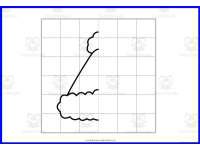
As is known by educational agents, making drawings of symmetrical figures offers various advantages and/or benefits for the cognitive, motor and creative development of students. For this reason, today I present to you this fantastic worksheet.
2.Objective
The purposes of this educational sheet are:
- Develop fine motor coordination: Drawing symmetrical figures involves drawing lines and shapes with precision. This process helps improve children's fine motor coordination, since they must learn to precisely control the movement of their hands and fingers to then achieve symmetry in the drawing.
- Promote visual perception: When we draw symmetrical figures, students are required to observe carefully and understand what symmetry is like in relation to a central axis. This will help and contribute to the development of visual perception, understanding of patterns, shapes in the environment as well as the ability to recognize patterns.
- Stimulate logical thinking: As is known, symmetry implies a sense of balance and order. When we draw symmetrical figures, children will be applying logical principles to ensure that both sides of the figure or object are equal. This will help foster logical thinking and reasoning skills.
- Promote creativity and aesthetics: Although you may be thinking that symmetry follows patterns and rules, believe it or not, it still leaves spaces for the student to develop their creativity. You should know that, thanks to this fantastic activity, children will be able to play with designs, colors and details on both sides of the figure or object, which will help promote artistic expression and the development of the aesthetic sense.
- Understand basic mathematical concepts:
You should know that symmetry is also related to basic mathematical concepts such as equality of lengths, equality of angles on opposite sides of the figure as well as the well-known axis of symmetry. By drawing symmetrical figures, you will introduce your children or students to all these concepts in a practical and visual way.
3.Order, scheme and stages
Introduce your class creatively through a motivating dynamic that awakens children's interest.
Then just enter the worksheet.
4.Grades or ages
This worksheet can be developed by children from 4 to 9 years old.
5. Form of application
Print this sheet and apply it individually.
6. Answer keys
This game does not require answers.
7.Use text labels
drawing, draw, draw for kids, art, activity art.
8.Rules
Specified above.
9.File types
The archive is in PDF format.
10.Number of pages
This document contains 9 pages.
Resource Tags
0 Reviews
Check out these other great products