


Endothermic and Exothermic Reactions Lab



About This Product
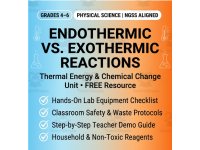
What you're getting from the FREE document
Curriculum Overview & Educational Value
Master Materials & Equipment Checklist (Per Group of 4)
Laboratory Safety Protocols & Waste Management
----------- Here is the info of the full version -----------
Teach endothermic and exothermic reactions in Grades 4–6! Features baking soda and yeast labs, temperature graphing, STEM design, rubric & answer key.
Take the mystery out of chemical energy transfer with this complete, classroom-tested Grade 4–6 Endothermic vs. Exothermic Reactions Unit! Students explore the Greek roots of energy words, conduct two hands-on laboratory experiments measuring perceptible temperature drops and spikes, graph dual thermal trajectories, and engineer their own outdoor emergency rescue packs.
Product Description
Chemical reactions can seem abstract to upper elementary and early middle school students until they physically feel a beaker turn ice-cold or watch warm foam rise to the brim. This 11-page comprehensive curriculum framework bridges physical observation with quantitative data collection.
Using simple, grocery-store-safe reagents (baking soda, vinegar, household hydrogen peroxide, and yeast), students investigate the fundamental law of conservation of energy: energy is neither created nor destroyed—it transfers between the reacting chemical system and its surroundings.
What’s Included in This 11-Page Comprehensive Pack?
1. Teacher Instructional Blueprints & Pacing Guides (Lessons 1–5)
Lesson 1: Thermal Energy on the Move & System Etymology — Breaks down Greek word roots (exo-, endo-, therme) and establishes the foundational System vs. Surroundings model so students understand why a thermometer drops during an endothermic reaction.
Lesson 2: Lab 1 — The Freeze Factor (Endothermic Reaction) — Step-by-step facilitation protocol for reacting sodium bicarbonate with acetic acid, tracking the drop from room temperature down.
Lesson 3: Lab 2 — The Heat Wave (Exothermic Reaction) — Protocol for decomposing hydrogen peroxide using active yeast catalase (or calcium chloride dissolution), capturing a exothermic thermal release.
Lesson 4: Data Modeling, Dual Graphing & Chemical Bonds — Guides students through plotting both reaction curves on a single coordinate grid, comparing rates of change, and understanding bond breaking (energy absorbed) versus bond making (energy released).
Lesson 5: STEM Engineering Challenge (Alpine Rescue Pack) — Connects lab science to real-world biomedical engineering as students design an emergency hot or cold pack for mountain hikers.
2. Five Dedicated Student Lab Worksheets (No-Prep, Single-Page Prints)
Worksheet 1: Pre-Lab Concept & Etymology Decoder — Etymology word-building puzzles, a "System vs. Surroundings" visual labeling diagram, and touch-perception prediction prompts.
Worksheet 2: Lab Log 1: The Freeze Factor (Endothermic Investigation) — Structured 7-interval temperature data table (0:00 to 3:00), \(\Delta T\) mathematical calculation box (\(T_f - T_i\)), qualitative sensory notes, and energy flow reasoning.
Worksheet 3: Lab Log 2: The Heat Wave (Exothermic Investigation) — 7-interval timed data table, \(\Delta T\) calculation, chemical change evidence checklist, and thermal release justification.
Worksheet 4: Dual Line Graph: Comparing Thermal Trajectories — Custom-scaled graphing grid with room-temperature baseline (\(21^\circ\text{C}\)), slope-rate analysis, and thermal equilibrium prediction questions.
Worksheet 5: STEM Engineering Design Blueprint: Alpine Rescue Pack — Real-world design brief with clear criteria and constraints, dedicated prototype blueprint sketch box, chemical reagent selection, and puncture-proof safety justifications.
3. Standards-Based Assessment & Master Reference Tools
Formative Assessment Rubric: A 4-tier rubric (Emerging, Developing, Proficient, Advanced) evaluating conceptual vocabulary, quantitative measurement precision, graphical modeling, and engineering design synthesis.
Formative Exit Ticket: A 3-question quick check evaluating student understanding of heat transfer directionality, mathematical sign conventions (positive vs. negative \(\Delta T\)), and molecular bond energy.
Teacher Master Answer Key: Complete solutions, realistic benchmark laboratory data sets, and grading criteria for all student worksheets and the exit ticket.
Standards Alignment
NGSS 5-PS1-4: Conduct an investigation to determine whether the mixing of two or more substances results in new substances.
NGSS MS-PS1-4: Develop a model that predicts and describes changes in particle motion, temperature, and state of a pure substance when thermal energy is added or removed.
NGSS MS-PS1-6: Undertake a design project to construct, test, and modify a device that either releases or absorbs thermal energy by chemical processes.
CCSS.MATH.PRACTICE.MP4: Model with mathematics through quantitative temperature graphing and delta calculations.
Why Teachers Love This Resource
Budget-Friendly & Safe: Uses inexpensive grocery items (baking soda, vinegar, active dry yeast, and 3% household hydrogen peroxide) with no hazardous chemical disposal requirements.
Zero Spillage Page Formatting: Every student worksheet and teacher reference tool fits onto its own dedicated page—no messy trailing lines or awkward overflows.
Clear Conceptual Anchors: Solves the common student misconception that "cold packs produce cold" by explicitly demonstrating that endothermic reactions absorb heat away from their surroundings.
Resource Tags
0 Reviews
Check out these other great products


