ESL Reading Comprehension + Writing Activity Worksheets on Peter Pan

- Grades
- Grades 7–12
- Pages
- 3
- File type
- Preparation
- Print ready


- Subject
- ELA, ESL, Reading Comprehension
- Topic
- ESL, English
- Preparation
- Print ready
- Standards
- CCSS.RI.8.1
Product description
From the author
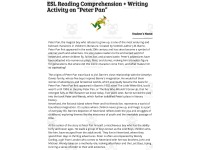
This English Second Language Teaching Resource on Peter Pan (3 PDF Slides; Reading Comprehension + Writing Activity) can be ideal to train Language skills in English. Suitable participants for this ESL EFL TESOL Reading + Writing Activity are Foreign Students at middle and High School (7th-12th Grade; teens).
This activity is intended for intermediate to advanced English learners. This Teaching Educational Resource Product can also be ideal for ESL EFL Centers worldwide or any English second language tutor.
This ESL EFL TESOL Teaching Resource on Peter Pan (Worksheet; 3 PDF Printable slides) is ideal for intermediate advanced English as a Second or Foreign Language (ESL EFL) Learners.
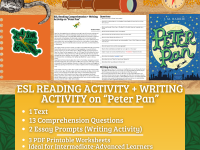
Within this ESL Reading Comprehension + Essay Writing Activity Worksheet on Peter Pan (fictional character by J.M Barrie) is included:
1 text on Peter Pan (fictional character by J.M Barrie)
13 Questions on the text
2 Essay Prompts for ESL Writing Activity (writing an essay on your own personal opinion on Peter Pan and whether you have ever read or watched it + writing an essay on your own opinion on whether you agree on Peter Pan's fear to grow up or whether you agree more with Wendy's point of view; it's important to accept to grow up)
This ESL, EFL Teaching Resource Reading + Writing Activity on Peter Pan (3 PDF Printable Slides; worksheets) is great for Intermediate advanced English as a second or foreign language learners (ESL- EFL). This English Second Language Worksheet on Peter Pan (fictional character by J.M Barrie) provides reading-comprehension and writing practice.
Learning with Alan is a Teaching Resources and Educational Material Store whose aim is to help English as a Second or foreign Language Teachers, Educators and Tutors worldwide (be it online or offline) to achieve their ESL EFL TESOL TEFL teaching objectives while creating a fun and stimulating environment. Never Forget! Learning is fun, So should English! Always
If you want to browse more PDF ESL, EFL, TESOL Teaching Resources and Educational Material click here Learning with Alan!
Related resources
More resources teachers may find useful
24 related resources were found using this product's title, contributor, categories and tags.

In the classroom
Teaching tips & learning objectives

Learning objectives
Students will recall factual details from an informational text, such as the author, publication dates, and character roles.
Students will explain the meaning of vocabulary and expressions in context, such as 'escapist' and 'to hold on.'
Students will write an extended personal or persuasive response connecting the text's themes to their own opinions.

Teaching tips
Preview vocabulary such as 'escapist,' 'nemesis,' and the idiom 'to hold on' before assigning the passage, since two questions ask students to define or explain them in context.
The Tinker Bell true/false question asks students to argue their answer from the text, not just answer yes or no — model how to cite the passage before students attempt it independently.
Because both writing prompts ask for personal opinion and are longer-form, consider assigning them as a follow-up writing block rather than in the same sitting as the 13 comprehension questions.

Skills covered
Reading comprehension — students answer 13 factual and inferential questions about an informational passage on Peter Pan.
Textual evidence and argumentation — students argue whether a true/false statement about Tinker Bell's personality is supported by the passage.
Extended written response — students write a personal reflection essay and a persuasive response comparing Peter's and Wendy's viewpoints.
Good to know
Questions teachers ask about this resource
Do the writing prompts require outside research, or can students answer from the passage and their own opinions?
Both prompts ask for personal reflection and opinion — whether students enjoyed the story and which side of the Peter-versus-Wendy debate they favor — so they can be answered directly from the reading and the student's own experience, without outside research.

No reviews yet
Downloaded this resource? Tell other teachers how it went.
Curriculum
Standards, concepts & topics
Standards
 Standards
- CCSS.RI.8.1 — Cite the textual evidence that most strongly supports an analysis of what the text says explicitly as well as inferences drawn from the text.
Core concepts
 Core concepts
Reading comprehension
Textual evidence
Vocabulary in context
Persuasive and reflective writing
 Topics
Explore more
Categories this resource belongs to
Explore related searches
More to explore
You may also like