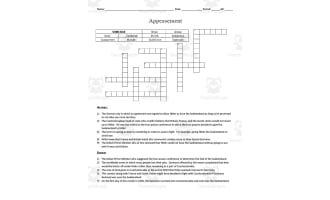
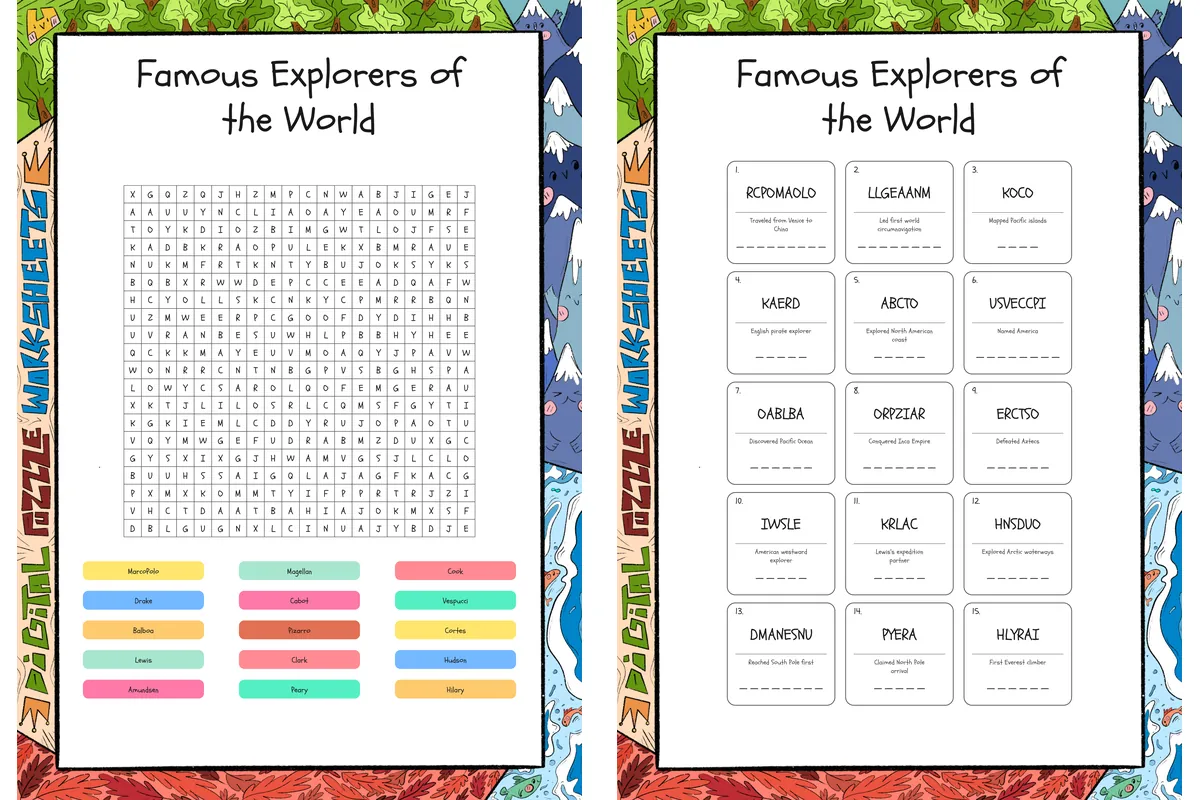
Famous Explorers of the World word search, scramble and crossword
- Grades
- Grades 4–6, Elementary, Middle School
- Pages
- 6
- File type
- Answer key
- Included


- Subject
- ELA, Vocabulary, Geography
- Topic
- word search, word scramble
- Resource types
- Word Searches, Worksheets, Worksheets & Printables, Crosswords Puzzles
- Answer key
- Included
About this resource
What's inside this resource
I made this famous explorers puzzle set for my 4th graders during our world history unit. The kids could name Columbus but had no idea about Magellan, da Gama, Cook, or other explorers from around the globe. So I put together a word search, a word scramble, and a crossword using words like Columbus, Magellan, da Gama, Cook, Cabot, Hudson, Pizarro, Cortes, Lewis, Clark, exploration, voyage, discovery, route, and navigation. Nothing fancy — just puzzles to help the names and their accomplishments finally stick.
The PDF is four pages. Three puzzles plus one answer key page. The word search works well for quiet time after recess. The scramble gets them talking because they argue about who was the first to circumnavigate the globe. The crossword I use for partners. I added a couple simple ship and compass drawings but nothing too busy.
Works for 4th through 5th grade. Print and go. Sometimes I have early finishers pick one explorer and write what they discovered on the back. The kids actually ask for these now.
Related resources
More resources teachers may find useful
24 related resources were found using this product's title, contributor, categories and tags.



In the classroom
Teaching tips & learning objectives

Learning objectives
Name the explorer behind a stated achievement — Amundsen for the South Pole, Magellan for the first circumnavigation, Balboa for reaching the Pacific Ocean
Separate explorers who are easily confused with one another: Cortes in Mexico against Pizarro in Peru, Lewis against Clark as expedition partners, Cabot against Hudson on North American waters
Spell fifteen explorer surnames accurately, including Amundsen, Vespucci and Pizarro, when reconstructing them from jumbled letters

Teaching tips
Running the scramble before the crossword turns the crossword into a recall check: the two share the same fifteen clue lines, but the scramble also hands students the letters.
The answers are names rather than concepts, so a world map pairs naturally with the set — Marco Polo's route to China, Hudson's Arctic waterways and Amundsen's South Pole can be placed against one another as students solve.
Several clues compress contested history into three or four words — "English pirate explorer", "Defeated Aztecs", "Conquered Inca Empire", "Discovered Pacific Ocean" — so allow a few minutes to unpack them with older classes.

Skills covered
Explorer identification — students turn a single achievement clue such as "Reached South Pole first" or "Mapped Pacific islands" into the name Amundsen or Cook.
Proper-name spelling — students rebuild surnames from jumbled letters, working USVECCPI into Vespucci and DMANESNU into Amundsen.
Crossword grid reasoning — students use intersecting letters and the twelve-number layout, where 7, 11 and 12 each begin a word in both directions, to place fifteen answers.
Good to know
Questions teachers ask about this resource
Which achievement does each clue attach to a name?
Amundsen reached the South Pole first, Magellan led the first world circumnavigation, Cook mapped Pacific islands, Hudson explored Arctic waterways, Drake is the English pirate explorer, Cortes defeated the Aztecs, Pizarro conquered the Inca Empire, Balboa is credited with the Pacific Ocean, Vespucci with naming America, Cabot with the North American coast, Marco Polo with travelling from Venice to China, Lewis is the American westward explorer with Clark as his expedition partner, Peary claimed the North Pole and Hilary is named as the first Everest climber. Columbus is not one of the fifteen.
How do the crossword and the scramble differ if they use the same clues?
The scramble hands students the letters as well as the clue — DMANESNU sits under "Reached South Pole first" with a blank line eight characters long — while the crossword gives only the clue and the intersecting letters already in the grid, which makes it the harder of the two on the same content.
Why does the crossword number only run to twelve when there are fifteen clues?
Three numbers start a word in both directions. Seven is Marco Polo across and Magellan down, eleven is Hudson across and Hilary down, and twelve is Pizarro across and Peary down, so twelve grid numbers carry seven across clues and eight down clues.

No reviews yet
Downloaded this resource? Tell other teachers how it went.
Resource details
Concepts & topics
Core concepts
 Core concepts
Age of Exploration
Explorer identification
Social studies vocabulary
 Topics
Explore more
Categories this resource belongs to
Explore related searches
More to explore
You may also like