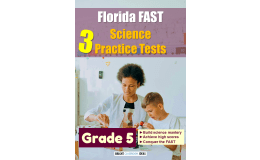
Florida (FAST) Science Practice Test for Grade 5


- Grades
- Grade 5
- Pages
- 34
- File type
- Answer key
- Included


- Subject
- Science
- Topic
- Florida FAST, Grade 5 science
- Resource types
- Assessments, Worksheets
- Answer key
- Included
Product description
From the author
Science Practice Questions for Grade 5
Help your students master key science concepts and feel confident on test day with this Grade 5 Science Practice Set! The questions provide review across physical, life, Earth and space science, and scientific inquiry.
📦 What’s Included
✅ 66-question Grade 5 Science Practice Set (multiple choice)
✅ Covers all domains: Physical, Life, Earth & Space, and Nature of Science
✅ Detailed Answer Key with explanations for every question
✅ Teacher’s Guide with pacing, differentiation, and reteaching strategies
Includes a printed benchmark list; full item-level alignment has not been verified
✅ Print & digital-friendly format
🏫 How It Works in the Classroom
This Grade 5 Science Practice Set is flexible and easy to implement:
Use as a classroom diagnostic or review (60–90 minutes)
Assign sections for targeted review by domain (Physical, Life, Earth/Space Science)
Use for selected science review before an assessment
Incorporate questions into centers, small groups, or exit tickets
Perfect for independent practice, homework, or sub plans
The student directions (page 2) guide test-taking strategies like annotation, elimination, and time management for success.
Science Topics
The questions cover topics including:
Physical Science (energy, forces, matter, heat transfer)
Life Science (ecosystems, cells, adaptations, body systems)
Earth & Space Science (weather, water cycle, solar system, plate tectonics)
Nature of Science (scientific method, variables, data analysis)
💛 Why Teachers Love It
⭐ Saves time with a complete, ready-to-use assessment
⭐ Includes detailed explanations for reteaching and review
⭐ Supports data-driven instruction and targeted intervention
⭐ Easy to differentiate using teacher guide strategies
Make science test prep simple and effective with this Grade 5 Science Practice Set! Add it to your classroom today and help your students build confidence and review the science topics they have studied.
Related resources
More resources teachers may find useful
24 related resources were found using this product's title, contributor, categories and tags.


In the classroom
Teaching tips & learning objectives

Learning objectives
Explain everyday physical events in terms of heat transfer, force and energy — why ice melts on a table, why a pushed box stops, why a compressed gas occupies less volume
Trace energy through an ecosystem from producers to consumers and predict what happens to one population when another changes
Sit a timed multiple-choice science paper at roughly one minute per question, choosing the BEST option and eliminating weak choices when unsure

Teaching tips
Choose questions that match your taught curriculum; the set includes concepts beyond introductory fifth-grade science.
Use the answer explanations to discuss reasoning and identify topics for follow-up.
Florida’s grade 5 science assessment is the Statewide Science Assessment. The original file’s FAST naming and claims of matching the official format and distribution are inaccurate.

Skills covered
Physical science reasoning — 17 items cover heat transfer, chemical versus physical change, force and acceleration, potential and kinetic energy, conductors, refraction and the compression of gases.
Life science reasoning — 19 items span body systems, cell structures, photosynthesis and cellular respiration, adaptation, populations and communities, and predator-prey and mutualistic relationships.
Timed test technique — the directions set roughly one minute per question, ask for the BEST of four options and prompt process of elimination, against a scored answer line.
Good to know
Questions teachers ask about this resource
Should I assign the whole test or select questions?
Select questions that match your students’ prior learning. The set ranges across several science domains and includes some more advanced concepts, so a focused group of questions may be more useful than the whole test.

No reviews yet
Downloaded this resource? Tell other teachers how it went.
Resource details
Concepts & topics
Core concepts
 Core concepts
Physical science
Life science
Earth and space science
Nature of science
Test preparation
 Topics
Explore more
Categories this resource belongs to
Explore related searches
More to explore
You may also like