Free Spanish LA Skills and Activities 4th Grade / Lenguaje



- Grades
- Grade 4
- Pages
- 67
- File type
- Answer key
- Included


- Subject
- Foreign Languages, Spanish, Language Development
- Topic
- Spanish language arts, Daily warm-ups
- Resource types
- Task Cards
- Answer key
- Included
Product description
From the author
Free Spanish Language Skills and Activities for 4th Grade provides 67 pages of printable activities to help students practice and strengthen their Spanish language abilities. This teaching resource targets key skills like reading, writing, speaking, and listening. Teachers can use the versatile activities for whole group instruction, small group practice, or as independent work. The varied activities allow students to work at their own pace on skills where they need additional support. Topics span 4th grade Spanish curriculum from basic conversational phrases to grammar concepts like adjectives and verbs. Teachers appreciate the ready-to-go format - simply print, laminate if desired, and add to literacy centers or station rotation. Follow our ShapeUp-N-Matematicas y Lenguaje store for similar activities covering kindergarten through 5th grade Spanish.
Related resources
More resources teachers may find useful
24 related resources were found using this product's title, contributor, categories and tags.
In the classroom
Teaching tips & learning objectives

Learning objectives
Clasificar sustantivos por número y por carácter colectivo o individual, distinguiendo pares como rebaño y oveja, jauría y perro, archipiélago e isla
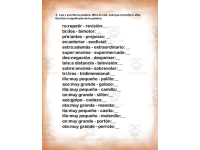
Identificar la raíz de una palabra y el significado que aportan prefijos y sufijos como bi-, pre-, extra-, tele-, -illo, -azo y -ote
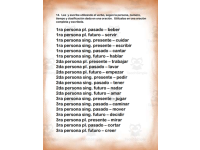
Ordenar palabras sueltas en una oración correcta, subrayar sujeto y predicado e indicar el tiempo verbal

Teaching tips
The instruction page assumes a folder or a manila envelope of at least 10 by 13 inches: the cover goes on the front, the instructions on the back, and the cards live inside ready to pull out
Have each child keep a notebook or diary for the daily work rather than writing on the cards, which keeps one laminated set going all year
The riddle and compound-word cards print their answers reversed underneath, so a child can check by reading backwards - useful for early finishers working alone

Skills covered
Morfología - los alumnos separan raíz, prefijo y sufijo en palabras como revisión, bimotor, supermercado, palillo y golazo, y escriben el significado resultante.
Sintaxis - una serie de oraciones desordenadas ("troncos en muy rio los flotan el rápido") se reorganizan, se subrayan sujeto y predicado y se indica el tiempo verbal.
Ortografía y acentuación - reglas de b, v, g y j, sílaba tónica y clasificación en agudas, graves o esdrújulas, más diptongos, triptongos e hiatos.
Good to know
Questions teachers ask about this resource
What language are the instructions and the activities in?
Spanish throughout, including the teacher's preparation and routine notes. The cards are written for a fourth-grade Spanish language-arts programme - gentilicios, diptongos e hiatos, sílaba tónica - rather than as beginner Spanish for English speakers.

No reviews yet
Downloaded this resource? Tell other teachers how it went.
Resource details
Concepts & topics
Core concepts
 Core concepts
Lenguaje
Gramática española
Ortografía
Vocabulario
Expresión escrita
 Topics
Explore more
Categories this resource belongs to
Explore related searches
More to explore
You may also like