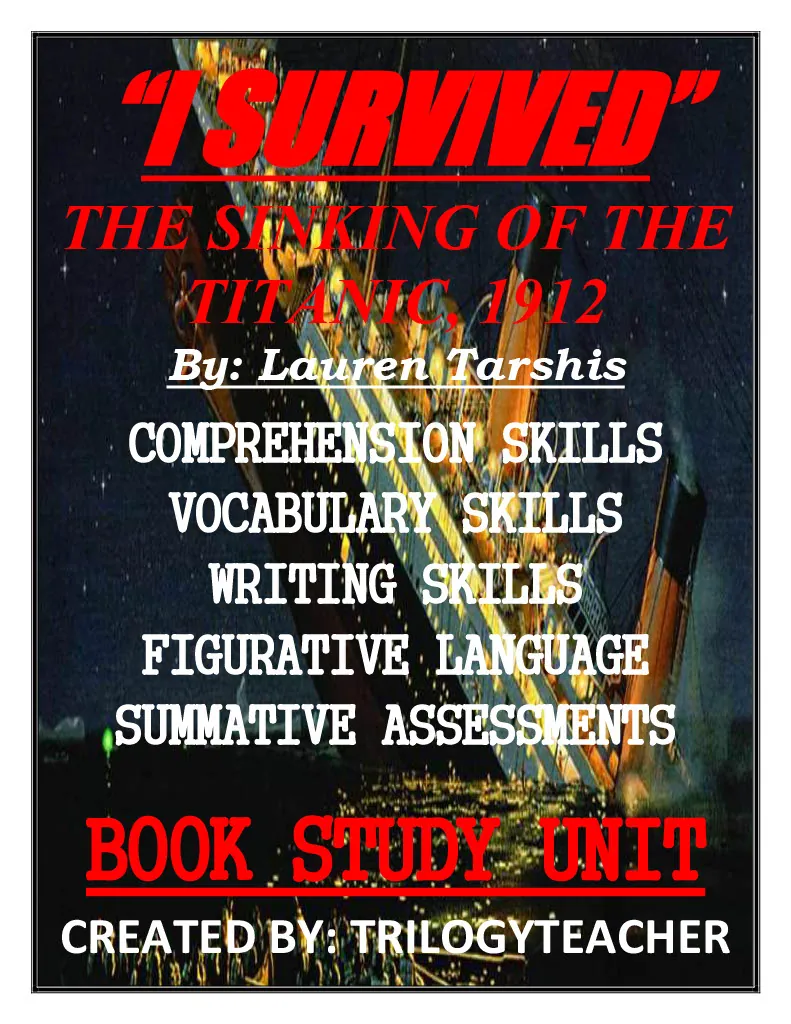
"I Survived" The Sinking of the Titanic, 1912" Novel Study Unit
- Grades
- Grades 5–7
- Pages
- 129
- File type
- Answer key
- Included


- Subject
- ELA, Reading
- Topic
- I Survived Titanic, Novel study
- Resource types
- Worksheets
- Answer key
- Included
- Standards
- RL.6.1
Product description
From the author
This is a Book Study Unit for "I Survived: The Sinking of the Titanic, 1912."
This 129-page Comprehension/Assessment/Book Study Unit Includes:
16 Chapter Comprehension Work Sheets!
16 Chapter Mystery Match Vocabulary Words Using Context Clues & Mystery Fun Blanks!
16 Student Score Part for Each Work Sheet!
16 Five Pt. CCSS Multiple Choice Exit Quizzes (1 for each Chapter) to Challenge Their Testing Skills! Each quiz has a variety of vocabulary using context clues, figurative language, inferencing, main ideas, themes, comprehension, tone, homophones, synonyms, & More!
A 25 Point Summative or Final Multiple Choice Test!
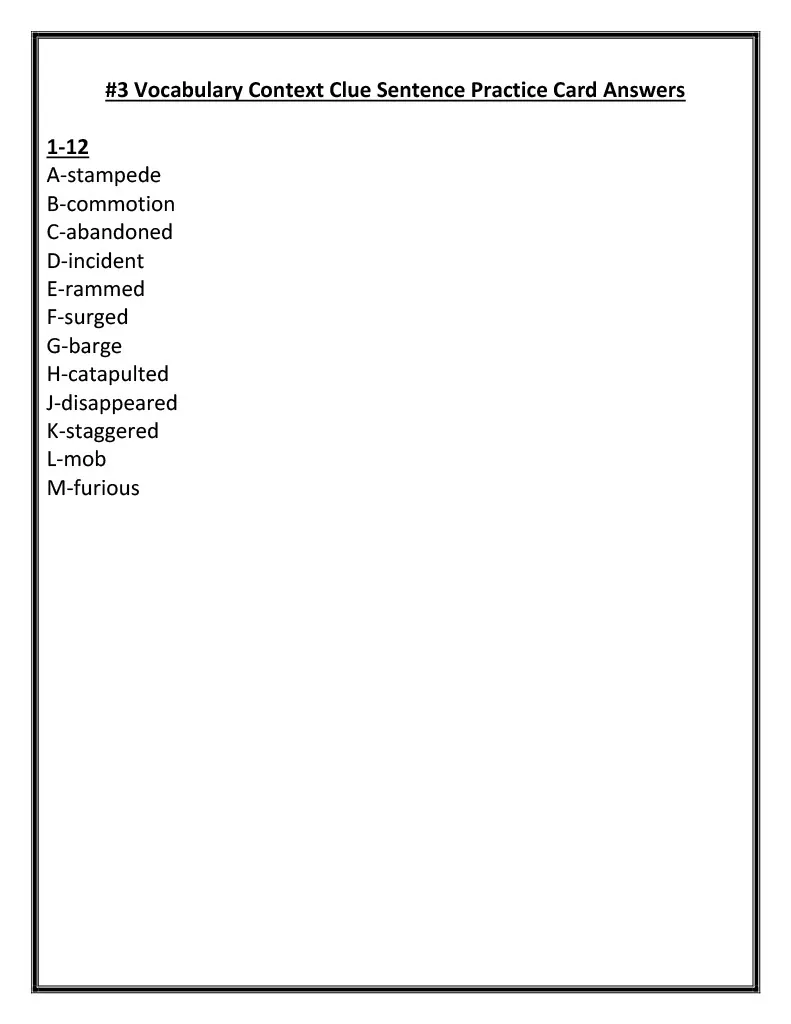
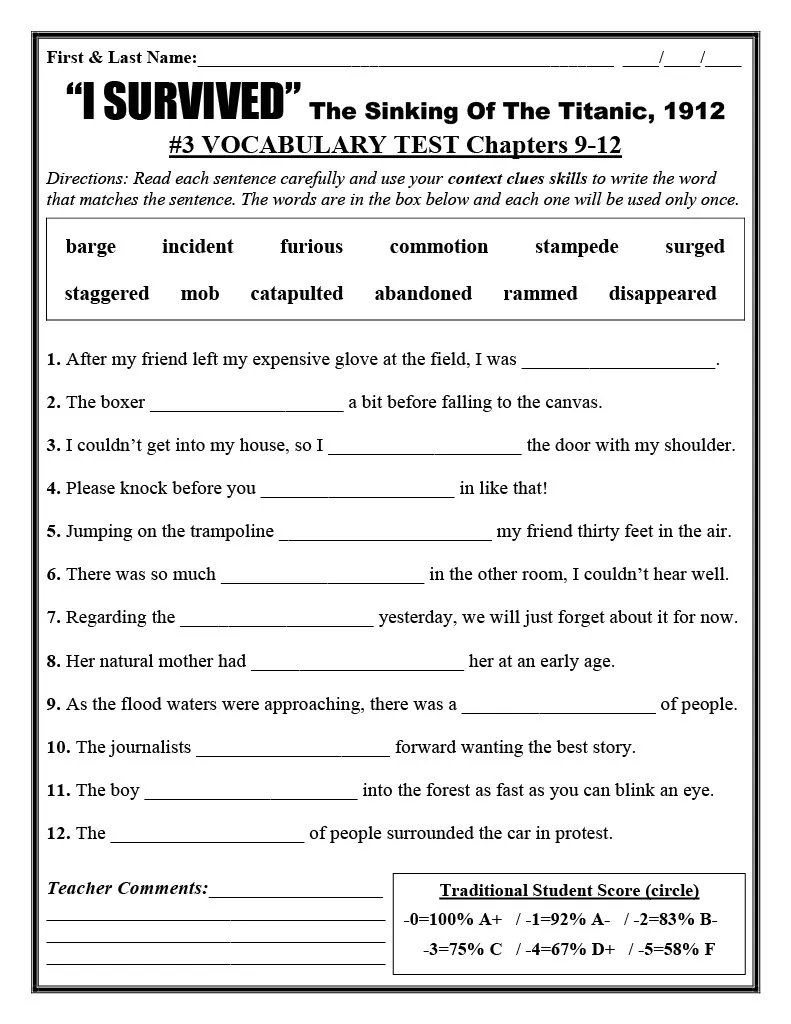
4 Vocabulary Twelve Point Fill-In-The-Blank Context Clue Tests (1 every Four Chapters) from the Mystery Match Vocabulary Words along with 48 Context Clue Practice Sentence Cards to help with the tests! Great for group activities, too! A WordArt Vocabulary Template, too, to Learn words in a fun, artistic way!
An 11-Point Fun and Engaging Historical Scavenger Fact Hunt at Very End of Book for Individual or Group work!
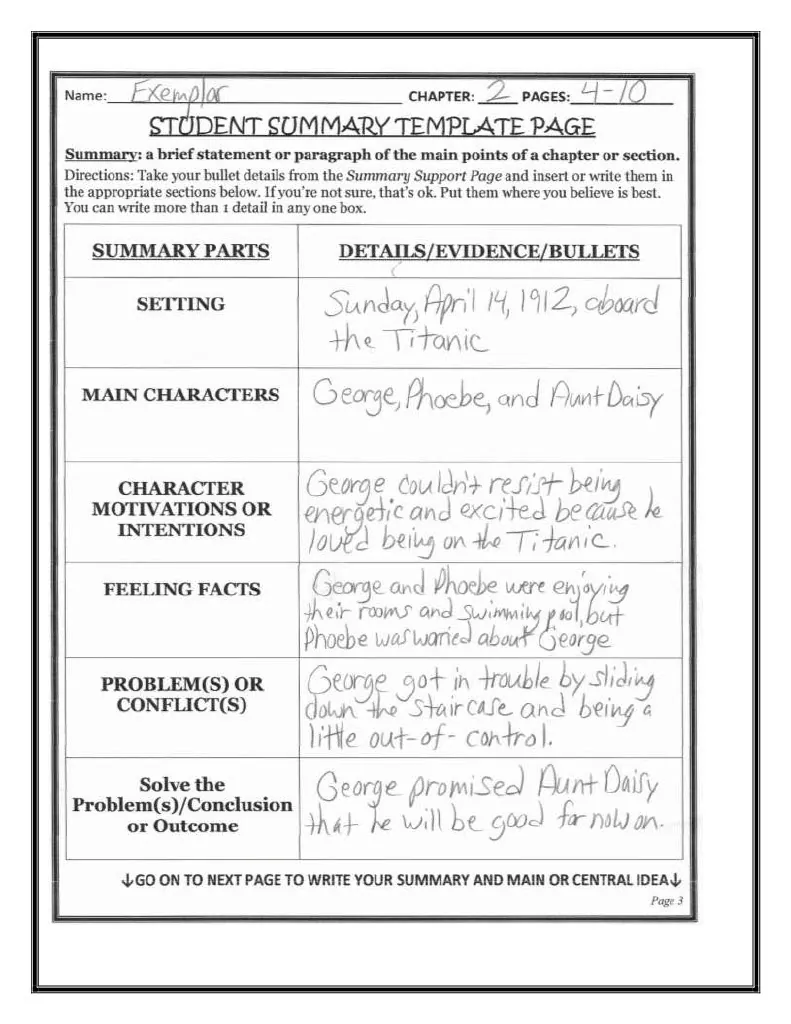
4 Engaging and Fun Writing Research & Writing Prompts!
A Student Reading Reference Page to Help with Reading/English Skills!
Key Standards: Themes; Main Ideas; Summaries; Inferencing; Engaged Discussions; Meanings of Unknown Words Using Context Clues; Vocabulary; Tone; Understanding and Identifying Figurative Language; Using Text Evidence; Comprehension; Cross Curricular Math, Science, Social Studies, Homophones; Setting; Synonyms; Point-of-View; Compound Words; And More!
Answer Keys to ALL Assessments!
Related resources
More resources teachers may find useful
24 related resources were found using this product's title, contributor, categories and tags.


In the classroom
Teaching tips & learning objectives

Learning objectives
Answer text-dependent comprehension questions for each of the 16 chapters, citing specific page-referenced evidence from the novel.
Identify and explain figurative language in the text, including similes and hyperbole, using a provided reference page of literary terms.
Build vocabulary using context clues through Mystery Match activities, context-clue practice cards, and periodic checkpoint tests.

Teaching tips
The comprehension worksheet items are explicitly not tested on the chapter exit quizzes -- only on the final test -- so they can be used purely for guided reading discussion without quiz pressure.
Use the Student Reading Reference Page (defining simile, hyperbole, theme, summary and more) as a handout at the start of the unit so students can refer back to it throughout all 16 chapters.
The vocabulary context-clue practice cards are designed for group work and pair well with the Vocabulary Checkpoint tests given every four chapters.

Skills covered
Text-evidence-based comprehension — students answer 10 questions per chapter that require locating specific page-referenced details in the novel.
Figurative language identification — students find and explain similes and hyperbole using a provided reference page, tied to exact page numbers in the text.
Context-clue vocabulary building — Mystery Match pages, practice cards, and checkpoint tests all require inferring word meaning from surrounding text rather than memorized definitions.
Good to know
Questions teachers ask about this resource
Do the comprehension worksheet questions show up again on the quizzes, or are they separate?
They're kept separate by design -- the unit's teacher instructions state comprehension worksheet items appear only on the final test, not on any of the 16 chapter exit quizzes, which draw instead on vocabulary and figurative language.

No reviews yet
Downloaded this resource? Tell other teachers how it went.
Curriculum
Standards, concepts & topics
Standards
 Standards
- RL.6.1
Core concepts
 Core concepts
Novel study
Text evidence
Figurative language
Context clues
Summary writing
 Topics
Explore more
Categories this resource belongs to
Explore related searches
More to explore
You may also like