Orange Shirt Day Reading Comprehension: Story & Study


- Grades
- Grades 3–6, Elementary, Middle School
- Pages
- 9
- File type
- Answer key
- Included


- Subject
- Social Studies, First Peoples (Native), ELA, Reading, Reading Comprehension, History, History: Canada
- Topic
- reading, Orange
- Resource types
- Worksheets & Printables, Worksheets
- Answer key
- Included
- Standards
- CCSS.RI.4.1 CCSS.RI.4.2 +1
About this resource
What's inside this resource
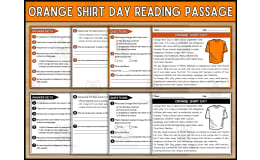
Students read a two-page informational passage about Orange Shirt Day, held every September 30 in Canada, and answer 11 comprehension questions. The passage explains what residential schools were and how long they operated, then tells how six-year-old Phyllis Webstad's new orange shirt was taken from her on her first day at St. Joseph's Mission near Williams Lake, British Columbia. It follows her story from a 2013 public talk to the first Orange Shirt Day and to the National Day for Truth and Reconciliation, made a federal statutory holiday in 2021. A calendar, a map of Canada and a short Words to watch for list support young readers.
The questions build in three parts. Part A, Find it in the text, asks students to order four events on a timeline, explain why September 30 was chosen, correct false statements and locate a fact by its section heading. Part B, Words and connections, covers the meaning of Survivors and reconciliation, what an idea in the text refers to, and cause-and-effect rows. In Part C, Think about it, students state a main idea with a detail, compare 2013 with 2021, and write their own message of respect on a shirt outline, linking it to the passage.
- Grades 4–6: informational reading for Orange Shirt Day and Truth and Reconciliation lessons
- Nine pages: the passage, three question pages, a teacher discussion guide and sample answers for every question
- File options: a color copy and an ink-saving black and white copy, both ready to print
Related resources
More resources teachers may find useful
24 related resources were found using this product's title, contributor, categories and tags.



In the classroom
Teaching tips & learning objectives

Learning objectives
Recall key facts about residential schools and the origin of Orange Shirt Day using details from an informational text.
Put historical events in time order.
Determine the meaning of words such as Survivors and reconciliation from context.

Teaching tips
Read the Approach with care notes on page 6 before teaching; they suggest letting families and Indigenous education staff know ahead of time when the lesson will happen.
Open with two or three of the before-reading questions, then read the passage aloud or with partners while students underline words to discuss.
Have students complete Parts A and B on their own and hold a short class talk before Part C, following the guide's suggested lesson flow.

Skills covered
Sequencing: students place four events, from Phyllis Webstad's first school day to the 2021 national day, in time order.
Close reading: true-or-false items require rewriting each false statement so it matches the passage.
Vocabulary in context: students explain what Survivors and reconciliation mean in this text.
Good to know
Questions teachers ask about this resource
What grade levels is this passage written for?
Grades 4–6. The passage is two pages long and includes a short list of words to watch for as students read.
How does it help teachers handle a sensitive topic?
The discussion guide's Approach with care notes cover preparing families, keeping the lesson factual and calm, never singling out students, checking in privately and using respectful terms.
What types of questions are included?
Eleven questions covering sequence, recall, true-or-false with corrections, text features, vocabulary, reference, cause and effect, main idea, comparison and a written response.
Are further resources suggested?
Yes. Page 7 lists books such as The Orange Shirt Story by Phyllis Webstad and suggests inviting a speaker from a local First Nations, Inuit or Métis community.

No reviews yet
Downloaded this resource? Tell other teachers how it went.
Curriculum
Standards, concepts & topics
Standards
 Standards
- CCSS.RI.4.1 — Refer to details and examples in a text when explaining what the text says explicitly and when drawing inferences from the text.
- CCSS.RI.4.2 — Determine the main idea of a text and explain how it is supported by key details; summarize the text
- CCSS.RI.4.4 — Determine the meaning of general academic and domain-specific words or phrases in a text relevant to a grade 4 topic or subject area.
Core concepts
 Core concepts
Orange Shirt Day
Every Child Matters
residential schools
Truth and Reconciliation
informational text
reading comprehension
 Topics
Explore more
Categories this resource belongs to
Explore related searches
More to explore
You may also like