Ordering Numbers Least To Greatest Task Cards


- Grades
- Grades 1–3, Elementary
- Pages
- 9
- File type
- Answer key
- Included


- Topic
- math, ordering numbers
- Resource types
- Task Cards, Worksheets & Printables
- Answer key
- Included
About this resource
What's inside this resource
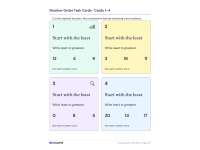
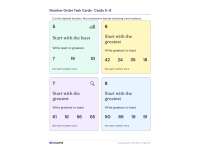
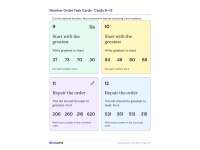
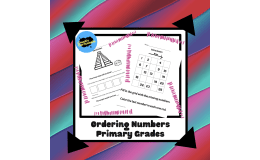
Twenty numbered task cards give students steady practice ordering numbers from least to greatest and from greatest to least. Each card names its direction in large type, so students know before they start whether to begin with the smallest or the largest number. The cards grow from numbers within 20 to two-digit and then three-digit numbers, which lets you hand a first grader the early cards and a third grader the later ones.
Cards 1–5 ask students to write three numbers to 20 least to greatest. Cards 6–10 switch to greatest to least with four two-digit numbers, including tricky pairs such as 61 and 16. Cards 11–15 show a three-digit list that is out of order and ask students to repair it. Cards 16–20 give a list in order plus one new number, and students write all four numbers with the new one in its place.
- Grades 1–3: comparing and ordering whole numbers to 999
- Nine pages: a teacher page with a worked model, five pages of cards (four per page), two recording sheets and an answer key
- Two versions: full-color and black-and-white PDFs
Related resources
More resources teachers may find useful
24 related resources were found using this product's title, contributor, categories and tags.


In the classroom
Teaching tips & learning objectives

Learning objectives
Order a set of whole numbers from least to greatest.
Order a set of whole numbers from greatest to least.
Compare two- and three-digit numbers by place value, starting with the largest place.

Teaching tips
Model the page 1 example aloud before handing out cards; it shows the same three numbers ordered in both directions.
Pick the card range that fits each learner: cards 1–5 for numbers to 20, cards 6–10 for two-digit work and cards 11–20 for three-digit lists.
Offer counters or a number line for the smaller numbers, as the support box on page 1 suggests.

Skills covered
Ordering in two directions: students write lists least to greatest on some cards and greatest to least on others, reading the direction on each card first.
Place-value comparison: pairs such as 61 and 16 or 408 and 418 push students to compare tens or hundreds before ones.
Error repair: on cards 11–15 students spot the misplaced numbers in a three-digit list and rewrite the whole list correctly.
Good to know
Questions teachers ask about this resource
How high do the numbers go?
Cards 1–5 stay within 20, cards 6–10 use two-digit numbers, and cards 11–20 use three-digit numbers up to 910.
Do the cards only ask for least to greatest?
No. About half of the cards ask for least to greatest and the rest ask for greatest to least. The direction is printed in large type at the top of every card.
Where do students write their answers?
Two recording sheets have a numbered line for each card, so students can write each complete list beside its card number.
Is there an answer key?
Yes. Page 9 lists the correct order for all 20 cards and adds short notes on common mistakes, such as comparing ones before tens.

No reviews yet
Downloaded this resource? Tell other teachers how it went.
Resource details
Concepts & topics
Core concepts
 Core concepts
Ordering numbers
Least to greatest
Greatest to least
Comparing numbers
Place value
Three-digit numbers
Topics
 Topics
Explore more
Categories this resource belongs to
Explore related searches
More to explore
You may also like