Our Hatching Calendar: The Life Cycle of a Baby Chick

- Grades
- Preschool–2, Elementary
- Pages
- 1
- File type
- Preparation
- Print ready


- Subject
- Science, Life Sciences, Animals
- Topic
- Chick Life Cycle, Hatching Calendar
- Resource types
- Diagrams, Teacher Tools
- Preparation
- Print ready
Product description
From the author
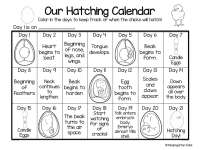
Our Hatching Calendar: The Life Cycle of a Baby Chick is a 1-page printable to take your students through the 21 day life cycle of a baby chick gearing up to hatch! The description for each day is simple and concise. A picture of the baby chick inside the egg is included for every 5 days so that students can really get a visual for how the baby chick is growing. They will color in their square for each passing day! This hatching calendar would be especially ideal if your students are following the journey of a live baby chick about to hatch.
Related resources
More resources teachers may find useful
24 related resources were found using this product's title, contributor, categories and tags.


In the classroom
Teaching tips & learning objectives

Learning objectives
Follow the twenty-one day development of a chick embryo in order, naming what changes at each stage
Track elapsed days against a real start date, colouring one square per day
Anticipate hatching from the signs the calendar names, such as the beak turning to the air space and the first cracks

Teaching tips
Fill in the "Day 1 is on" line as the eggs go into the incubator; every square after it is counted from that date
One square coloured at the same point each morning turns the calendar into a daily routine rather than a one-off worksheet
Print one for the classroom wall and smaller copies for individual children if you want both a shared countdown and a personal record

Skills covered
Life cycle sequencing — children follow embryonic development in order across twenty-one days, from a beating heart to a chick ready to hatch.
Calendar tracking — a square is coloured for each day that passes, counting forward from a start date written on the sheet.
Observation and anticipation — the candling squares and the watch-for-cracks note connect the printed calendar to what children can actually see in the incubator.
Good to know
Questions teachers ask about this resource
What are the "Candle Eggs" squares for?
Two of the twenty-one squares carry that note, marking the days set aside for candling — holding a light behind an egg to see how the embryo is developing. The calendar names the step and its timing; it does not give instructions for doing it, so plan the light source yourself.

No reviews yet
Downloaded this resource? Tell other teachers how it went.
Resource details
Concepts & topics
Core concepts
 Core concepts
Life cycle
Chick development
Calendar tracking
Animal science
 Topics
Explore more
Categories this resource belongs to
Explore related searches
More to explore
You may also like