



Plant Xylem Capillary Action Hydro-Transport STEM Lab (BIO05)



About This Product
Bring vascular plant anatomy, xylem transport mechanics, capillary action, hydrogen bonding adhesion vs. cohesion, and fluid rate math to life with the Plant Xylem Capillary Action Hydro-Transport STEM Lab (BIO05)! Designed for Middle School Life Science, Biology, Botany, Math, and STEM classes, this 3-page, print-ready lab packet challenges students to measure fluid ascension rates in plant stems and synthetic micro-tubes.
What Is Included in This 3-Page Packet?
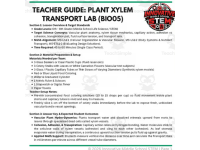
📋 Page 1: Teacher Guide & Lesson Plan
Features NGSS alignment (MS-LS1-1 Plant Cell Structures, MS-LS1-2 Plant Organ Systems, MS-ETS1-2 Engineering Design), key botanical transport concepts, food dye station setup instructions, expected student learning goals, safety guidelines, and a full teacher answer key.
🌿 Page 2: Student Mission Card & Blueprint
Hooks students with a botanical engineering scenario to model micro-fluidic transport networks inspired by plant biology. Includes material constraints (cups, celery/carnations, capillary tubes/narrow straws, food coloring dye, water, metric ruler, timer) and a dedicated schematic sketching zone to diagram xylem vessel channels, adhesion wall forces, and cohesion fluid columns.
📊 Page 3: Testing Log & Scientific Reflection
Features a structured lab data table tracking vessel diameter type, elapsed time in minutes, dye ascension fluid height in millimeters, and travel rate calculations. Includes an applied math section to calculate Fluid Transport Rates in mm per minute (Height / Time), followed by reflection questions analyzing adhesion vs. cohesion, narrow vessel capillary advantage, and transpiration suction.
Educational Value & Key Benefits:
Hands-On Plant Physiology: Connects abstract plant tissue functions like xylem and stomata transpiration directly to physical fluid mechanics.
Integrates Applied Math & Rate Calculations: Teaches students how to measure precise metric length changes in millimeters and compute speed-over-time rates.
Low-Cost High-Engagement Life Science STEM: Uses budget-friendly items like celery, carnations, plastic cups, food dye, straws, and rulers for an unforgettable middle school botany experiment across Grades 6–8.
0 Reviews
Check out these other great products


