


Reindeer Science: Arctic Winter Survival, Grades 3-5




About This Product
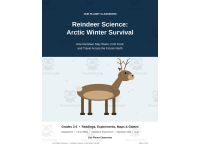
How does a reindeer survive an Arctic winter in the dark, in deep snow, with almost nothing to eat? This 30-page science pack for Grades 3-5 answers that question with seven winter survival tools: hollow hairs that trap warm air, wide hooves that work like snowshoes, a fur-covered nose, body fat, antlers on males and females, a coat that turns lighter in winter, and hooves that dig through snow to find lichen. Every fact was checked against wildlife and zoo sources, so there are no guessed numbers anywhere.
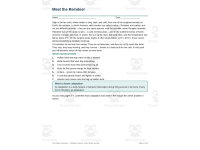
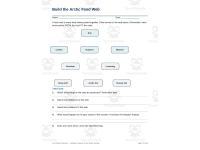
Teacher guides on pages 2 and 3 give an eight-day plan, differentiation for Grades 3 and 4-5, a vocabulary preview, and a note on how the science was checked. Four readings on pages 4 to 7 introduce the reindeer, explain the winter coat, the hooves, nose, and body fat, and finish with antlers and the great migration, each with check questions and a think-about-it prompt. Students then match eight adaptations to the winter job each one does, match six winter problems to the adaptation that solves them, and label eight parts of a reindeer diagram from a word bank. A food-chain reading and a nine-part food-web activity show how sun, lichen, grasses, mosses, reindeer, lemming, gray wolf, arctic fox, and snowy owl connect. A hands-on insulation experiment on pages 13 to 15 runs a fair test: which material, cotton balls, foil, paper towel, or nothing, keeps an ice cube solid the longest, with a question, hypothesis, procedure, recording sheet, and conclusion prompts for claim, evidence, and reasoning. A migration map on pages 16 and 17 traces the Porcupine herd's fall and spring routes; the herd travels about 1,500 miles every year, one of the longest land migrations of any animal. Pages 18 and 19 compare how reindeer, arctic fox, polar bear, and snowy owl solve the same cold problem differently, with a Venn diagram and a statement sort. Ten vocabulary words are matched and then found in a word search, ten true-or-false statements test winter survival, a ten-question quiz checks the whole pack, and four pretend-you-are-a-reindeer scenarios ask students to choose and explain the best answer. Complete answer keys on pages 25 to 29 cover every activity, and a certificate on page 30 finishes the pack.
Resource Tags
0 Reviews
Check out these other great products


