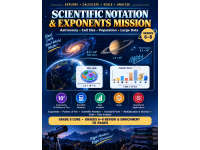
Scientific Notation & Exponents Mission | Grades 6–8 | 70 Pages



About This Product
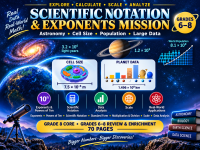
Scientific Notation & Exponents Mission | Powers of Ten, STEM Math & Real-World Applications
Grades 6–8 | 70 Pages
Explore the mathematics behind the universe, microscopic organisms, population growth, and modern technology with Scientific Notation & Exponents Mission, a comprehensive 70-page math workbook designed for middle school students in Grades 6–8.
Featuring 58 mission-based activity pages and 348 questions, this resource helps students develop confidence with exponents, powers of ten, scientific notation, standard form, multiplication, division, scale, and mathematical reasoning.
Students apply mathematical concepts through engaging STEM scenarios involving astronomy, planetary distances, cell sizes, microorganisms, population data, satellite technology, and large-scale digital information.
Designed around Grade 8 core math skills, this workbook also provides review and enrichment opportunities for students in Grades 6–8.
What's Included:
70-page printable math workbook
58 mission-based student activity pages
348 math questions
Exponents and powers of ten activities
Scientific notation and standard form conversions
Multiplication and division with scientific notation
Mathematical error analysis
Metric scale and measurement challenges
Astronomy and biology-based math investigations
Population and large-data analysis
Mathematical modeling and decision-making activities
Final integrated scientific notation mission
8-page teacher answer key (pages 63–70)
Major Learning Topics:
Exponents & Powers of Ten
Exponent rules
Missing exponent challenges
Positive and negative powers of ten
Numerical patterns
Place-value reasoning
Order-of-magnitude comparisons
Scientific Notation & Operations
Converting between scientific notation and standard form
Multiplication and division
Comparing extremely large and small numbers
Identifying calculation errors
Evaluating mathematical claims
Astronomy & Space Math
Planetary distances
Satellite data
Moon orbit analysis
Asteroid measurements
Star distances
Deep-space magnitude comparisons
Biology & Microscopic Measurements
Cell sizes
Bacteria and viruses
DNA measurements
Microscope scale
Pollen measurements
Microorganism data
Population & Large Data
Population comparisons
Population growth trends
Cloud storage capacity
Digital data compression
Sensor data throughput
Large-scale data analysis
Skills Developed:
Scientific notation
Exponent rules
Powers of ten
Numerical magnitude comparison
Multiplication and division
Metric conversions
Measurement and scale
Mathematical modeling
Graph and data interpretation
Error analysis
Multi-step problem-solving
Critical thinking
Cross-curricular STEM reasoning
Perfect For:
Middle school math classrooms
Grade 8 scientific notation instruction
Exponents and powers of ten practice
Pre-algebra lessons
STEM and STEAM education
Cross-curricular math and science activities
Math enrichment
Independent practice
Spiral review
Early finishers
Homeschool education
Help students understand how mathematics makes it possible to describe microscopic organisms, enormous astronomical distances, growing populations, and complex technological systems.
Explore. Calculate. Scale. Analyze.
Bigger numbers. Bigger discoveries. Stronger mathematical skills.
Resource Tags
0 Reviews
Check out these other great products