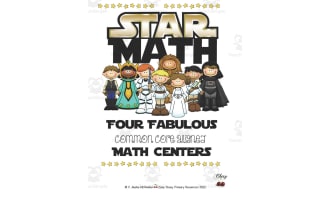
Star Wars Addition & Subtraction Math Worksheets - EBOOK


- Grades
- Preschool–1, Elementary
- File type
- Preparation
- Print ready


- Subject
- Math, Addition and Subtraction, Addition
- Topic
- graph, count
- Resource types
- Worksheets & Printables, Worksheets
- Preparation
- Print ready
About this resource
What's inside this resource
Related resources
More resources teachers may find useful
24 related resources were found using this product's title, contributor, categories and tags.


In the classroom
Teaching tips & learning objectives

Learning objectives
Add and subtract within 20 and record each answer in the space provided, using sums and differences such as 16+4, 12+8 and 20-15
Subtract multiples of ten from multiples of ten, as in 50-40, 30-10 and 20-10
Use a colour legend to turn a computed answer into an action, matching each of the four results to its assigned colour

Teaching tips
The colour-by-answer page only works if every problem is solved first, so it makes a natural self-checking task: a wrong answer produces a colour that does not match the legend
The counting page directs students to mark each character as it is counted, which is worth demonstrating once before the class starts, since the marking is what keeps the tally accurate
The bar graph and the plotted-point page record the same findings, so the pair can be used to talk about why one set of data can be shown in more than one form

Skills covered
Addition and subtraction fluency - two full pages of problems are solved and written into printed circles, with sums and differences inside 20.
Subtracting tens - the colouring page mixes in 50-40, 30-10 and 20-10 alongside the within-20 problems.
Colour-by-answer decoding - students match each computed result to the legend, where 5 is blue, 10 tan, 15 yellow and 20 brown, before colouring the character.
Good to know
Questions teachers ask about this resource
How do the counting page and the two graph pages work together?
As one sequence. Students count the characters on the counting page, marking each as it is counted, then record those totals twice: first on a bar graph scaled from 5 to 25, then on a second page where the same findings are plotted as points with the number written above each point.
What does the colour legend on the colouring page use?
Four answers and four colours: 5 blue, 10 tan, 15 yellow and 20 brown. Every problem on that page resolves to one of those four numbers, so 26-11 and 20-15 both call for yellow while 50-40, 5+5, 10+0 and 20-10 all call for tan.
How is the strip puzzle put together?
Cut the sheet along the outer black line, then cut the strips apart. Students solve the problems printed in the grey area of each strip, and the answers decide the order: the strips are glued in numerical order onto the template page that follows, which is marked "Glue puzzle pieces here."

No reviews yet
Downloaded this resource? Tell other teachers how it went.
Resource details
Concepts & topics
 Core concepts
 Topics
Explore more
Categories this resource belongs to
Explore related searches
More to explore
You may also like