STEM Basics: How to Use a Compound Microscope Lab (SB9)



About This Product
Bring compound optical light microscope mechanics, low-to-high power focusing protocols, total magnification ratio math (Ocular x Objective), iris diaphragm aperture lighting control, and optical image inversion mapping to life with STEM Basics: How to Use a Compound Microscope Lab (SB9)! Designed for Middle School Life Science, General Science, Biology, Math, and STEM classes across Grades 6–8, this comprehensive 7-page print-ready lab skills packet transforms careless optical handling into industrial laboratory precision.
What Is Included in This 7-Page Packet?
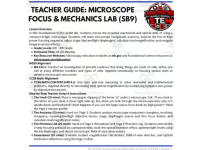
🔬 Page 1: Teacher Guide & Lesson Overview
Provides foundational skill context, NGSS alignment (MS-LS1-1), CCSS math connections (magnification multiplication ratios), safety protocols, and a flexible pacing roadmap.
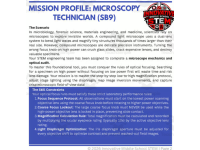
🎯 Page 2: Student Mission Profile (The Hook)
Engages students through a real-world microscopy technician career scenario establishing strict laboratory testing protocols and lens protection rules.
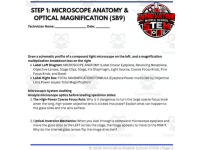
📐 Page 3: Microscope Anatomy & Optical Magnification Sheet
Features pre-lab exercises where students diagram optical component parts, calculate total magnification powers across 4x, 10x, and 40x objectives, and decode optical inversion physics.
📋 Page 4: Laboratory Operation & Step-by-Step Procedure Card
A dedicated instructional card providing step-by-step guidance on lens paper cleaning, low-power coarse-focus alignment, iris diaphragm contrast adjustments, and high-power fine-focus isolation.
📊 Page 5: Measurement Practice Log & Field Data Matrix
A structured data log for calculating total magnification powers, plotting e-letter directional inversion maps, and drawing detailed field-of-view specimen sketches.
💡 Page 6: Teacher Lab Metrology Cheat Sheet
Offers quick solutions for setting stage safety stop screws, fixing black-screen field errors, detecting dust specs on objective lenses, and sourcing durable prepared specimen slides.
📝 Page 7: Microscopy Metrology Master Rubric
A 4-point assessment rubric evaluating fine-focusing protocols, magnification ratio math, field observation accuracy, and technical science mastery.
Educational Value & Key Benefits:
Protects School Equipment: Enforces the strict rule of using fine focus knobs exclusively under high power, preventing crushed slides and scratched objective lenses!
Teaches the Inversion Effect: Hands-on activity clearly demonstrates how lenses invert and reverse specimen images, eliminating student frustration during slide manipulation.
Independent Classroom Flow: Separate procedural cards keep lab groups focused and self-directed.
Resource Tags
0 Reviews
Check out these other great products