The Declaration of Independence word search, scramble and crossword pu
- Grades
- Grades 4–6
- Pages
- 6
- File type
- Answer key
- Included


- Subject
- Social Studies, History: USA, Vocabulary
- Topic
- Declaration of Independence, Civics vocabulary
- Resource types
- Word Searches, Crosswords Puzzles
- Answer key
- Included
Product description
From the author
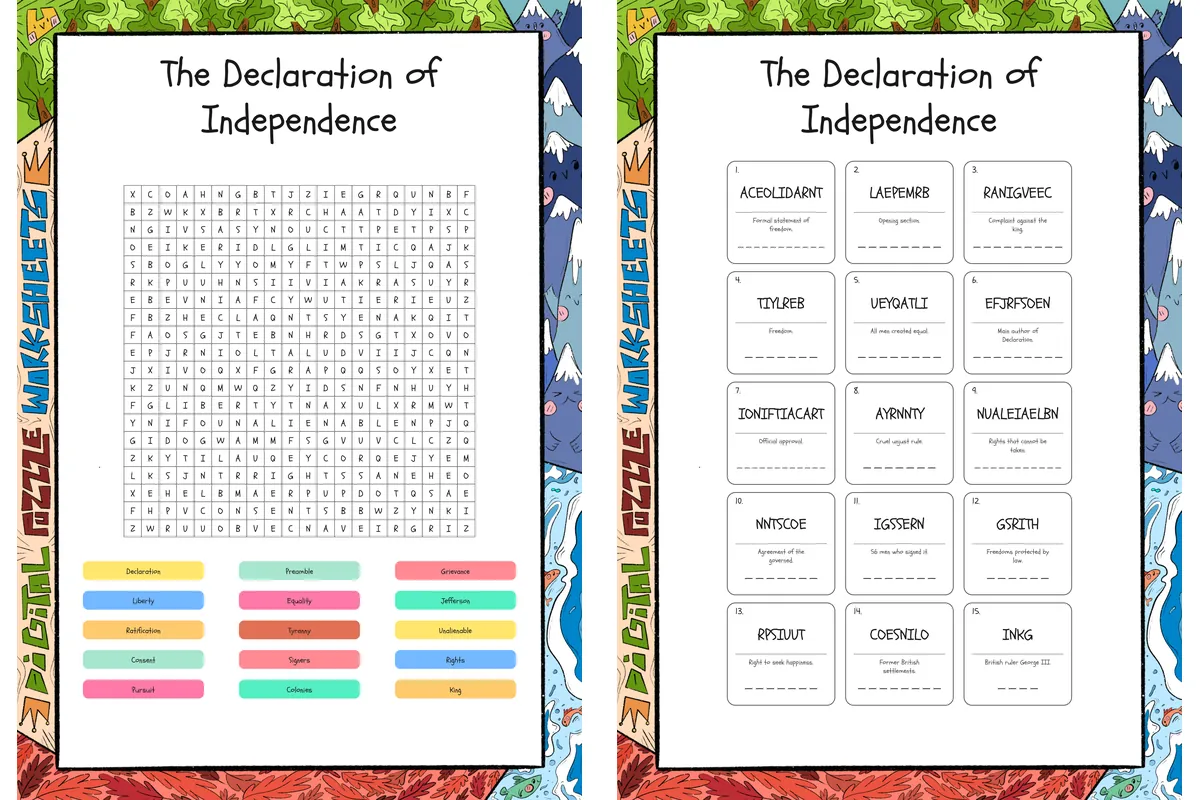
I made this Declaration of Independence puzzle set for my fourth graders during our American Revolution unit. The three puzzles revisit fifteen terms, including Declaration, preamble, grievance, liberty, equality, Jefferson, ratification, tyranny, unalienable, consent, signers, rights, pursuit, colonies and king.
The download contains three two-page PDFs: a word search, a scramble and a crossword, each with its own completed key. Use the word search for independent practice or try the crossword with partners.
For an extension, have early finishers name two rights mentioned in the Declaration on the back.
Related resources
More resources teachers may find useful
24 related resources were found using this product's title, contributor, categories and tags.
In the classroom
Teaching tips & learning objectives

Learning objectives
Match a plain-language meaning to the term it names — 'Opening section' to Preamble, 'Official approval' to Ratification, 'Cruel unjust rule' to Tyranny
Recall the fifteen terms attached to the Declaration, including Jefferson as its main author and the fifty-six Signers
Spell demanding civic vocabulary correctly when rebuilding it from scrambled letters such as NUALEIAELBN and IONIFTIACART

Teaching tips
Teach the vocabulary before handing any of the three out: Ratification, Preamble and Unalienable are not recoverable from their clues alone by a student meeting them for the first time.
Run the word search first as the lightest of the three — it prints the fifteen answers underneath the grid, so it works as exposure rather than as a test.
Keep the scramble for after the crossword: both use the identical clue list, so a student who has worked the grid already knows the fifteen answers and only has the spelling left to do.

Skills covered
Civic vocabulary — students work with fifteen terms tied to the Declaration: Declaration, Preamble, Grievance, Liberty, Equality, Jefferson, Ratification, Tyranny, Unalienable, Consent, Signers, Rights, Pursuit, Colonies and King.
Unscrambling multi-syllable words — the scramble asks students to rebuild long letter strings such as IONIFTIACART and NUALEIAELBN.
Grid reasoning — the crossword gives no letters, so students rely on the clue plus the crossing entries to place answers of the right length.
Good to know
Questions teachers ask about this resource
Are the clues written as definitions or taken from the document itself?
They are short plain-language definitions written for the puzzle — 'British ruler George III' for King, '56 men who signed it' for Signers, 'Agreement of the governed' for Consent. The set provides vocabulary clues rather than the full Declaration text.
What do students need to know before starting?
Enough of the document to attach a term to a meaning. Several answers — Preamble, Ratification, Unalienable, Grievance — cannot be reached from their clues by a student who has not met the vocabulary, since the clues give the meaning rather than a letter pattern or an example.

No reviews yet
Downloaded this resource? Tell other teachers how it went.
Resource details
Concepts & topics
Core concepts
 Core concepts
Declaration of Independence
Civic vocabulary
Word puzzles
Definition matching
 Topics
Explore more
Categories this resource belongs to
Explore related searches
More to explore
You may also like