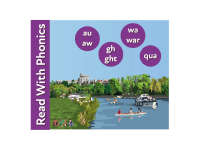
The River Trip: Reinforces The Phonic Sounds au, aw, gh, ght, wa, qua, war



About This Product
Read the story called 'The River Trip' and revise the sounds au and aw. Also introduces gh, ght, wa, qua and war.
Learn To Read With Phonics Reading Packs are a quick and easy way to teach children to read in just six months.
They are ideal for all ages (from 4 years plus), especially reluctant older readers of 7, 8, 9+, children with learning difficulties and children where English is a foreign language.
The packs are designed to be used one to one or in small groups with a teacher and child or parent/guardian and child learning together.
The packs consist of a structured course that build 44 phonic sounds into the text. As the children read the adventures of a loveable boy called Sam, they can have fun searching for hidden sounds. They will build up 44 sounds in total. This will enable them to read 80% of words in the English language, by breaking them down into sounds or syllables - pl ay ing. Children using phonics in this way progress fast.
A series of stories, The Bouncing Castle and The Famous Cousin From The Country reinforce the complex middle sounds being learnt. By the end of the scheme, the child will be ready to progress to 'solo' reading books, such as Roald Dahl's 'Georges Marvellous Medicine' and 'Fantastic Mr Fox'.
Many of the packs have cut out practice pages for matching words to pictures and phrases to pictures, to fix the sound words in the child's memory. The simple text and fun colour sketches, appeal to young readers and have helped the authors to teach many, many children to read.
The reading packs may be used in any order, just pick the pack for the sound you require. However, when using the packs for a complete non reader we suggest you start with packs teaching initial sounds (word building with three or four letter words).
Then move on to learning phonic sounds in this order: ch, sh, wh, th, oo, ee, ar, or, ur, ir, er, magic e, ea, oa, ai, ay, oi, oy, oa, short y (as in happy), long y (as in sky), soft c (as in mice), soft g (as in engine), ou, ow, au and aw.
Next, move onto more complex sounds as in, tion, le, el, ough, gue, que, ine, ue, ie, ei, prefixes and suffixes.
How To Use
Each pack introduces a sound.
1) Learn the sound with the child/children
2) Read the sentences or stories several times, encouraging the child/children to talk about the pictures.
3) At the end of the sentences or story, there is a list of words and phrases, which the child can match to the pictures.
Practise each sound several times, until the child is familiar with it.
What's Included
38 pages
Resource Tags
0 Reviews
Check out these other great products