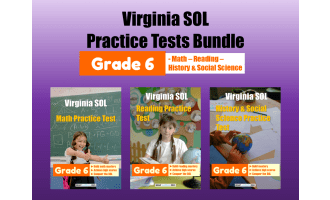
Virginia SOL Pack of 3 Reading Practice Tests for Grade 6


- Grades
- Grade 6
- Pages
- 69
- File type
- Answer key
- Included


- Subject
- ELA, Reading
- Topic
- Virginia SOL, Grade 6 reading
- Resource types
- Worksheets, Assessments
- Answer key
- Included
- Standards
- RI.6.1
Product description
From the author
Looking for a rigorous and engaging 6th grade reading SOL practice test bundle that truly prepares students for success? This Virginia SOL Reading test prep resource includes 3 full-length, standards-aligned tests designed to build comprehension, stamina, and confidence before test day.
What’s Included
3 full-length Virginia SOL Reading practice tests (40 questions each; 120 total)
Fiction, nonfiction, poetry, and drama passages for comprehensive skill coverage
Realistic SOL-style questions including charts and graphs for data analysis (see chart on page 7 & page 21)
Student answer sheets for each test (see page 16 layout)
Complete answer key with quick-check grids and skill-by-skill breakdowns
Publisher’s approximate score conversion chart; not an official state score
Teacher’s Guide with pacing calendar, reteaching strategies, and differentiation supports
Class data tracker to monitor student growth over time
How It Works in the Classroom
This 6th grade SOL reading test prep resource is designed for a simple, effective testing cycle:
Test 1 → Diagnostic to identify skill gaps early
Test 2 → Mid-prep progress monitoring
Test 3 → Final review or full-length test simulation
Use it for:
Whole group test prep
Independent practice and assessments
Small group reteaching based on data
Sub plans or review days
Each practice test uses multiple-choice reading questions with a variety of passages like fiction (The Translation), nonfiction (The Northern Lights), poetry (The Cartographer), and drama selections, helping students practice across genres and question types.
Standards & Learning Goals
Aligned to Virginia SOL Grade 6 Reading standards, including:
Vocabulary & word study (Greek/Latin roots, prefixes, idioms, connotation/denotation)
Literary analysis (theme, character development, tone, point of view, figurative language)
Nonfiction comprehension (main idea, text structure, author’s purpose, charts/graphs)
Students will:
Strengthen comprehension across multiple genres
Practice interpreting charts and data visuals
Build test-taking stamina and confidence
Why Teachers Love It
⭐ No-prep, print-and-go test prep solution
⭐ Easy grading with quick-reference answer grids
⭐ Data-driven instruction with skill breakdowns and tracking
⭐ Built-in differentiation and reteaching strategies
⭐ Realistic SOL-style practice that builds confidence and readiness
Simplify your test prep and boost student confidence with this all-in-one Grade 6 Reading SOL practice test bundle. Download today and give your students the structured practice they need to succeed!
Related resources
More resources teachers may find useful
24 related resources were found using this product's title, contributor, categories and tags.

In the classroom
Teaching tips & learning objectives

Learning objectives
Determine theme, main idea, and author's purpose across fiction, nonfiction, poetry, and drama passages
Identify figurative language (allusion, metaphor, simile, personification, hyperbole) in context
Build sustained test-taking stamina across three full-length, timed reading assessments

Teaching tips
Use the three tests as an early diagnostic, a later checkpoint and a final practice before the assessment.
Use the skills coverage map to choose reading skills for review between tests.
Record raw scores on the Class Data Tracker to compare responses across the three tests.

Skills covered
Theme and central idea — questions on passages like "The Translation" ask students to identify the story's theme after reading a full narrative arc
Figurative language identification — students classify specific lines (e.g., "the bridge between two worlds") as metaphor, simile, hyperbole, or allusion
Vocabulary in context and connotation/denotation — each test includes a dedicated word-study question set testing word meaning within a sentence

No reviews yet
Downloaded this resource? Tell other teachers how it went.
Curriculum
Standards, concepts & topics
Standards
 Standards
- RI.6.1
Core concepts
 Core concepts
Reading comprehension
Test preparation
Theme
Figurative language
Nonfiction text structure
 Topics
Explore more
Categories this resource belongs to
Explore related searches
More to explore
You may also like