



3,982 products added recently
Page 64 - Science Activities
Ignite your students' interest in science with activities that make learning interactive and exciting. This collection offers experiments, demonstrations, and inquiry-based projects covering various scientific fields. By integrating these science activities into your lessons, you can encourage critical thinking, foster curiosity, and deepen understanding of scientific concepts.

 Show filters


Alphabet Tracing Worksheets | Letter Recognition & Beginning Sounds
ELA, Reading, Writing, Phonics, Language Development, Spelling, ESL, Handwriting, Life Sciences, Science, Kindergarten, Preschool, Grade 1, 2, Worksheets & Printables, Teacher Tools, Classroom Decor, Activities, Centers, Worksheets, Workbooks
The alphabet worksheet sets are designed to help young learners develop basic reading and writing skills through tracing, writing, and coloring. This interactive and engaging set of alphabet worksheets is designed to help young learners develop basic letter skills through tracing, writing, finding letters, and coloring. Children can learn letters by enjoying a combination of tradition and hands-on learning fun. These printable worksheets offer useful lessons and provide rich practice in a fun and interactive way. They are designed to help students easily use this second grade resource to learn about alphabet worksheet activities. A collaborative learning activity added by students. Alphabet worksheet sets are designed to help young children develop basic reading and writing skills through tracing, writing, and tracing. This alphabet resource is perfect for kindergarten students and is great as a letter of the week activity. The alphabet worksheet sets are designed to help young children develop basic reading and writing skills through tracing, writing, and tracing.
Author LAMO
Rating
Tags English Language Arts, Phonics , Phonics & Phonological Awareness, Back To School, Worksheets, Printables, Homeschool, Centers, Letter , Alphabet

Tea Activity
Science, Earth and Environmental Sciences, Life Sciences, Nature & Plants, Grade 2, 3, 4, 5, 6, 7, 8, Activities
Activity Introduction An amazing activity designed for the students to learn more about famous places in different countries. The Tea Fact Sheet Do you like STEM subjects? what is your favorite one? Have you ever tried to plant a seed? If yes, tell us more about it. Or have you ever tried to invent something? If yes, tell us more about it. And how do you think it will help us? Have you ever seen a microorganism under a microscope? What was it? And how it looked like? Mathematics is a marvelous subject. Let' sharpen our brains and solve some equations. Do you like timetable tricks? What is your favorite one? Do you know how to code? Have you ever created an app or a game before? If yes, how was it like? Tea Activity The activity is perfect for encouraging the researching skills for the students, while learning more about this fantastic place. Tea This friendly designed worksheet is suitable for students at school, homeschooling, and as a group activity. Instructions Do some research to figure out the answers to the following questions: How was tea first discovered? When did people start drinking tea? What tea flavors do you know about? What is matcha? Format Available in a PDF format.
Author Educational Voice
Tags Tea, Tea Activity, Tea Fact, Tea Facts, Tea Facts For Kids, Agriculture, Farming, Farming Facts, Farming Facts For Kids

Kites Reading Comprehension Passage - Cored Ed Encyclopedia
ELA, Language Development, Resources for Teachers, Reading Comprehension, Reading, Pre-Reading, Writing, Strategies, Science, Physics, Grade 2, 3, 4, 5, Worksheets & Printables, Worksheets, Teacher Tools, Centers, Activities, Writing Prompts, Assessments, Tests, Quizzes and Tests, Quizzes
This kites reading comprehension contains the following: Visualize on the Cover (Teacher Read Aloud Script) Start your lesson by taking a few moments to visualize the topic and share thoughts or feelings about it. Pre-Reading Trivia Students will write down one thing they already know about the subject and then read five more facts and discuss. These facts are fun, and the students will enjoy learning about the subject before reading more. Reading Passage The text is a high-interest reading passage with set paragraphs, roughly three to four paragraphs long. It contains a variety of themes about the topic, anywhere from history to technology. The passage is between 250 and 350 words in length. Mixed Questions The first question page contains four multiple-choice questions, each with a choice of four answers, and three written response questions that require a sentence or two from the student. Vocabulary Questions Practice seven key words from the text in this section across two activities. First section is scrambled words where students will unscramble three words given a clue for each. The second section is a word to meaning matching activity. Creative Writing In this question, the student will be required to write a five to eight sentence paragraph on a question related to the topic. Extension Activities This page is optional for fast finishers or to take home. There are several activities, each one requiring a different skill. Do some, do none, do all, completely optional - but you will feel reassured knowing every possibility is planned for. Includes summary writting question. Answer Key There are answers for the multiple-choice questions, written response questions have sample answers, vocabulary answers and if there is a summary question then a sample summary will be provided as well. FULL CATALOG OF DOWNLOAD LINKS AND ENCYCLOPEDIA INDEX HERE Lesson Snapshot Title: Kites Genre: Nonfiction (informational text) Subject: Science (Forces & motion) / Reading (Informational Text) Primary Topic: How kites fly and how people use them Estimated Guided Reading Level (A–Z): O What This Lesson Teaches Best Explains what a kite is and how it stays connected to the ground with a long line. Teaches how wind and forces affect flight, naming lift , drag , and gravity and describing how they work together. Shows how parts of a kite (like a bridle and tail ) help it face the wind and stay steady. Builds understanding of history and change over time by describing how kites were used long ago in Asia and for serious jobs. Connects kites to modern uses and ideas (cameras, antennas, and exploring tethered kites for wind power). Learning Goals Students will describe what a kite is made of and how it is held to the ground. Students will explain, using the text’s words, how wind can create lift and how drag and gravity act on a kite. Students will identify how a bridle and a tail help a kite fly steadily. Students will retell two ways kites were used long ago besides play. Students will describe one way changing the kite’s angle or the line length can change its movement. Key Vocabulary From the Text tethered — tied or connected so it cannot fly away. bridle — small set of strings that helps face wind. surface — the outside part wind flows around. gravity — force that pulls things downward. inventors — people who create new ideas or tools. Cored Ed Encyclopedia Overview The Cored Ed Encyclopedia is a weekly series of lessons that you can pick up and use right away. These short readings fit into whatever time you have available. Each one includes a warm-up, a reading, and a set of questions, but it’s flexible — you can do just the reading, the full lesson, or skip the writing section if you need to. Each lesson focuses on a single topic so students don’t get lost. The writing is clear but never childish, making it perfect for grades two through five. Topics range from animals and science to history, inventions, and everyday things. No matter the level of the student, everyone should take away at least one new idea or fact from each lesson. The materials are easy to print, easy to explain, and require no setup. They work well for whole-class teaching, partner work, or independent study.
Author Cored Education
Rating
Tags Vocabulary, Spelling, Reading Comprehension, Reading Passages, Reading, Creative Writing, Reading Strategies, Writing Prompts, Physics, Kites
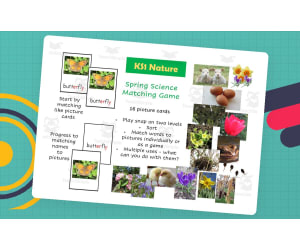
KS1 science - spring game
Science, Life Sciences, Biology, Preschool, Kindergarten, Grade 1, Activities, Games
Help children learn to recognise and name common spring flowers/animals etc… with our picture cards. Play Snap on two levels of difficulty: Start by matching like for like (cards with both pictures and words) for ages 3+ and progress to the harder version which involves matching without clues. The words are phonetically coded to help with decoding, though it is not necessary to be able to read the words - naming is the aim of the game . Other uses:** These cards can also be used: for sorting activities (e.g. frogspawn/tadpole/frog; flower (inc. catkins); young: lambs, chicks, tadpoles; etc…) To stimulate discussion To encourage children to look for these signs of spring!
Author Lilibette's Resources
Tags KS1 Plants Game, Ks1 Spring Game, Spring Flowers Game Ks1, Animals Game, Life Cycle

Integumentary System – Lab Station Activity
Science, Life Sciences, Human Body, Grade 7, 8, 9, 10, 11, 12, Labs, Experiments, Activities
This fully editable Lab Station Activity on the Integumentary System is meant to get your students out of their seats and engaged in the content. This activity was designed for middle and high school biology students. Each station not only offers a unique opportunity to test your students' knowledge (offer an opinion, answer questions based on a video or reading, draw, etc.) but also provides a fantastic learning opportunity where your kids are learning through assessment. Each station comes with a description card while some also contain more detailed instructions, a reading, questions to answer, etc. Students are equipped with a recording sheet (passport) to write their answers. There is almost no prep for you. Simply print the cards, lay them out around the room and you're all set. An answer key is also provided where applicable. This resource covers the following topics: - Skin layers - Hair - Sweat - Skin color - Sunburn and tanning - Nails Bonus Activities: To ensure your students don't have any downtime between stations, your lab also includes a 10-word word scramble and word search, both with an answer key. You can use them as part of their mark, as a bonus so it's not mandatory, etc. However you choose to use it, it will ensure that your students are always busy and never idle. Note: For stronger classes, I give the word scramble and for weaker ones, the word search. How do the Lab Stations work? Each station is specially designed to be a unique complement to the material while at the same time, provide a valuable learning experience. Below is an overview of how each station works. In your activity , each will be tailored to the specific content. Station 1: Get Hands-On – using their creative skills, students are required to draw or build. Station 2: Research – using a classroom computer or their own device, students must research a specific question/issue surrounding the topic. Station 3: Explain yourself – students write down an opinion to a question in paragraph form. Station 4: Rest Station - students can use this time to catch up on work they didn't have time to complete at a previous station or prepare themselves for an upcoming one. Station 5 - Applicability reading – students read a short passage from an article, website, etc. which directly connects the classroom content to a real-life application. Station 6: Test your knowledge – students answer 5 multiple choice questions than provide a written explanation for how/why they came to their conclusions. Station 7: Learn from the expert – using a classroom computer or their own device, students must watch a short video clip and answer the associated questions. They may stop, rewind and restart as often as they like during the time frame. Station 8 - Rest Station. Station 9: Become the question master – Students must create 2 multiple-choice questions, 2 true/false questions and 1 short answer question. Students must also supply the answers. ------------------------------- You might also be interested in my other lab station activities Biology: • Cell and the Cell Theory • The Human Digestive System • The Circulatory System • The Human Respiratory System • Mitosis and the Cell Cycle • Cellular Respiration and Photosynthesis • Photosynthesis • Cancer: Cell Division Gone Wrong - Volume I • Cancer: Cell Division Gone Wrong - Volume II • Cell Membrane and Transport • Hearing and the Human Ear • The Human Eye • Genetic Material: DNA and RNA • The Nervous System • Energy Flow In Ecosystems • DNA Manipulation and GMOs • Transcription and Translation • Cellular Respiration • Thermoregulation • Proteins and Nucleic Acids • Mutations • Meiosis • DNA, Genes, Chromosomes, and Alleles • Genetic Disorders • Fats • Reproductive Technologies • Muscular and Skeletal System • Integumentary System Coming Soon: - Excretory system - Endocrine system - Carbohydrates and Lipids Physics: • Newton's Three Laws of Motion • Kinetic and Gravitational Potential Energy • Current Electricity and Circuit Diagrams • Static Electricity • Light Optics and the Production of Light • Sound, Sound Energy and Speed • One and Two-Dimensional Motion • Uniform Acceleration • How Planes Fly • Refraction • Friction • Energy and Its Forms • Density and Buoyancy • Electricity Production • Calculating Average Speed, Velocity, and Displacement • Mass, Volume, Density, & Buoyancy • Work and Energy • Renewable Energy • Plate Tectonics • The Rock Cycle • Natural Disasters • Pressure, Volume, and Temperature Coming Soon: - Work = F x d - Nonrenewable energy sources - Projectile Motion - Momentum, Conservation of Momentum and Impulse - Power - The Doppler Effect and Supersonic Travel Chemistry: • Atomic Model, Notation and Atoms • Chemical Reactions and Balancing Equations • Molecular and Ionic Compounds • Physical and Chemical Properties & Changes • Acids, Bases, and Neutralization Reactions • The Periodic Table • Single and Double Displacement Reactions • Balancing Chemical Equations • Synthesis, Decomposition and Combustion Reactions • Atomic Theory, Atomic Structure and Isotopes • Types of Bonds and Intermolecular Forces • The Mole/Avogadro's Number • Density and Buoyancy • The Particle Theory and the Classification of Matter • Pure Substances and Mixtures • Solutions and Mechanical Mixtures Coming Soon: - Periodic table group properties General Science: • The Scientific Method and Science Skills • The Different Types of Clouds Ecology and the Environment: • Ecosystems • The Classification of Living Things • Biodiversity and Invasive Species • The Carbon and Water Cycle • Climate Change • Photosynthesis • Cellular Respiration and Photosynthesis • Ecological Succession • Plant Sexual and Asexual Reproduction • Earth's Seasons • Interactions Within Ecosystems • Physical and Behavioral Adaptations Space Science: • The Life and Death of Stars • The Moon and its Phases • Life In Space • Our Solar System • Solar and Lunar Eclipse • Earth's Seasons • Asteroids, Comets and Meteors These station cards are meant to be used as a lab activity but can also be utilized in a review task before a test or a quiz. Used either way, your students will love it! I know mine do and I'm telling you from first-hand experience as I've used this activity in my own class. Thank you for your interest in my products. If you have any questions, please send me an email - devon@teachwithfergy.com
Author Teach With Fergy
Tags Integumentary, System, Functions, Structure, Lab Station, Lab 8 Integumentary System Answers, Excretory System Labs
Science Reading Comprehension Passage 38: Geological Time PPT
Science, Earth and Environmental Sciences, Earth Sciences, Common Core, ESL, Language Development, ELA, Reading Comprehension, Reading, Geology, Grade 5, 6, 7, Teacher Tools, Presentations, Tests, Quizzes and Tests, Assessments, Activities
Free Reading Passage on Geological Time for Earth Science What's inside this free product? Science Reading Comprehension Passage: Geological Time Independent PPT Version: This is the independent PPT version containingone lesson. Product Info: 38 slides (US English with Answers) PPT Version Teaching Duration: 90 Minutes Science Reading Comprehension Outline: Introducing a comprehensive resource tailored for 5th and 6th graders, this product offers enriching reading passages supplemented with illustrative pictures and graphs to clarify key concepts. Aligned with the Common Core State Standards (CCSS), it offers a hassle-free approach to teaching, given that the bulk of the preparation is already done for you. The passages present a diverse set of questions – from multiple choice to data analysis and fill-in-the-blanks. This ensures a rich blend of high-interest content and fundamental curriculum-based science themes. With its versatility, you can seamlessly integrate these lessons into various classroom settings, whether it's whole class discussions, morning exercises, independent desk tasks, small group engagements, contingency plans for substitute teachers, regular homework assignments, or even themed activities for holidays. FULL CATALOG OF DOWNLOAD LINKS HERE Grade 5/6 Links: Physical Science Part 1 - Physical and Chemical Properties Google Docs/Slides/Forms PDF PPT Word Free Supplementary Pack Accompanying Videos Physical Science Part 2 - Motion and Energy Google Docs/Slides/Forms PDF PPT Word Free Supplementary Pack Accompanying Videos Physical Science Part 3 - Electricity and Magnets Google Docs/Slides/Forms PDF PPT Word Free Supplementary Pack Accompanying Videos Life Science Part 1 - Cells, Reproduction and Genetics Google Docs/Slides/Forms PDF PPT Word Free Supplementary Pack Accompanying Videos Life Science Part 2 - Human Body Systems Google Docs/Slides/Forms PDF PPT Word Free Supplementary Pack Accompanying Videos Life Science Part 3 - Plant Parts and Ecosystems Google Docs/Slides/Forms PDF PPT Word Free Supplementary Pack Accompanying Videos Earth Science Part 1 - Plate Tectonics and Rock Cycle Google Docs/Slides/Forms PDF PPT Word Free Supplementary Pack Accompanying Videos Earth Science Part 2 - Ocean Exploration and Natural Resources Google Docs/Slides/Forms PDF PPT Word Free Supplementary Pack Accompanying Videos Earth Science Part 3 - Weather and Solar System Google Docs/Slides/Forms PDF PPT Word Free Supplementary Pack Accompanying Videos For similar products and other frees, do check out Cored Group on TeachSimple .
Author Cored Education
Tags Science, Elementary, Reading, Comprehension, Vocabulary, Answers, Physics, Physical Science, Ccss, Common Core
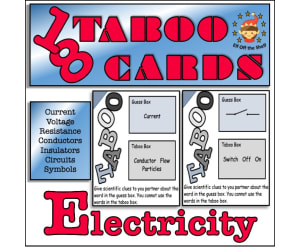
Current Electricity Taboo Cards 1
Science, Physics, Grade 5, 6, 7, 8, 9, Activities
Eighteen taboo cards on: -explaining current, voltage and resistance; -explaining and naming conductors and insulators; -circuits and symbols How to Use: -Work in pairs -Place cards in a pile face down -Student takes a card and gives scientific clues to their partner to help them guess the word in the guess box -The clue giver cannot use the words in the taboo box in the clues See more Elf Off the Shelf resources on this topic and many others
Author Elf off the Shelf Resources
Tags Taboo Cards, Current Electricity Printable, Electricity Taboo Cards, Phsyics Activity, Science
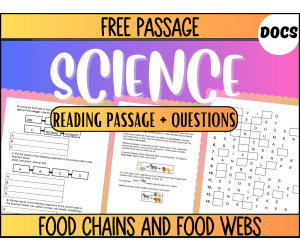
Free Reading Passage: Food Chains and Food Webs (Google Docs)
ELA, Reading, Reading Comprehension, Science, Life Sciences, Biology, Common Core, Resources for Teachers, ESL, Language Development, Grade 2, 3, 4, Centers, Activities, Assessments, Teacher Tools, Tests, Quizzes and Tests
Free Reading Passage on Food Chains and Food Webs for Life Science What's inside this free product? Science Reading Comprehension Passage26 : Food Chains and Food Webs Independent Google Docs Version: This is the independent Google Docs version containingone lesson with full answer keys. Product Info: 7 PAGES (US English with Answers) Google Docs Version Teaching Duration: Approximately 90 Minutes Science Reading Comprehension Outline: Targeted for students in 3rd and 4th grades, these reading passages are enhanced with illustrations and graphs to elucidate critical points. Each lesson aligns with the Common Core State Standards, allowing you to integrate science reading practice effortlessly, knowing that minimal preparation is needed on your part. Each passage comes with a variety of questions in different formats, including multiple-choice formats, data analysis, and fill-in-the-blanks. The topics covered strike a balance between engaging content and core curriculum-based science subjects. Versatile in application, these lessons are suitable for a variety of settings such as whole-class instruction, morning activities, independent desk work, small group discussions, contingency plans for substitute teachers, homework assignments, or even special holiday-themed tasks. FULL CATALOG OF DOWNLOAD LINKS HERE Grade 3/4 Links: Physical Science Part 1 - Properties of Objects and Materials Google Docs/Slides/Forms PDF PPT Word Free Supplementary Pack Accompanying Videos Physical Science Part 2 - Position and Motion of Objects Google Docs/Slides/Forms PDF PPT Word Free Supplementary Pack Accompanying Videos Physical Science Part 3 - Light, Heat, Electricity, Magnetism Google Docs/Slides/Forms PDF PPT Word Free Supplementary Pack Accompanying Videos Life Science Part 1 - Characteristics of Organisms Google Docs/Slides/Forms PDF PPT Word Free Supplementary Pack Accompanying Videos Life Science Part 2 - Life Cycles of Organisms Google Docs/Slides/Forms PDF PPT Word Free Supplementary Pack Accompanying Videos Life Science Part 3 - Organisms and Environments Google Docs/Slides/Forms PDF PPT Word Free Supplementary Pack Accompanying Videos Earth Science Part 1 - Properties of Earth Materials Google Docs/Slides/Forms PDF PPT Word Free Supplementary Pack Accompanying Videos Earth Science Part 2 - Changes in the Earth and Sky Google Docs/Slides/Forms PDF PPT Word Free Supplementary Pack Accompanying Videos Earth Science Part 3 - Objects in the Sky Google Docs/Slides/Forms PDF PPT Word Free Supplementary Pack Accompanying Videos For similar products and other frees, do check out Cored Group on TeachSimple .
Author Cored Education
Tags Science, Elementary, Reading, Comprehension, Vocabulary, Answers, Physics, Physical Science, Ccss, Digital Centers

Crack and Peel Skin Photoshop Activity
Science, Technology, Grade 7, 8, 9, 10, Activities
Students will work with digital tools in the Crack and Peel Skin Photoshop Activity . Students will take a perfectly good image and add in some skin imperfections. Step by step directions are included.
Author OK Products
Tags Crack And Peel Skin, Photoshop, Photopea, Mobile Applications, Graphics, Graphic Design, Computer Lesson, Technology, Computer Science

Venus Flytrap Plant Flipbook Craft DIY Science Study Writing activitiy
Life Sciences, Science, Biology, Nature & Plants, Grade 1, 2, 3, 4, Crafts, Activities, Parts of and Anatomy of, Worksheets & Printables, Writing Prompts
Make learning about Venus flytraps fun and interactive with this printable DIY flipbook craft! Students will explore the fascinating world of Venus flytraps by learning about their habitat, plant parts, life cycle, unique adaptations, carnivorous feeding habits, and importance while strengthening reading comprehension and writing skills through engaging science activities. I like using this resource during plant science units, botany lessons, carnivorous plant studies, classroom centers, independent work, and homeschool learning. It's a low-prep activity that combines science, reading, writing, and creativity into one meaningful project. What You Will Get This resource includes a printable Venus Flytrap DIY flipbook that helps students organize and record what they learn about this fascinating carnivorous plant through reading, writing, and hands-on learning. What's Included in this Flipbook? • Venus Flytrap DIY flipbook craft templates • Reading and writing activities • Plant facts and science research pages • Habitat, life cycle, and feeding adaptations sections • Plant parts and unique adaptations pages • Writing prompts and reflection activities • Easy-to-follow assembly instructions This resource is perfect for: • Plant science lessons • Botany units • Carnivorous plant studies • Classroom science centers • Homeschool learning • Independent work and early finishers Why you will love this? • Easy to print and assemble • Encourages reading, writing, and scientific thinking • Builds nonfiction reading comprehension skills • Supports research and observation skills • Sparks curiosity with an extraordinary plant species • Creates a meaningful keepsake students can share This Venus Flytrap DIY Flipbook Craft is a fun and interactive way for students to discover the life cycle, unique adaptations, carnivorous feeding habits, and importance of Venus flytraps while developing reading, writing, and science skills through creative, hands-on learning.
Author Perfect_Printables
Rating
Tags Plant Science, Botany, Science Activities, Writing Activities, Craft Activities, Venus Flytrap Flipbook, DIY Flipbook Craft, Carnivorous Plant Study, Plant Science Writing Prompt, Venus Flytrap Research Activity
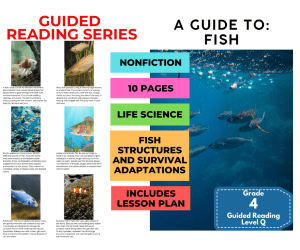
A Guide to Fish: Guided Reading Level Q with Lesson Plan
ELA, Resources for Teachers, Reading Comprehension, Reading, Science, Language Development, Life Sciences, Earth and Environmental Sciences, Pre-Reading, Vocabulary, Grade 3, 4, 5, Worksheets & Printables, Worksheets, Teacher Tools, Centers, Activities, Literacy Readers, Quizzes, Quizzes and Tests, Assessments, Lesson Plans
This A Guide to Fish (level q) guided reading book with lesson plan includes: Guided Reading Color Label (front cover x1) This is a quick way to match the book’s demands to what students can generally handle.. The overall goal is to use the level/color to pick books for several smaller groups. To qualify for a certain level, a student is expected to read a book from that level with about 90–94% accuracy. If a student is consistently accurate and understands, move up a level. If the student is struggling at that level, drop down and add more support. Each student will improve at completely different rates, but it is generally one of the best ways to check progress across the class. DOWNLOAD THE CATALOG TO VIEW ALL GUIDED READING BOOKS AVAILABLE (SORTED LEVELS A-Z) Pre-Reading Question (x1) Teacher asks the prompt aloud, can be while showing the cover or first page. Students share what they already know, or make educated guesses from the cover. Prompt them to use the target vocabulary. Write some of their responses on the board to look back at during the reading. Vocabulary Words (x5) Introduce the five words, best doing it one at a time. Start by saying it, while students repeat and then see if anyone knows what it means before reading further. Read through the meaning and try to briefly connect each word to a picture or gesture so it’s meaningful. Ask students to flip through the book pages and point to where they see each of the vocabulary words. While reading the book pause upon coming across one of the vocab words or read the sentence twice to make sure students understand the word has appeared. Optional: Ask students to raise hands whenever they see/hear one of the new words. Guided Reading Pages (x10) Check the book snapshot (below) for: primary topic - do you need to prep extra reading or intro materials on this? what is taught best - decide on 1-2 bullets to focus on, use the prompt or words provided here for best results. learning goals - what you are checking for students to be able to do after the session, elicit answers using prompts or words provided. key vocabulary (see section above). questions overview - so you know what is coming up and if you need to prep extra materials to assist understanding. Run the lesson You may have already looked at a few of the pages together, but you can show them some of the pictures again first to set meaning. Depending on how much time you have and how familiar your students are with guided reading class, you may want to read the book aloud first with the group first. Students whisper or partner read, while you listen in. If time, do it as a group, one student reading a page each. Use the guided page’s prompts to coach: “Check the picture / does it make sense?” “Point under the words / try the first sound” “Reread the sentence smoothly”. Try to focus more on one student per session (rotating every time), so you can work out if they are ready to move up or need to move down a level. Comprehension Questions (back cover x3) This is your way to check that students didn’t just say the words, but actually understood the text. First, let students answer by pointing to the page/picture and saying a short sentence. After any answer, follow with: “Show me where you found that in the text.” In bigger groups, have partners answer first (10–20 seconds), then call on 2–3 students to share. Differentiation tips: Emerging speakers/struggling readers: oral + pointing On-level: oral in a full sentence Higher: one written sentence or draw + label Book Snapshot Title: A Guide to: Fish Genre: Nonfiction (informational) Subject: Life Science Primary Topic: Fish structures and survival adaptations Estimated Guided Reading Level (A–Z): Q What This Book Teaches Best Explains how gills help fish breathe by extracting oxygen from water and releasing carbon dioxide. Describes how a fish’s streamlined shape and fins support efficient movement, stability, steering, and turning. Introduces the lateral line as a sensory system that detects vibrations and pressure changes to help fish navigate and find prey. Compares freshwater and saltwater habitats and explains how fish maintain the right internal balance of salt and water. Shows multiple survival strategies such as bioluminescence, camouflage, cartilaginous skeletons, and schooling (“safety in numbers”). Learning Goals Explain how fish breathe using gills and what happens as water passes over gill filaments. Describe how fins and a streamlined body shape help fish move, steer, and turn in water. Identify what the lateral line does and how it helps fish survive (navigation and finding prey). Compare how freshwater fish and saltwater fish manage water and salt in their bodies. Explain at least two survival adaptations described in the text (camouflage, bioluminescence, schooling). Describe what “cartilaginous fish” are and what the text says cartilage allows them to do. Key Vocabulary From the Text vertebrates — animals that have a backbone. specialized — made for a specific job or purpose. filaments — thin, threadlike parts of the gills. bioluminescence — the ability to make your own light. cartilaginous — having a skeleton made of cartilage, not hard bone. Discussion Prompts Pre-reading question: What body parts or behaviors might help fish survive in different kinds of water? Comprehension questions: What does the text explain that gills do for a fish? Comprehension questions: How does the lateral line help fish, according to the text? Comprehension questions: Why does the text say swimming in a school can help fish survive? Printing Tips 1. Best Printing Method (Recommended) “Booklet” Printing (Best if Available) If your printer or PDF viewer supports Booklet Printing , use this. Settings to use: Print mode: Booklet Paper size: Letter or A4 (either works) Orientation: Landscape Print on both sides: Yes Flip on: Short edge Scaling: Fit to printable area Booklet subset: First test: Front sides only Then: Back sides only This will automatically: Pair pages correctly Put the cover on the outside Align everything for folding After printing, fold in half and staple along the spine . 2. If “Booklet” Printing Is NOT Available You can still print this correctly with manual duplex printing . Step-by-step: Open the PDF. Choose Print . Set: Orientation: Landscape Pages per sheet: 1 Print on both sides: Yes Flip on: Short edge Print all pages . Because each PDF page already contains two facing book pages, the result will still fold cleanly into a book. Thousands of Cored Education products are included with your TeachSimple membership. Download links and encyclopedia index available here. Extend the discussion of fish survival with these animal body parts and functions worksheets .
Author Cored Education
Rating
Tags Reading Comprehension, Reading Passages, Reading, Guided Reading, Guided Reading Lesson Plan, Guided Reading Activity, Pre-reading, Science Lesson Plans, Life Science, Earth Science
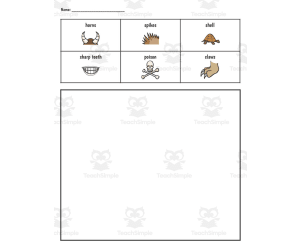
Animal Adaptation Activity
Science, Life Sciences, Animals, Grade 2, 3, 4, Activities
This is an Animal Adaptation Activity. It is a 3-page printable to give your science students opportunity to learn more about animals and their defense mechanisms.
Author ELA Resources
Tags Animals, Adaptations, Defense Mechanisms, Writing, Science Center, Animal Adaptation Activity

Finger Butterfly Activity
Science, Life Sciences, Biology, Animals, Grade 2, 3, 4, 5, 6, 7, 8, Activities
Activity Introduction An amazing activity designed for the students to learn more about animals in different countries. Finger Butterfly Do you like animals? what is your favorite one? Do you own a pet? If yes, tell us more about it, like what its name? And what do you like most about it? What are the animal kingdoms? Can you write down the characteristics of each animal class like mammals, birds, reptiles, amphibian, fish and mollusks. Do you know that some animals can sing, can you name any of them? What is the largest and the smallest mammal in the world? What is the largest and the smallest bird in the world? What is the largest and the smallest fish in the world? Finger Butterfly Activity The activity is perfect for encouraging the researching skills for the students, while learning more about this fantastic place. Finger Butterfly This friendly designed worksheet is suitable for students at school, homeschooling, and as a group activity. Instructions Cut the butterfly out, then colour it and decorate it as you wish. Fold along the dotted line. Cut two pieces of the pipe cleaner and wrap them around your finger. Take them off, then glue them to the butterfly's body. Wear the butterfly on your fingers and enjoy. Materials needed Colours Scissors Beads/sequins Pipe cleaner Glue Format Available in a PDF format.
Author Educational Voice
Tags Finger Butterfly Activity, Butterfly, Butterflies, Butterfly Facts, Butterfly Facts For Kids, Butterflies Facts, Butterflies Facts For Kids
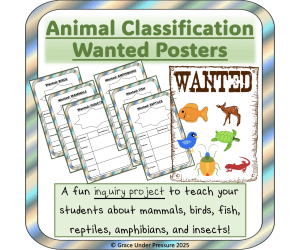
Science Project: Animal Classification Posters Types of Animals
Science, Life Sciences, Insects, Animals, Biology, Research, Grade 2, 3, 4, 5, Activities, Worksheets & Printables, Worksheets
This elementary science project is a fun and interactive way for your students to learn about animal classes- different types of animals and how we can tell them apart by their unique features! Students can work independently or in small groups to research six animal classes: mammals, reptiles, fish, amphibians, birds, and insects. They need to find information about the following topics: Vertebrate or invertebrate: Find out if this kind of animal has a back bone or not. (Check the correct box.) Features: What helps people classify this kind of animal? What features make them different than the other classes? Five examples of animals from this class: Find some unique ones! Fun facts: What interesting information should your classmates know? These posters are specially designed to be printed on 11x17 paper for the best results! How to Use: Print a two-page note-taking sheet for each student. Print the posters on 11x17 paper: one for each student or group. Assign each student or small group one kind of animal class to research. Provide information, books, or websites for students to use to complete research. Students will fill in the information on their poster. They will present to the rest of the class so that everyone learns about each animal class. The other students take notes on their sheets. The completed posters can be hung up to present the information around your room. Grades to Use WIth: This elementary science project is great for students in 2nd, 3rd, 4th, and 5th grade who are developing research skills and learning about animal classification. What's Included: A total of 9 pages in PDF Format: Ready to print and use! Title Page 2-Page Note-Taking Sheet to use during the presentations 6 Posters- one for each of the six animal classes included: mammals, reptiles, fish, amphibians, birds and insects.
Author Grace Under Pressure
Rating
Tags Animal Classes, Vertebrate, Invertebrate, Mammals, Science Project, Birds, Reptiles, Amphibians, Animal Research Posters, Types Of Animals
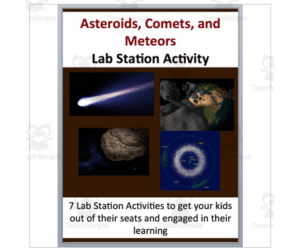
Asteroids, Comets and Meteors - 7 Lab Station Activities
Science, Earth and Environmental Sciences, Space, Grade 9, 10, 11, Activities
Asteroids, Comets and Meteors - 7 Lab Station Activities Introduction: A priceless teaching aid made specifically for science educators focusing on astronomy. Meant primarily for students of grades 9-11, this resource can be adapted to meet different needs. It contains seven lab station activities centered on asteroids, comets, and meteors designed to stimulate active learning with various assessment opportunities. Station Details: Station One: Sparks creativity by allowing students to draw or build related concepts. Station Two: Targeted independent inquiry into issues or questions linked to asteroids, comets, and meteors. Station Three: Written discourse where learners provide their view in paragraph format on a significant question. Stations Four/Eight: Rest spaces giving students the chance to make up for missed assignments or prepare for upcoming ones without pressure. Station Five:The application of learnings in practical settings through small reading sections directly relating classroom lessons with real-life scenarios. -Focus Areas- - Understanding asteroid locations and uses - Distinguishing between meteors/meteorites/meteoroids - Impacts from collisions between asteroids and Earth - Crater creation process - Using asteroids/comets as fuel resources >station Six: Validates understanding through multiple choice query followed by written explanations on reasoning behind chosen responses. >station Seven: Digital natives are catered for through video content coupled with related questions which compensate traditional print sources. These lab stations also include recording sheets for students to document their findings. In turn, this simplifies the grading process for teachers while teaching students about tracking coursework. The lab stations can be utilized in various settings such as group activities, individual assignments or even as homework tasks. In Conclusion Critical tool in promoting comprehensive acquisition and application of knowledge. A well-structured design of the product ensures student engagement during the learning process of complex scientific concepts ideally within a stress free space.
Author Teach With Fergy
Tags Astronomy Education, Asteroids, Comets, Meteors, Lab Activities
Simple Machines: Finding the Wheel & Axle and Pulleys - FLASH-MAC
Science, Technology, Engineering, Common Core, Grade 5, 6, 7, 8, Activities
Simple Machines: Finding the Wheel & Axle and Pulleys - FLASH-MAC FLASH-MAC is an interactive learning tool targeted towards students in Grades 5 through 8. It presents the science of simple machines in an easily digestible format by focusing on fundamental components like wheels, axles, and pulleys. Main Features: An engaging hands-on approach that encourages students to physically interact with various objects demonstrating these elementary mechanical principles. A cross-disciplinary focus that includes both science and engineering, fostering a comprehensive understanding of simple machines and their real-world applications. Suited for group or whole-class sessions conducted by teachers as well as for homeschooling parents who want to add a practical dimension to theoretical instruction. Academic Relevance: This teaching resource strictly aligns with the Common Core State Standards ensuring its relevancy within the current academic framework. Furthermore, the material has been designed around Bloom's Taxonomy which promotes detailed cognitive development amongst learners. Compatibility: Functionality has been optimized for MAC users ensuring seamless operation during classroom or home use. In Summary: This is more than a mere teaching aid; Simple Machines: Finding the Wheel & Axle and Pulleys - FLASH-MAC represents an integrated approach towards applied physics (focusing on wheels and axles) as well as mechanical basics revolving around pulleys. Packaged within universally recommended educational frameworks, it guarantees deep knowledge assimilation capitalizing upon active-learning pedagogy suitable across various learning environments from traditional classrooms to homeschool setups.
Author Classroom Complete Press
Tags Software (Mac), Simple Machine Wheel And Axle, Wheel And Axle Machine

Physical Science Reading Comprehension Passage: Magnets (Word)
Science, ELA, Reading, Reading Comprehension, Strategies, Resources for Teachers, Physics, Grade 6, 7, 8, 9, 10, Writing Prompts, Worksheets & Printables, Centers, Activities, Teacher Tools, Assessments, Quizzes and Tests, Quizzes, Tests
Physical Science Reading Comprehension Passage and Questions: Magnets (Word Document) This very engaging science reading passage is about magnetism and the invisible forces magnets exert on certain materials . It explains magnetic fields, north and south poles, attraction and repulsion, and why materials such as iron, nickel, and cobalt respond strongly to magnets. Students also compare permanent magnets with electromagnets and explore how magnets are used in compasses, speakers, scrapyard cranes, MRI machines, and other everyday technologies. This passage is designed to bridge the gap between science and literacy by strengthening reading comprehension while sparking scientific curiosity in middle school students. It blends English Language Arts skills with accurate science content, helping students build background knowledge, understand key concepts, use evidence from the text, and explain scientific ideas clearly. This resource supports science classroom practice while also reinforcing important literacy skills such as main idea, vocabulary, comprehension, and summarizing. Ideal for interdisciplinary learning in ELA and Science. Suitable for Grade 9 review, too! Student Tasks for The Passage: 10 multiple-choice questions targeting main idea, key details, science concepts, comparison, and real-world applications 10 True/False statements to check understanding and address common misconceptions 5 text-based short-answer questions that require students to explain important ideas from the passage 5 vocabulary matching items with clear, student-friendly definitions 1 summary prompt that asks students to condense the central ideas accurately Full answer key for every section Available Formats for this Resource PDF Fillable PDF Google Docs FULL CATALOG OF DOWNLOADING LINKS HERE Product Details Length: 7 pages total Grades: 6–8, also suitable for Grade 9 review Use cases: close reading, stations, homework, intervention, test prep, and sub plans Standards support: Reinforces informational-text skills and supports NGSS-style sense-making by helping students read scientific explanations, connect evidence to key concepts, interpret real-world examples, and explain cause-and-effect relationships in science. Why Teachers Choose This Set Authentic science content paired with rigorous literacy practice Consistent task structure across all passages for easier planning and smoother student routines Clear, age-appropriate writing that builds confidence without oversimplifying Other Science Reading Collections and Topics You May Find in the Store: 1. Astronomy & Space Science 2. Volcanoes, Rocks, & Mountains 3. Rock Cycle, Soil, & Sinkholes 4. Mars, Glaciers, & Antarctica 5. Water Cycle, Acid Rain, & Wastewater 6. Insects, Animals, & Ecosystems 7. Bioluminescence & Insects 8. Animal Skin, Cats, & T. Rex 9. Human Body and Senses 10. Health & Applied Bioscience 11. Waves, Light, & Imaging 12. Electricity & Energy 13. Motion & Materials 14. Chemistry and Materials Science 15. Electromagnetism 16. Acids and Bases 17. Gas Laws 18. Biotechnology 19. Periodic Trends 20. Protists and Fungi 21. Microevolution 22. Blood 23. Chemical Bonding 24. Magnets 25. Muscles 26. Nuclear Chemistry 27. Electromagnetic Devices 28. Epigenetics 29. The Law of Conservation of Mass 30. Atomic Models 31. Isotopes and Ions 32. Light 33. Human-Environment Interaction 34. Theory of Evolution 35. Photosynthesis 36. Origins of Life and Early Earth 37. Gene Expression and Regulation 38. Thermochemistry 39. Allergies 40. Coevolution 41. Birth to Adulthood 42. Cells 43. Entropy and Free Energy 44. The Human Brain 45. Mixtures and Solutions 46. Invertebrates 47. Zoo Animals 48. Biochemistry 49. Animal Behavior 50. Population Ecology ...and many more engaging science reading passages that cover intriguing and important topics designed to spark curiosity and support student learning. Use this passage to reinforce ELA skills in science, to add literacy to your lessons, and to support independent work. The passages strengthen main idea, evidence use, vocabulary in context, inference, cause and effect, and summary writing. With ready-to-use assessments and complete answer keys, you can provide focused practice that is simple to run and fast to review.
Author Middle & High School - CORED Education
Rating
Tags Middle School, Reading Comprehension, Reading Strategies, ELA, Centers, Reading Passage, Assessments, Vocabulary, Physical Science, Magnets
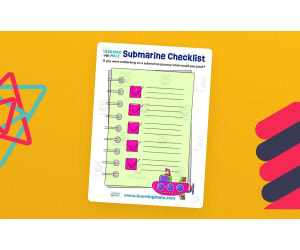
Submarine Checklist Activity
Science, Technology, Engineering, Basic Science, Grade 2, 3, 4, 5, 6, 7, 8, 9, Activities
Activity Introduction An amazing activity designed for the students to learn more about STEM subjects. Submarine Checklist Do you like STEM subjects? what is your favorite one? Have you ever tried to plant a seed? If yes, tell us more about it. Or have you ever tried to invent something? If yes, tell us more about it. And how do you think it will help us? Have you ever seen a microorganism under a microscope? What was it? And how it looked like? Mathematics is a marvelous subject. Let' sharpen our brains and solve some equations. Do you like timetable tricks? What is your favorite one? Do you know how to code? Have you ever created an app or a game before? If yes, how was it like? Submarine Checklist Activity The activity is perfect for encouraging the researching skills for the students, while learning more about this topic. Submarine Checklist This friendly designed worksheet is suitable for students at school, homeschooling, and as a group activity. Instructions If you were embarking on a submarine journey what would you pack? Format Available in a PDF format.
Author Educational Voice
Tags Submarine Checklist Activity, Submarine Checklist, Submarine, Submarines, Submarine Facts, Submarine Facts For Kids, STEM, STEM Facts, Ocean, Oceans

Earth Science Reading Comprehension Passage: Ice Age Leftovers. SAMPLE
Science, ELA, Reading, Reading Comprehension, Strategies, Resources for Teachers, Earth and Environmental Sciences, Earth Sciences, Grade 6, 7, 8, 9, Writing Prompts, Worksheets & Printables, Centers, Activities, Teacher Tools, Assessments, Quizzes and Tests, Quizzes, Tests
This is a free passage sample from the complete resource. The full version includes everything needed for a complete reading comprehension activity: the passage, multiple-choice questions, short-answer questions, vocabulary matching, a summary-writing task, and a detailed answer key. Download the complete passage resource by clicking on the following links: PDF Fillable PDF Word Docs Google Docs Science Reading Comprehension Passages and Questions: Ice Age Leftovers (PDF) This very engaging earth science reading passage about how ice left from the Ice Age still affects Earth today . It explains the differences between glaciers, ice sheets, ice shelves, icebergs, and sea ice , and shows how each one shapes land, oceans, weather, and climate. This passage is designed to bridge the gap between science and literacy through strengthening reading comprehension and sparking scientific curiosity in middle school students. The passage blends English Language Arts skills with accurate science content that supports NGSS classroom practice. Ideal for interdisciplinary learning in ELA and Science. Suitable for Grade 9 review, too! Student Tasks for The Passage: 5 multiple-choice questions targeting main idea, key details, inference, vocabulary in context, and use of evidence 5 vocabulary matching items with clear, student-friendly definitions 5 text-based questions that require citing specific lines or facts 1 summary prompt that asks students to condense central ideas accurately Full answer key for every section FULL CATALOG OF DOWNLOADING LINKS HERE Product Details Length: 5 pages total Grades: 6–8, also suitable for Grade 9 review Use cases: close reading, stations, homework, intervention, test prep, and sub plans Standards support: reinforces informational-text skills and supports NGSS-style sense making through observation, modeling, and clear use of claim, evidence, and reasoning Why Teachers Choose This Set Authentic science content paired with rigorous literacy practice Consistent task structure across all passages for easier planning and smoother student routines Clear, age-appropriate writing that builds confidence without oversimplifying Other Science Reading Collections you May find in the store: 1. Astronomy & Space Science 2. Volcanoes, Rocks, & Mountains 3. Rock Cycle, Soil, & Sinkholes 4. Mars, Glaciers, & Antarctica 5. Water Cycle, Acid Rain, & Wastewater 6. Insects, Animals, & Ecosystems 7. Bioluminescence & Insects 8. Animal Skin, Cats, & T. Rex 9. Human Body and Senses 10. Health & Applied Bioscience 11. Waves, Light, & Imaging 12. Electricity & Energy 13. Motion & Materials 14. Chemistry and Materials Science Use this set to reinforce ELA skills in science, to add literacy to your lessons, and to support independent work. The passages strengthen main idea, evidence use, vocabulary in context, inference, cause and effect, and summary writing. With ready-to-use assessments and complete answer keys, you can provide focused practice that is simple to run and fast to review.
Author Middle & High School - CORED Education
Rating
Tags Middle School, Reading Comprehension, Reading Strategies, ELA, Centers, Reading Passage, Assessments, Vocabulary, Environmental Science, Space

Volcano Puzzle Activity
Science, Earth and Environmental Sciences, Earth Sciences, Environmental Science, Grade 1, 2, 3, 4, 5, 6, 7, 8, 9, Activities
Activity Introduction An amazing activity designed for the students to learn more about natural disasters in different countries. Volcano Puzzle What do you know about this natural disaster? Do you know in which part of the world this could happen? Have you ever read about the safety misusers that we could have to protect ourselves from this natural disaster? If yes, can you tell us more about them? Can you name other natural disasters? If yes, tell us more about where they are likely to happen? And how frequently? Do you like reading about Geography? What is your favorite country in the whole world? If you are going on a trip where it will be? Which country? What you are going to see there? Does this country has a famous place to visit? Do you like reading about Geology? If yes, what is your favourite topic? Volcano Puzzle Activity The activity is perfect for encouraging the researching skills for the students, while learning more about this fantastic place. Volcano Puzzle This friendly designed worksheet is suitable for students at school, homeschooling, and as a group activity. Format Available in a PDF format.
Author Educational Voice
Tags Volcano Puzzle Activity, Volcano Activity, Volcano, Volcanoes, Volcanoes Activty, Volcanoes Activity For Kids, Volcanoes Facts, Volcanoes Facts For Kids, Volcano Puzzle, Puzzle

Watercolor Painting Photoshop Activity
Science, Technology, Grade 7, 8, 9, 10, Activities
Students will work with digital tools in the Watercolor Painting Photoshop Activity . Students will paint a watercolor scene. Step by step directions are included.
Author OK Products
Tags Watercolor, Painting, Photoshop, Photopea, Computer Science, Mobile Applications, Graphic Designs, Design Concepts

Clouds Activity
Earth Sciences, Earth and Environmental Sciences, Science, Grade 2, 3, 4, 5, 6, 7, 8, 9, 10, Activities
Activity Introduction An amazing activity designed for the students to learn more about famous phenomena in different countries. Clouds What do you know about this phenomenon? Where it happens? When it happens? What are the safety measures that we should take to be safe during this phenomenon? Are there any other places in the world that experienced this phenomenon? If yes, tell us more about them. Why do you think it happens? Do you like reading about Geography? What is your favorite country in the whole world? Clouds Activity The activity is perfect for encouraging the researching skills for the students, while learning more about this fantastic phenomenon. Clouds The activity is perfect for encouraging the researching skills for the students, while learning more about this fantastic phenomenon. Instructions Draw each type of cloud inside the boxes below. Look at the sky and try to find an interesting shape like a rabbit or a boat, then draw it below. Format Available in a PDF format.
Author Educational Voice
Tags Clouds Activity, Clouds, Clouds Facts, Clouds Facts For Kids, Weather, Weather Facts, Weather Facts For Kids, Weather Activity, Earth, Earth Facts
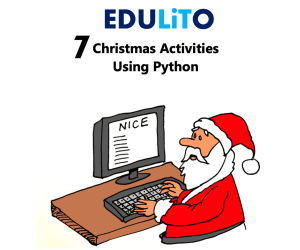
7 Christmas Activities using the Python Programming Language
Science, Technology, Computer Science, Grade 8, 9, 10, Activities
This resource includes 7 Christmas themed, stand alone activities for students learning how to program using Python. The activities go from basic activities to more complex tasks. Some of the skills and knowledge tested includes using input, FOR and WHILE loops, string manipulation, lists, exporting to an external file and importing from an external file. The seven activities are: Activity 1 - What do you want for Xmas? Santa asks a child their name and also asks what they want for Christmas. The child tells Santa their name and what they want for Christmas. Santa then replies with a sentence that includes the child’s name and what they want for Christmas. Activity 2 - Ho Ho Ho! Write a program that uses a FOR loop so that Santa can say “Ho Ho Ho” 100 times! Activity 3 - Make a Christmas Tree Activity 4 – Guess the Reindeer - Write a program that allows Santa to play a game of guess the name of the reindeer. Activity 5 – Are you on the “Nice” list? Write a program that only gives the child a present if they are on the “Nice” list. Activity 6 – Presents Database - Santa would like to set up a database that stores data about the present each child asks for. You will need to create a notepad file for this exercise. Activity 7 – Random Present Chooser - Your younger sister is going to see Santa in his Grotto. Santa has a choice of 8 gifts to give to your sister.
Author Edulito
Tags Computer Science , Python, Activities, Christmas, Xmas, Holidays, Programming, Coding
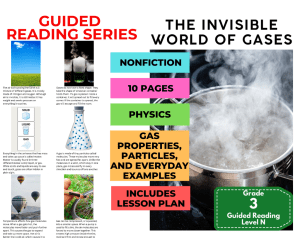
Guided Reading Level N - Invisible World of Gases (with Lesson Plan)
ELA, Resources for Teachers, Reading Comprehension, Reading, Language Development, Science, Physics, Engineering, Technology, Pre-Reading, Grade 2, 3, 4, Worksheets & Printables, Worksheets, Teacher Tools, Centers, Activities, Literacy Readers, Quizzes, Quizzes and Tests, Assessments
This Guided Reading Book - The Invisible World of Gases (Level N) with lesson plan includes: Guided Reading Color Label (front cover x1) This is a quick way to match the book’s demands to what students can generally handle.. The overall goal is to use the level/color to pick books for several smaller groups. To qualify for a certain level, a student is expected to read a book from that level with about 90–94% accuracy. If a student is consistently accurate and understands, move up a level. If the student is struggling at that level, drop down and add more support. Each student will improve at completely different rates, but it is generally one of the best ways to check progress across the class. DOWNLOAD THE CATALOG TO VIEW ALL GUIDED READING BOOKS AVAILABLE (SORTED LEVELS A-Z) Pre-Reading Question (x1) Teacher asks the prompt aloud, can be while showing the cover or first page. Students share what they already know, or make educated guesses from the cover. Prompt them to use the target vocabulary. Write some of their responses on the board to look back at during the reading. Vocabulary Words (x5) Introduce the five words, best doing it one at a time. Start by saying it, while students repeat and then see if anyone knows what it means before reading further. Read through the meaning and try to briefly connect each word to a picture or gesture so it’s meaningful. Ask students to flip through the book pages and point to where they see each of the vocabulary words. While reading the book pause upon coming across one of the vocab words or read the sentence twice to make sure students understand the word has appeared. Optional: Ask students to raise hands whenever they see/hear one of the new words. Guided Reading Pages (x10) Check the book snapshot (below) for: primary topic - do you need to prep extra reading or intro materials on this? what is taught best - decide on 1-2 bullets to focus on, use the prompt or words provided here for best results. learning goals - what you are checking for students to be able to do after the session, elicit answers using prompts or words provided. key vocabulary (see section above). questions overview - so you know what is coming up and if you need to prep extra materials to assist understanding. Run the lesson You may have already looked at a few of the pages together, but you can show them some of the pictures again first to set meaning. Depending on how much time you have and how familiar your students are with guided reading class, you may want to read the book aloud first with the group first. Students whisper or partner read, while you listen in. If time, do it as a group, one student reading a page each. Use the guided page’s prompts to coach: “Check the picture / does it make sense?” “Point under the words / try the first sound” “Reread the sentence smoothly”. Try to focus more on one student per session (rotating every time), so you can work out if they are ready to move up or need to move down a level. Comprehension Questions (back cover x3) This is your way to check that students didn’t just say the words, but actually understood the text. First, let students answer by pointing to the page/picture and saying a short sentence. After any answer, follow with: “Show me where you found that in the text.” In bigger groups, have partners answer first (10–20 seconds), then call on 2–3 students to share. Differentiation tips: Emerging speakers/struggling readers: oral + pointing On-level: oral in a full sentence Higher: one written sentence or draw + label Book Snapshot Title: The Invisible World of Gases Genre: Nonfiction (informational) Subject: Physical Science Primary Topic: Gas properties, particles, and everyday examples Estimated Guided Reading Level (A–Z): N What This Book Teaches Best Explains matter as anything with mass that takes up space, and names three states: solid, liquid, and gas. Describes gas molecules as tiny particles that move fast, spread far apart, and bounce off one another. Teaches key gas properties: gases have no fixed shape , take the shape of a container, and can spread out to fill a space. Connects temperature to motion by explaining that when a gas gets hot, molecules move faster, spread out, and the gas expands . Gives real-world examples of gases and their effects, including air pressure, pumping air into a tire, water vapor/steam, and helium balloons. Learning Goals Identify what the text says matter is and give the three states of matter named in the book. Describe how gas molecules move and how they are spaced compared to molecules in a solid. Explain what the book says happens to gas molecules when a gas gets hot. Explain how gas can be compressed and how that creates high pressure in a tire. Describe how water can change into water vapor and how steam forms when it cools. Use text details to explain why a helium balloon floats unless it is tethered. Key Vocabulary From the Text molecules — tiny particles that make up a gas. mixture — different things combined together. pressure — a pushing force on something. compressed — squeezed into a smaller space. atmosphere — a thick layer of gases around Earth. Discussion Prompts Pre-reading question: What do you think might be in the air around us even when we can’t see it? Comprehension questions: What does the text say matter is? How does the text explain what happens to gas molecules when a gas gets hot? Why does a balloon filled with helium float up unless it is tethered? Printing Tips 1. Best Printing Method (Recommended) “Booklet” Printing (Best if Available) If your printer or PDF viewer supports Booklet Printing , use this. Settings to use: Print mode: Booklet Paper size: Letter or A4 (either works) Orientation: Landscape Print on both sides: Yes Flip on: Short edge Scaling: Fit to printable area Booklet subset: First test: Front sides only Then: Back sides only This will automatically: Pair pages correctly Put the cover on the outside Align everything for folding After printing, fold in half and staple along the spine . 2. If “Booklet” Printing Is NOT Available You can still print this correctly with manual duplex printing . Step-by-step: Open the PDF. Choose Print . Set: Orientation: Landscape Pages per sheet: 1 Print on both sides: Yes Flip on: Short edge Print all pages . Because each PDF page already contains two facing book pages, the result will still fold cleanly into a book. Thousands of Cored Education products are included with your TeachSimple membership. Download links and encyclopedia index available here.
Author Cored Education
Rating
Tags Reading Comprehension, Reading Passages, Reading, Guided Reading, Guided Reading Lesson Plan, Guided Reading Activity, Pre-reading, Vocabulary, Science Lesson Plans, Physics