



3,991 products added recently
Page 70 - Science Activities
Ignite your students' interest in science with activities that make learning interactive and exciting. This collection offers experiments, demonstrations, and inquiry-based projects covering various scientific fields. By integrating these science activities into your lessons, you can encourage critical thinking, foster curiosity, and deepen understanding of scientific concepts.

 Show filters


Clouds Activity
Earth Sciences, Earth and Environmental Sciences, Science, Grade 2, 3, 4, 5, 6, 7, 8, 9, 10, Activities
Activity Introduction An amazing activity designed for the students to learn more about famous phenomena in different countries. Clouds What do you know about this phenomenon? Where it happens? When it happens? What are the safety measures that we should take to be safe during this phenomenon? Are there any other places in the world that experienced this phenomenon? If yes, tell us more about them. Why do you think it happens? Do you like reading about Geography? What is your favorite country in the whole world? Clouds Activity The activity is perfect for encouraging the researching skills for the students, while learning more about this fantastic phenomenon. Clouds The activity is perfect for encouraging the researching skills for the students, while learning more about this fantastic phenomenon. Instructions Draw each type of cloud inside the boxes below. Look at the sky and try to find an interesting shape like a rabbit or a boat, then draw it below. Format Available in a PDF format.
Author Educational Voice
Tags Clouds Activity, Clouds, Clouds Facts, Clouds Facts For Kids, Weather, Weather Facts, Weather Facts For Kids, Weather Activity, Earth, Earth Facts
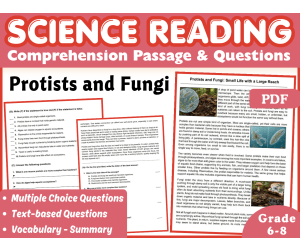
Life Science Reading Comprehension Passage: Protists and Fungi (PDF)
Science, ELA, Reading, Reading Comprehension, Strategies, Resources for Teachers, Life Sciences, Biology, Grade 6, 7, 8, 9, 10, Writing Prompts, Worksheets & Printables, Centers, Activities, Teacher Tools, Assessments, Quizzes and Tests, Quizzes, Tests
Life Science Reading Comprehension Passage and Questions: Protists and Fungi (PDF) This very engaging science reading passage is about protists and fungi , two groups of small but highly important organisms that affect ecosystems in major ways. It explains how protists can live in water, soil, or hosts; how some protists, such as algae, make food through photosynthesis and support aquatic food chains; and how others, such as Plasmodium , can cause disease. It also explains how fungi absorb nutrients, break down dead material, recycle nutrients, form helpful partnerships with plant roots, and contribute to foods and medicines such as bread and penicillin. This passage is designed to bridge the gap between science and literacy by strengthening reading comprehension while sparking scientific curiosity in middle school students. It blends English Language Arts skills with accurate science content, helping students build background knowledge, understand key concepts, use evidence from the text, and explain scientific ideas clearly. This resource supports science classroom practice while also reinforcing important literacy skills such as main idea, vocabulary, comprehension, and summarizing. Ideal for interdisciplinary learning in ELA and Science. Suitable for Grade 9 review, too! Student Tasks for The Passage: 10 multiple-choice questions targeting main idea, key details, science concepts, comparison, and real-world applications 10 True/False statements to check understanding and address common misconceptions 5 text-based short-answer questions that require students to explain important ideas from the passage 5 vocabulary matching items with clear, student-friendly definitions 1 summary prompt that asks students to condense the central ideas accurately Full answer key for every section Available Formats for this Resource Fillable PDF Word Docs Google Docs FULL CATALOG OF DOWNLOADING LINKS HERE Product Details Length: 7 pages total Grades: 6–8, also suitable for Grade 9 review Use cases: close reading, stations, homework, intervention, test prep, and sub plans Standards support: Reinforces informational-text skills and supports NGSS-style sense-making by helping students read scientific explanations, connect evidence to key concepts, interpret real-world examples, and explain cause-and-effect relationships in science. Why Teachers Choose This Set Authentic science content paired with rigorous literacy practice Consistent task structure across all passages for easier planning and smoother student routines Clear, age-appropriate writing that builds confidence without oversimplifying Other Science Reading Collections and Topics You May Find in the Store: 1. Astronomy & Space Science 2. Volcanoes, Rocks, & Mountains 3. Rock Cycle, Soil, & Sinkholes 4. Mars, Glaciers, & Antarctica 5. Water Cycle, Acid Rain, & Wastewater 6. Insects, Animals, & Ecosystems 7. Bioluminescence & Insects 8. Animal Skin, Cats, & T. Rex 9. Human Body and Senses 10. Health & Applied Bioscience 11. Waves, Light, & Imaging 12. Electricity & Energy 13. Motion & Materials 14. Chemistry and Materials Science 15. Electromagnetism 16. Acids and Bases 17. Gas Laws 18. Biotechnology 19. Periodic Trends 20. Protists and Fungi 21. Microevolution 22. Blood 23. Chemical Bonding 24. Magnets 25. Muscles 26. Nuclear Chemistry 27. Electromagnetic Devices 28. Epigenetics 29. The Law of Conservation of Mass 30. Atomic Models 31. Isotopes and Ions 32. Light 33. Human-Environment Interaction 34. Theory of Evolution 35. Photosynthesis 36. Origins of Life and Early Earth 37. Gene Expression and Regulation 38. Thermochemistry 39. Allergies 40. Coevolution 41. Birth to Adulthood 42. Cells 43. Entropy and Free Energy 44. The Human Brain 45. Mixtures and Solutions 46. Invertebrates 47. Zoo Animals 48. Biochemistry 49. Animal Behavior 50. Population Ecology ...and many more engaging science reading passages that cover intriguing and important topics designed to spark curiosity and support student learning. Use this passage to reinforce ELA skills in science, to add literacy to your lessons, and to support independent work. The passages strengthen main idea, evidence use, vocabulary in context, inference, cause and effect, and summary writing. With ready-to-use assessments and complete answer keys, you can provide focused practice that is simple to run and fast to review.
Author Middle & High School - CORED Education
Rating
Tags Middle School, Reading Comprehension, Reading Strategies, ELA, Centers, Reading Passage, Assessments, Vocabulary, Biology, Life Science
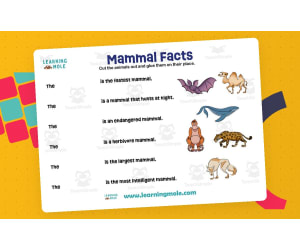
Mammals Activity – Animals Around the World
Science, Life Sciences, Biology, Animals, Grade 3, 4, 5, 6, 7, 8, Activities
Activity Introduction An amazing activity designed for the students to learn more about animals in different countries. Mammals Do you like animals? what is your favorite one? Do you own a pet? If yes, tell us more about it, like what its name? And what do you like most about it? What are the animal kingdoms? Can you write down the characteristics of each animal class like mammals, birds, reptiles, amphibian, fish and mollusks. Do you know that some animals can sing, can you name any of them? What is the largest and the smallest mammal in the world? What is the largest and the smallest bird in the world? What is the largest and the smallest fish in the world? Mammals Activity The activity is perfect for encouraging the researching skills for the students, while learning more about this fantastic place. Mammals This friendly designed worksheet is suitable for students at school, homeschooling, and as a group activity. Instructions Cut the animals out and glue them on their place. Format Available in a PDF format.
Author Educational Voice
Rating
Tags Mammals Activity, Mammals, Mammal, Mammals Facts, Mammals Facts For Kids, Animal, Animals, Animals Facts, Animals Facts For Kids

Cupid February | Kindergarten Unplugged / Digital Coding
Science, Technology, Computer Science, Preschool, Kindergarten, Grade 1, Activities
Cupid February | Kindergarten Unplugged/Digital Coding is a unique teaching resource designed to introduce early-grade and kindergarten learners into the world of computer programming. This is a STEM-centred educational tool, which can be adopted with or without computers. Main Highlights: Based around "honey bees" , an engaging theme perfect for July learning activities. Packed with elementary logic puzzles reinforcing problem-solving skills, vital for "Hour of Code" initiatives. Inclusive of hands-on, printable puzzles with ‘snip-and-paste’ commands – making it action-orientated and captivating! Packaged Content: Broad Guidelines In-depth instructions guiding both teachers as well as students on using this resource effectively. Coding materials A colourful coding navigation chart & matching pieces planned to make children explore this tool more enthusiastically! Deregulation Sheet A fun-filled 'overcome the code worksheet' along with smartboard charts bringing collective pleasure into the system. All resources are conveniently packaged for printing (PDFs) or digital sharing (Google Slides). Tailoring To Your Teaching Plans: Easily adaptable materials allow you to make alterations in the code or remove unnecessary slides prior sharing them on platforms like Google Classroom. Students can either use physical printed out sheets or enjoy performing drag-and-drop exercises digitally! No Barriers With Distance Learning: This digitized operation makes Cupid February | Kindergarten Unplugged / Digital coding an effective tool even for remote classrooms! Resourceful For Varied Learners: Ideal for those looking for quality teaching material in traditional classroom settings, or homeschooling parents aiming to incorporate STEM education early in their curriculum. This well-thought-out educational resource turns complex concepts like computer programming into manageable, game-based exercises - making the journey into digital world more friendly and approachable! About Product Target Audience: Preschoolers through Grade 1 Supplementary Topic Coverage: Science; sub-subjects include Computer Science Type of Product: Activity toolkit Files Included: PDF format standardly sized at 11 x 8.5 inches or customizable Google Slides.
Author Roombop
Tags Educational Tool, Computer Programming, Coding, Logic Puzzles, Hands-on Activities

Chemistry & Materials Science: Reading Comprehension Passages (Word)
Science, ELA, Reading, Reading Comprehension, Strategies, Resources for Teachers, Chemistry, Grade 6, 7, 8, 9, Writing Prompts, Worksheets & Printables, Centers, Activities, Teacher Tools, Assessments, Quizzes and Tests, Quizzes, Tests
Chemistry and Materials Science: Reading Comprehension Passages (Word) This very engaging collection of physical science reading passages about chemistry and material science is designed to bridge the gap between science and literacy through strengthening reading comprehension and sparking scientific curiosity in middle school students. Each passage blends English Language Arts skills with accurate science content that supports NGSS classroom practice. Ideal for interdisciplinary learning in ELA and Science. Suitable for Grade 9 review, too! What Is Included? There are (3) informational passages: Salt: Tiny Crystals, Big Effects The Hidden Science of Clothing Fingerprints: Patterns That Solve Crimes Student Tasks for Each Passage: 5 multiple-choice questions targeting main idea, key details, inference, vocabulary in context, and use of evidence 5 vocabulary matching items with clear, student-friendly definitions 5 text-based questions that require citing specific lines or facts 1 summary prompt that asks students to condense central ideas accurately Full answer key for every section Available Formats for this Resource PDF Google Docs FULL CATALOG OF DOWNLOADING LINKS HERE Other Science Reading Collections you May find in the store: 1. Astronomy & Space Science 2. Volcanoes, Rocks, & Mountains 3. Rock Cycle, Soil, & Sinkholes 4. Mars, Glaciers, & Antarctica 5. Water Cycle, Acid Rain, & Wastewater 6. Insects, Animals, & Ecosystems 7. Bioluminescence & Insects 8. Animal Skin, Cats, & T. Rex 9. Human Body and Senses 10. Health & Applied Bioscience 11. Waves, Light, & Imaging 12. Electricity & Energy 13. Motion & Materials 14. Chemistry and Materials Science Product Details Length: 13 pages total Grades: 6–8, also suitable for Grade 9 review Use cases: close reading, stations, homework, intervention, test prep, and sub plans Standards support: reinforces informational-text skills and supports NGSS-style sense making through observation, modeling, and clear use of claim, evidence, and reasoning Why Teachers Choose This Set Authentic science content paired with rigorous literacy practice Consistent task structure across all passages for easier planning and smoother student routines Clear, age-appropriate writing that builds confidence without oversimplifying Use this set to reinforce ELA skills in science, to add literacy to your lessons, or to support independent work. The passages strengthen main idea, evidence use, vocabulary in context, inference, cause and effect, and summary writing. With ready-to-use assessments and complete answer keys, you can provide focused practice that is simple to run and fast to review.
Author Middle & High School - CORED Education
Rating
Tags Middle School, Reading Comprehension, Reading Strategies, ELA, Centers, Reading Passage, Assessments, Vocabulary, Physical Science, Chemistry

Life Science Reading Comprehension Passage: Goosebumps. SAMPLE
Science, ELA, Reading, Reading Comprehension, Strategies, Resources for Teachers, Life Sciences, Biology, Grade 6, 7, 8, 9, Writing Prompts, Worksheets & Printables, Centers, Activities, Teacher Tools, Assessments, Quizzes and Tests, Quizzes, Tests
This is a free passage sample from the complete resource. The full version includes everything needed for a complete reading comprehension activity: the passage, multiple-choice questions, short-answer questions, vocabulary matching, a summary-writing task, and a detailed answer key. Download the complete passage resource by clicking on the following links: PDF Fillable PDF Word Docs Google Docs Life Science Reading Comprehension Passage and Questions: Goosebumps (PDF) This very engaging life science reading passage about goosebumps and why humans still get them. It explains that goosebumps happen when tiny muscles attached to hair follicles tighten and pull hairs upright. In furry animals, this reaction helps trap heat and can make the animal look larger when threatened. In humans, the reflex is mostly vestigial , meaning it is a leftover from ancestors who had more body hair. The passage also explains how goosebumps connect to the sympathetic nervous system , adrenaline , strong emotions, music, fear, cold, and even scientific research on stress and feelings. This passage is designed to bridge the gap between science and literacy through strengthening reading comprehension and sparking scientific curiosity in middle school students. The passage blends English Language Arts skills with accurate science content that supports NGSS classroom practice. Ideal for interdisciplinary learning in ELA and Science. Suitable for Grade 9 review, too! Student Tasks for The Passage: 5 multiple-choice questions targeting main idea, key details, inference, vocabulary in context, and use of evidence 5 vocabulary matching items with clear, student-friendly definitions 5 text-based questions that require citing specific lines or facts 1 summary prompt that asks students to condense central ideas accurately Full answer key for every section FULL CATALOG OF DOWNLOADING LINKS HERE Product Details Length: 5 pages total Grades: 6–8, also suitable for Grade 9 review Use cases: close reading, stations, homework, intervention, test prep, and sub plans Standards support: reinforces informational-text skills and supports NGSS-style sense making through observation, modeling, and clear use of claim, evidence, and reasoning Why Teachers Choose This Set Authentic science content paired with rigorous literacy practice Consistent task structure across all passages for easier planning and smoother student routines Clear, age-appropriate writing that builds confidence without oversimplifying Other Science Reading Collections you May find in the store: 1. Astronomy & Space Science 2. Volcanoes, Rocks, & Mountains 3. Rock Cycle, Soil, & Sinkholes 4. Mars, Glaciers, & Antarctica 5. Water Cycle, Acid Rain, & Wastewater 6. Insects, Animals, & Ecosystems 7. Bioluminescence & Insects 8. Animal Skin, Cats, & T. Rex 9. Human Body and Senses 10. Health & Applied Bioscience 11. Waves, Light, & Imaging 12. Electricity & Energy 13. Motion & Materials 14. Chemistry and Materials Science Use this set to reinforce ELA skills in science, to add literacy to your lessons, and to support independent work. The passages strengthen main idea, evidence use, vocabulary in context, inference, cause and effect, and summary writing. With ready-to-use assessments and complete answer keys, you can provide focused practice that is simple to run and fast to review.
Author Middle & High School - CORED Education
Rating
Tags Middle School, Reading Comprehension, Reading Strategies, ELA, Centers, Reading Passage, Assessments, Vocabulary, Life Science, Biology

Our Planets
ELA, Language Development, Vocabulary, Writing, Science, Basic Science, Grade 2, 3, 4, Activities
Our Planets Teaching Resource Introducing the perfect collaboration of science and literacy, Our Planets,Grade Level N leveled reader is designed to immerse students into the intriguing realm of the Solar System by providing a wealth of exciting details about the planets. A key feature that makes the leveled reader Our Planets a unique teaching tool is its integration of astronomy and literary skills. Science enthusiasts among your students will be intrigued by the interstellar facts. Other students just might catch that astronomy bug! The book is readily accessible in a PDF format enabling printing before class or sharing across digital platforms and can be adapted for individualized learning, small groups, or a whole class activity. It is also great for homeschooling students or science enrichment. Included are several additional activity sheets brimming with interesting task-based assignments designed to bolster several areas including language arts basics, vocabulary-building exercises, and writing skills. Listed on the first page of the reader are specific science concepts and English language skills targeted in the resource to simplify lesson planning. The text integrates The Next Generation Science Standards, specifically Earth and Space Science as well as ELA Common Core Standards that help build creativity and innovation, critical thinking, problem-solving, collaboration, and communication. What’s Included 9 pages and Answer Key.
Author Sue Peterson
Tags Astronomy, Literacy, Science, Solar System, Activity Sheets
Down to Earth Season 1 Worksheet - 8 Episodes
Science, Earth and Environmental Sciences, Earth Sciences, Grade 7, 8, 9, 10, 11, 12, Activities
Down to Earth with Zac Efron - Season 1 Keep your students engaged with these worksheets. I've created 8 worksheets, 1 for each episode of season 1. Each worksheet contains 10 short answer questions and all answers are included. Down to Earth with Zac Efron takes viewers around the world with the famous actor as he explores different cultures and ways of life. The first season follows Zac and wellness expert Darin Olien as they travel to places like France, Iceland, Costa Rica, and Sardinia. Each location provides insights into sustainability practices, nature conservation, green energy, and environmentally-friendly living. While traveling, Zac and Darin try local foods, meet eco-innovators, and have unique experiences that shape their perspectives. Themes of the series include appreciating our planet, adopting healthier lifestyles, and finding meaning through new adventures. Get students thinking about eco-friendly living, green energy, healthy eating, and all the environmental issues Zac explores. They'll connect it back to their own lives and communities. Use the worksheets for: Individual/group work during each episode Pre and post episode discussions Extra credit or assessments These videos can be utilized in any climate change or ecology unit as a daily viewing exercise or as a one-off if needed.
Author Teach With Fergy
Tags Down To Earth, Environmentalism, Movie Worksheets, Science Movie Worksheets

Cellular Respiration and Photosynthesis – Lab Station Activity
Science, Life Sciences, Biology, Grade 7, 8, 9, 10, Labs, Experiments, Activities
This fully editable Lab Station Activity on Cellular Respiration and Photosynthesis is meant to get your students out of their seats and engaged in the content. Each station not only offers a unique opportunity to test your students' knowledge (offer an opinion, answer questions based on a video or reading, draw, etc.), but also provides a fantastic learning opportunity where your kids are learning through assessment. Each station comes with a description card while some also contain more detailed instructions, a reading, questions to answer, etc. Students are equipped with a recording sheet (passport) to write their answers. There is almost no prep for you. Simply print the cards, lay them out around the room and you're all set. An answer key is also provided where applicable. These station cards are meant to be used as a lab activity but can also be utilized in a review task before a test or a quiz. Used either way, your students will love it! I know mine do and I'm telling you from first-hand experience as I've used this activity in my own class, This lab activity covers: - Photosynthesis - Cellular Respiration ---------------------------------------------- Bonus Activities: To ensure your students don’t have any downtime between stations, your lab also includes a 10-word word scramble and word search, both with an answer key. You can use them as part of their mark, as a bonus so it’s not mandatory, etc. However you choose to use it, it will ensure that your students are always busy and never idle. Note: For stronger classes, I give the word scramble and for weaker ones, the word search. ----------------------------------------------- How do the Lab Stations work? Each station is specially designed to be a unique complement to the material while at the same time, providing a valuable learning experience. Below is an overview of how each station works. In your activity , each will be tailored to the specific content. Station 1: Get Hands-On – using their creative skills, students are required to draw or build. Station 2: Research - using a classroom computer or their own device, students must research a specific question/issue surrounding the topic. Station 3: Explain yourself – students write down an opinion to a question in paragraph form. Station 4: Rest Station - students can use this time to catch up on work they didn't have time to complete at a previous station or prepare themselves for an upcoming one. Station 5 - Applicability reading – students read a short passage from an article, website, etc. which directly connects the classroom content to a real-life application. Station 6: Test your knowledge – students answer 5 multiple choice questions then provide a written explanation for how/why they came to their conclusions. Station 7: Learn from the expert – using a classroom computer or their own device, students must watch a short video clip and answer the associated questions. They may stop, rewind and restart as often as they like during the time frame. Station 8 - Rest Station. Station 9: Become the question master – Students must create 2 multiple-choice questions, 2 true/false questions, and 1 short answer question. Students must also supply the answers. These station cards are meant to be used as a lab activity but can also be utilized in a review task before a test or a quiz. Used either way, your students will love it! I know mine do and I'm telling you from first-hand experience as I've used this activity in my own class. Thank you for your interest in my products. If you have any questions, please send me an email - devon@teachwithfergy.com
Author Teach With Fergy
Tags Cells, Plants, Photosynthesis, Respiration, Lab Activity, Photosynthesis And Cellular Respiration Lab, Photosynthesis And Respiration Lab Answer Key, Hands On Photosynthesis Activity, Photosynthesis Lab Middle School
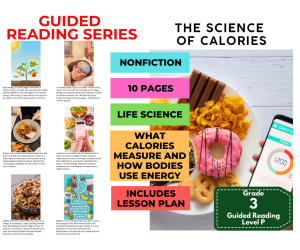
The Science of Calories: Guided Reading Level P with Lesson Plan
ELA, Resources for Teachers, Reading Comprehension, Reading, Science, Life Sciences, Health, P.E. & Health, Physics, Language Development, Grade 2, 3, 4, Worksheets & Printables, Worksheets, Teacher Tools, Centers, Activities, Literacy Readers, Quizzes, Quizzes and Tests, Assessments, Lesson Plans
This The Science of Calories (level p) guided reading book with lesson plan includes: Guided Reading Color Label (front cover x1) This is a quick way to match the book’s demands to what students can generally handle.. The overall goal is to use the level/color to pick books for several smaller groups. To qualify for a certain level, a student is expected to read a book from that level with about 90–94% accuracy. If a student is consistently accurate and understands, move up a level. If the student is struggling at that level, drop down and add more support. Each student will improve at completely different rates, but it is generally one of the best ways to check progress across the class. DOWNLOAD THE CATALOG TO VIEW ALL GUIDED READING BOOKS AVAILABLE (SORTED LEVELS A-Z) Pre-Reading Question (x1) Teacher asks the prompt aloud, can be while showing the cover or first page. Students share what they already know, or make educated guesses from the cover. Prompt them to use the target vocabulary. Write some of their responses on the board to look back at during the reading. Vocabulary Words (x5) Introduce the five words, best doing it one at a time. Start by saying it, while students repeat and then see if anyone knows what it means before reading further. Read through the meaning and try to briefly connect each word to a picture or gesture so it’s meaningful. Ask students to flip through the book pages and point to where they see each of the vocabulary words. While reading the book pause upon coming across one of the vocab words or read the sentence twice to make sure students understand the word has appeared. Optional: Ask students to raise hands whenever they see/hear one of the new words. Guided Reading Pages (x10) Check the book snapshot (below) for: primary topic - do you need to prep extra reading or intro materials on this? what is taught best - decide on 1-2 bullets to focus on, use the prompt or words provided here for best results. learning goals - what you are checking for students to be able to do after the session, elicit answers using prompts or words provided. key vocabulary (see section above). questions overview - so you know what is coming up and if you need to prep extra materials to assist understanding. Run the lesson You may have already looked at a few of the pages together, but you can show them some of the pictures again first to set meaning. Depending on how much time you have and how familiar your students are with guided reading class, you may want to read the book aloud first with the group first. Students whisper or partner read, while you listen in. If time, do it as a group, one student reading a page each. Use the guided page’s prompts to coach: “Check the picture / does it make sense?” “Point under the words / try the first sound” “Reread the sentence smoothly”. Try to focus more on one student per session (rotating every time), so you can work out if they are ready to move up or need to move down a level. Comprehension Questions (back cover x3) This is your way to check that students didn’t just say the words, but actually understood the text. First, let students answer by pointing to the page/picture and saying a short sentence. After any answer, follow with: “Show me where you found that in the text.” In bigger groups, have partners answer first (10–20 seconds), then call on 2–3 students to share. Differentiation tips: Emerging speakers/struggling readers: oral + pointing On-level: oral in a full sentence Higher: one written sentence or draw + label Book Snapshot Title: The Science of Calories Genre: Nonfiction (informational science text) Subject: Science (Nutrition/Human Body) Primary Topic: What calories measure and how bodies use energy Estimated Guided Reading Level (A–Z): P What This Book Teaches Best Defines energy as what living things need to survive and function, and connects energy to everyday examples like cars and lamps. Explains that a calorie measures energy in food (not weight or size) and describes it as a scientific unit of measurement. Shows how most energy starts with the sun , and how plants use photosynthesis to turn light into chemical energy stored in plant parts. Describes how the human body uses energy all the time (even during rest or sleep) to power the heart, lungs, and brain. Explains how food energy is released through digestion , how activity increases energy demand, and how extra calories may be stored as body fat. Learning Goals Explain what energy is and why living things need it. Describe what a calorie measures according to the text. Explain how plants get energy from the sun and where that energy is stored in a plant. Describe how digestion helps the body unlock energy from food. Describe how physical activity changes the body’s need for calories. Explain what happens when more calories are consumed than the body needs for daily activities. Key Vocabulary From the Text measurement — finding out how much of something there is. photosynthesis — plants use sunlight to make chemical energy. digestion — the process that unlocks energy in food. intestines — long tubes that help finish breaking down food. converted — changed from one form into another. Discussion Prompts Pre-reading question: What do you think calories tell us about the food we eat? Comprehension questions: What does the book say a calorie measures? Comprehension questions: How does the book explain that plants capture and store energy from the sun? Comprehension questions: What does the book say happens when a person consumes more calories than needed for daily activities? Printing Tips 1. Best Printing Method (Recommended) “Booklet” Printing (Best if Available) If your printer or PDF viewer supports Booklet Printing , use this. Settings to use: Print mode: Booklet Paper size: Letter or A4 (either works) Orientation: Landscape Print on both sides: Yes Flip on: Short edge Scaling: Fit to printable area Booklet subset: First test: Front sides only Then: Back sides only This will automatically: Pair pages correctly Put the cover on the outside Align everything for folding After printing, fold in half and staple along the spine . 2. If “Booklet” Printing Is NOT Available You can still print this correctly with manual duplex printing . Step-by-step: Open the PDF. Choose Print . Set: Orientation: Landscape Pages per sheet: 1 Print on both sides: Yes Flip on: Short edge Print all pages . Because each PDF page already contains two facing book pages, the result will still fold cleanly into a book. Thousands of Cored Education products are included with your TeachSimple membership. Download links and encyclopedia index available here.
Author Cored Education
Rating
Tags Reading Comprehension, Reading Passages, Reading, Guided Reading, Guided Reading Lesson Plan, Guided Reading Activity, Pre-reading, Science Lesson Plans, Life Science, Health

Flight – Digital Interactive Notebook
Science, Technology, Engineering, Grade 6, 7, 8, 9, Activities
Flight - Digital Interactive Notebook This educational resource is perfect for middle and high school students, fitting seamlessly in the growing trend of 1:1 classrooms. It incorporates all the conveniences digital technology has to offer while maintaining the effectiveness and familiarity of traditional notebooks. The Digital Interactive Notebook offers: 25 activity -rich lessons 36 interactive pages that are easily accessible on any digital device such as a tablet, cellphone or Chromebook A range of topics from the history and future of flight to environmental and social effects of airlines. It is flexible enough to adjust as needed for specific classroom settings. Slide pages can be effortlessly added or removed, allowing educators unprecedented control over content delivery. The resource is organized into six comprehensive chapters: The History and Future of Flight How Planes and Other Aircraft Fly Improving Flight How Living Things Fly Properties of Air Environmental & Social Effects of Airlines Note: {Each chapter comprises engaging activities such as drag-and-drop functions, audio recording answers, unit-wide vocabulary checks, research tasks} . All materials stored securely in cloud-based programs like Google Drive can be accessed anywhere at any time by both teachers & students leaving no room for lost materials or forgotten assignments. In summary, this innovative Flight - Digital Interactive Notebook encourages progressive learning enhancing student engagement & active participation understanding avionics' intricacies & its social implications making it an ideal resource option both in-person learning settings or for homework tasks.
Author Teach With Fergy
Tags Flight, Digital Interactive Notebook, Aviation Education, 1:1 Classroom, Cloud-based Learning
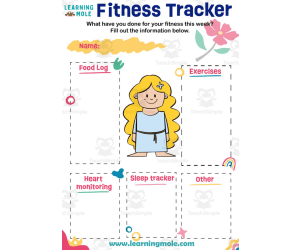
Fitness Tracker Activity
Science, Technology, Life Sciences, Human Body, Grade 2, 3, 4, 5, 6, 7, 8, 9, Activities
Activity Introduction An amazing activity designed for the students to learn more about STEM. Fitness Tracker Do you like STEM subjects? what is your favorite one? Have you ever tried to plant a seed? If yes, tell us more about it. Or have you ever tried to invent something? If yes, tell us more about it. And how do you think it will help us? Have you ever seen a microorganism under a microscope? What was it? And how it looked like? Mathematics is a marvelous subject. Let' sharpen our brains and solve some equations. Do you like timetable tricks? What is your favorite one? Do you know how to code? Have you ever created an app or a game before? If yes, how was it like? Fitness Tracker Activity The activity is perfect for encouraging the researching skills for the students, while learning more about this fantastic topic. Fitness Tracker This friendly designed worksheet is suitable for students at school, homeschooling, and as a group activity. Instructions Archimedes' puzzle is the world's oldest puzzle. Can you arrange all of the pieces to fit into a square? Format Available in a PDF format.
Author Educational Voice
Tags Fitness Tracker, Fitness Tracker Activity, Fitness Tracker Facts, Fitness Tracker Facts For Kids, Technology, Technology Facts, Technology Facts For Kids, STEM, STEM For Kids
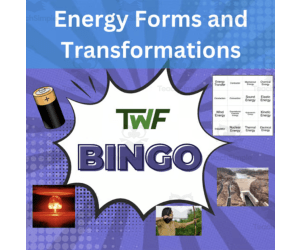
Energy Forms and Transformations Science BINGO Activity
Science, Physics, Grade 6, 7, 8, 9, 10, 11, Activities
Your students will love this engaging science review activity. Everyone loves BINGO and it makes for a great review activity that is fun and competitive. This interactive game reinforces key scientific concepts and theories, ensuring curriculum relevance and accuracy. The game package includes 36 unique 4x4 bingo cards featuring essential terms and concepts from Energy Forms and Transformations, a set of call-out cards with clear and concise definitions tailored to the students' level, and detailed gameplay instructions. To play, simply distribute the bingo cards to your students along with markers or chips. Read out the definitions from the call-out cards in a random order, and have students place a marker on the corresponding term on their card. The first student to complete a row or column exclaims "Bingo!" and emerges victorious. Following the game, engage in a discussion of the terms to reinforce understanding and clarify any misconceptions. The beauty of this game is that it allows for multiple rounds of learning and review. Teachers will appreciate the game's ability to encourage active participation and engagement in the classroom setting, catering to various student learning styles and promoting differentiated learning. By matching definitions to terms on their bingo cards, students actively engage with the material, enhancing their retention and comprehension of complex scientific theories. Here is a sample from the instructions. BINGO – Instructions, Terms, and Descriptions Cut out and distribute the BINGO cards to your students. Each student will get a unique card. Students can use markers or chips to cover squares that have been called. Print out and cut out each term/description below – these are the call-out cards. Fold each call-out card and place in a hat or box and remove one at a time. After you’ve read the call-out card description, your students are to place a marker on the term associated with the description located on their card. The first student to get 4 in a row horizontally or vertically, wins. Ensure accuracy by checking marked terms on student card to the called-out descriptions.
Author Teach With Fergy
Tags Science Bingo, Bingo Activity, Energy Forms, Energy Transformations
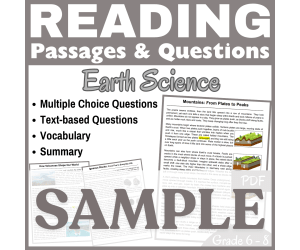
Volcanoes, Rocks, & Mountains: SAMPLE Reading Passage (PDF)
Science, Earth and Environmental Sciences, ELA, Reading, Reading Comprehension, Strategies, Resources for Teachers, Earth Sciences, Geology, Grade 6, 7, 8, 9, Writing Prompts, Worksheets & Printables, Centers, Activities, Teacher Tools, Assessments, Quizzes and Tests, Quizzes, Tests
This is a ONE PASSAGE SAMPLE. The following is the description of the FULL resource and the downloading links: Volcanoes, Rocks, & Mountains: Reading Comprehension Passages (PDF) This very engaging collection of earth science reading passages about Mountains, Volcanoes, and Igneous Rocks is designed to bridge the gap between science and literacy through strengthening reading comprehension and sparking scientific curiosity in middle school students. Each passage blends English Language Arts skills with accurate science content that supports NGSS classroom practice. Ideal for interdisciplinary learning in ELA and Science. Suitable for Grade 9 review, too! What Is Included? There are (3) informational passages: Mountains: From Plates to Peaks See how plate collisions fold rock, faults lift blocks, and volcanism builds peaks. Learn how rivers, glaciers, and gravity continue to reshape ranges over time. How Volcanoes Shape Our World Examine hazards such as ash, gases, lahars, and pyroclastic flows, along with benefits like fertile soils, mineral resources, geothermal energy, and new land. Learn how monitoring and planning reduce risk. Igneous Rocks: From Fire to Everyday Life Compare intrusive and extrusive rocks, link cooling rates to crystal size and texture, and connect granite, basalt, pumice, and obsidian to everyday uses in buildings, roads, tools, and art. Student Tasks for Each Passage: 5 multiple-choice questions targeting main idea, key details, inference, vocabulary in context, and use of evidence 5 vocabulary matching items with clear, student-friendly definitions 5 text-based questions that require citing specific lines or facts 1 summary prompt that asks students to condense central ideas accurately Full answer key for every section Available Formats for this Resource Word Docs Google Docs FULL CATALOG OF DOWNLOADING LINKS HERE Other Science Reading Collections and Topics You May Find in the Store: 1. Astronomy & Space Science 2. Volcanoes, Rocks, & Mountains 3. Rock Cycle, Soil, & Sinkholes 4. Mars, Glaciers, & Antarctica 5. Water Cycle, Acid Rain, & Wastewater 6. Insects, Animals, & Ecosystems 7. Bioluminescence & Insects 8. Animal Skin, Cats, & T. Rex 9. Human Body and Senses 10. Health & Applied Bioscience 11. Waves, Light, & Imaging 12. Electricity & Energy 13. Motion & Materials 14. Chemistry and Materials Science 15. Electromagnetism 16. Acids and Bases 17. Gas Laws 18. Biotechnology 19. Periodic Trends 20. Protists and Fungi 21. Microevolution 22. Blood 23. Chemical Bonding 24. Magnets 25. Muscles 26. Nuclear Chemistry 27. Electromagnetic Devices 28. Epigenetics 29. The Law of Conservation of Mass 30. Atomic Models 31. Isotopes and Ions 32. Light 33. Human-Environment Interaction 34. Theory of Evolution 35. Photosynthesis 36. Origins of Life and Early Earth 37. Gene Expression and Regulation 38. Thermochemistry 39. Allergies 40. Coevolution 41. Birth to Adulthood 42. Cells 43. Entropy and Free Energy 44. The Human Brain 45. Mixtures and Solutions 46. Invertebrates 47. Zoo Animals 48. Biochemistry 49. Animal Behavior 50. Population Ecology ...and many more engaging science reading passages that cover intriguing and important topics designed to spark curiosity and support student learning. Product Details Length: 13 pages total Grades: 6–8, also suitable for Grade 9 review Use cases: close reading, stations, homework, intervention, test prep, and sub plans Standards support: reinforces informational-text skills and supports NGSS-style sense making through observation, modeling, and clear use of claim, evidence, and reasoning Why Teachers Choose This Set Authentic science content paired with rigorous literacy practice Consistent task structure across all passages for easier planning and smoother student routines Clear, age-appropriate writing that builds confidence without oversimplifying Use this set to reinforce ELA skills in science, to add literacy to your lessons, or to support independent work. The passages strengthen main idea, evidence use, vocabulary in context, inference, cause and effect, and summary writing. With ready-to-use assessments and complete answer keys, you can provide focused practice that is simple to run and fast to review.
Author Middle & High School - CORED Education
Rating 5
Tags Middle School, Reading Comprehension, Reading Strategies, Reading Passages, ELA, Centers, Reading Passage, Assessments, Vocabulary, Earth Science
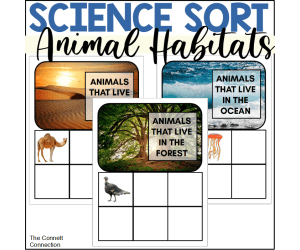
Animal Habitats Sort
Science, Life Sciences, Biology, Grade 1, 2, 3, Activities, Centers, Assessments, Teacher Tools
Allow students to sort animals by which habitat they live in. What is Included: There are sorting card headers for each habitat. There are sorting mats for each habitat. There are three to six picture cards for each of the sets of sorting activities. The animal habitats included in this set include: Antarctic, Arctic, Beach, Desert, Forest, Grassland, Ocean, Pond, Rain Forest, and Swamp Each sorting mat includes a real life example of an animal that belongs in that particular habitat. All of the picture cards also include real photographs of each habitat. What Questions are Asked: To use these, students will lay out either the header cards or the sorting mats. They will then sort the animal images beneath or on top of the correct sorting mat. When to Use: Science Center - The sorting mats can be placed in a science center for students to learn about living things and where they live. Morning Work - These animal sorts can allow teachers to create quick and easy morning activities for students while they wait on their classmates to arrive to class. Independent Practice - These animal sorts are great for students to independently work on living things. Emergency Sub Plans - The low prep nature and easy to set up activity , makes these worksheets a great activity to leave with subs to assign to students. Small Group Activity - These animal sorts can be used in small groups so teachers can target the students who need extra practice with living things. Writing Review Activity - These animal sorts work well as a review to reinforce student's learning of living things. These sorting activities are easy to create. The mats just need to be printed out. The picture cards need to be printed and cut apart. Once made, the sort can be used over and over.
Author The Connett Connection
Rating
Tags Science Sort, Hands On Assessment, Animal Habitats, Habitats
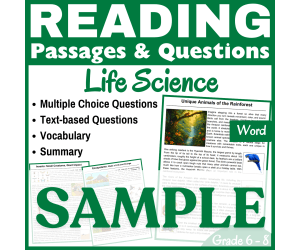
Insects, Animals, & Ecosystems: SAMPLE Reading passage (Word)
Science, ELA, Reading, Reading Comprehension, Strategies, Resources for Teachers, Life Sciences, Animals, Insects, Nature & Plants, Grade 6, 7, 8, 9, Writing Prompts, Worksheets & Printables, Centers, Activities, Teacher Tools, Assessments, Quizzes and Tests, Quizzes, Tests
This is a ONE PASSAGE SAMPLE. The following is the description of the FULL resource and the downloading links: Insects, Animals, & Ecosystems: Reading Comprehension Passages (Word) This very engaging collection of life science reading passages about Insects, Animals, & Ecosystems is designed to bridge the gap between science and literacy through strengthening reading comprehension and sparking scientific curiosity in middle school students. Each passage blends English Language Arts skills with accurate science content that supports NGSS classroom practice. Ideal for interdisciplinary learning in ELA and Science. Suitable for Grade 9 review, too! What Is Included? There are (3) informational passages: Ecosystems: Webs of Life and Change See how living things and their surroundings fit together. Follow energy from producers to consumers to decomposers, and notice how fires, floods, or people can disturb a system and how it can recover. Insects: Small Creatures, Giant Impact Meet the helpers that pollinate, recycle waste, and feed countless animals. Learn how simple body parts and smart behaviors let insects thrive almost everywhere. Unique Animals of the Rainforest Visit a forest bursting with life, from Hyacinth Macaws and pink river dolphins to golden lion tamarins and poison dart frogs. Understand why protecting habitats keeps these remarkable species alive. Student Tasks for Each Passage: 5 multiple-choice questions targeting main idea, key details, inference, vocabulary in context, and use of evidence 5 vocabulary matching items with clear, student-friendly definitions 5 text-based questions that require citing specific lines or facts 1 summary prompt that asks students to condense central ideas accurately Full answer key for every section Available Formats for this Resource PDF Google Docs FULL CATALOG OF DOWNLOADING LINKS HERE Other Science Reading Collections and Topics You May Find in the Store: 1. Astronomy & Space Science 2. Volcanoes, Rocks, & Mountains 3. Rock Cycle, Soil, & Sinkholes 4. Mars, Glaciers, & Antarctica 5. Water Cycle, Acid Rain, & Wastewater 6. Insects, Animals, & Ecosystems 7. Bioluminescence & Insects 8. Animal Skin, Cats, & T. Rex 9. Human Body and Senses 10. Health & Applied Bioscience 11. Waves, Light, & Imaging 12. Electricity & Energy 13. Motion & Materials 14. Chemistry and Materials Science 15. Electromagnetism 16. Acids and Bases 17. Gas Laws 18. Biotechnology 19. Periodic Trends 20. Protists and Fungi 21. Microevolution 22. Blood 23. Chemical Bonding 24. Magnets 25. Muscles 26. Nuclear Chemistry 27. Electromagnetic Devices 28. Epigenetics 29. The Law of Conservation of Mass 30. Atomic Models 31. Isotopes and Ions 32. Light 33. Human-Environment Interaction 34. Theory of Evolution 35. Photosynthesis 36. Origins of Life and Early Earth 37. Gene Expression and Regulation 38. Thermochemistry 39. Allergies 40. Coevolution 41. Birth to Adulthood 42. Cells 43. Entropy and Free Energy 44. The Human Brain 45. Mixtures and Solutions 46. Invertebrates 47. Zoo Animals 48. Biochemistry 49. Animal Behavior 50. Population Ecology ...and many more engaging science reading passages that cover intriguing and important topics designed to spark curiosity and support student learning. Product Details Length: 14 pages total Grades: 6–8, also suitable for Grade 9 review Use cases: close reading, stations, homework, intervention, test prep, and sub plans Standards support: reinforces informational-text skills and supports NGSS-style sense making through observation, modeling, and clear use of claim, evidence, and reasoning Why Teachers Choose This Set Authentic science content paired with rigorous literacy practice Consistent task structure across all passages for easier planning and smoother student routines Clear, age-appropriate writing that builds confidence without oversimplifying Use this set to reinforce ELA skills in science, to add literacy to your lessons, or to support independent work. The passages strengthen main idea, evidence use, vocabulary in context, inference, cause and effect, and summary writing. With ready-to-use assessments and complete answer keys, you can provide focused practice that is simple to run and fast to review.
Author Middle & High School - CORED Education
Rating
Tags Middle School, Reading Comprehension, Reading Strategies, ELA, Centers, Reading Passage, Assessments, Vocabulary, Life Science, Insects
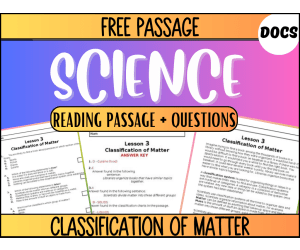
Free Reading Passage: Classification of Matter (Docs)
ELA, Reading, Science, Physics, Common Core, Reading Comprehension, ESL, Language Development, Vocabulary, Resources for Teachers, Grade 2, 3, 4, Centers, Activities, Assessments, Teacher Tools, Tests, Quizzes and Tests, Worksheets, Worksheets & Printables
Free Reading Passage on Classification of Matter for Physical Science What's inside this free product? Science Reading Comprehension Passage3: Classification of Matter Independent Docs Version: This is the independent Docs version containingone lesson. Product Info: 5 PAGES (US English with Answers) Docs Version Teaching Duration: 90 Minutes Science Reading Comprehension Outline: Targeted for students in 3rd and 4th grades, these reading passages are enhanced with illustrations and graphs to elucidate critical points. Each lesson aligns with the Common Core State Standards, allowing you to integrate science reading practice effortlessly, knowing that minimal preparation is needed on your part. Each passage comes with a variety of questions in different formats, including multiple-choice formats, data analysis, and fill-in-the-blanks. The topics covered strike a balance between engaging content and core curriculum-based science subjects. Versatile in application, these lessons are suitable for a variety of settings such as whole-class instruction, morning activities, independent desk work, small group discussions, contingency plans for substitute teachers, homework assignments, or even special holiday-themed tasks. FULL CATALOG OF DOWNLOAD LINKS HERE Grade 3/4 Links: Physical Science Part 1 - Properties of Objects and Materials Google Docs/Slides/Forms PDF PPT Word Free Supplementary Pack Accompanying Videos Physical Science Part 2 - Position and Motion of Objects Google Docs/Slides/Forms PDF PPT Word Free Supplementary Pack Accompanying Videos Physical Science Part 3 - Light, Heat, Electricity, Magnetism Google Docs/Slides/Forms PDF PPT Word Free Supplementary Pack Accompanying Videos Life Science Part 1 - Characteristics of Organisms Google Docs/Slides/Forms PDF PPT Word Free Supplementary Pack Accompanying Videos Life Science Part 2 - Life Cycles of Organisms Google Docs/Slides/Forms PDF PPT Word Free Supplementary Pack Accompanying Videos Life Science Part 3 - Organisms and Environments Google Docs/Slides/Forms PDF PPT Word Free Supplementary Pack Accompanying Videos Earth Science Part 1 - Properties of Earth Materials Google Docs/Slides/Forms PDF PPT Word Free Supplementary Pack Accompanying Videos Earth Science Part 2 - Changes in the Earth and Sky Google Docs/Slides/Forms PDF PPT Word Free Supplementary Pack Accompanying Videos Earth Science Part 3 - Objects in the Sky Google Docs/Slides/Forms PDF PPT Word Free Supplementary Pack Accompanying Videos For similar products and other frees, do check out Cored Group on TeachSimple .
Author Cored Education
Tags Science, Elementary, Reading, Comprehension, Vocabulary, Answers, Physics, Physical Science, Ccss, Common Core

TinkerCAD step-by-step instructions for Snowflake Ornament
Special Resources, Science, Technology, Engineering, Grade 5, 6, 7, 8, 9, 10, 11, 12, Activities, Projects
TinkerCAD step-by-step instructions for Snowflake Ornament Students only need to know the bare basics to complete this. I tested this with a fifth-grade class and most could complete it with no help. Designed to print with no supports for easy printing. Include TinkerCAD tool guide! Has a content page. Great beginners’ tool for learning to make 3D models and learn TinkerCAD. TinkerCAD is a free online program that makes 3D model that work on 3D printers, laser etching machines, water jets, plasma cutters and many more!! Tinkercad is an easy-to-use, browser-based computer-aided design (CAD) software developed by Autodesk. It is primarily used for creating and designing 3D models, particularly in the field of 3D printing. Tinkercad is popular among beginners and hobbyists due to its intuitive interface and simplified tools. Here are some key features and uses of Tinkercad: 1) 3D Modeling: Tinkercad allows users to create 3D models by combining basic shapes and manipulating them using tools such as scaling, rotating, and moving. It provides a wide range of primitive shapes like cubes, spheres, cylinders, and more, which can be customized to create complex designs. 2) Design Customization: Users can apply various modifications to their designs, including resizing, rounding edges, adding text, creating holes, and aligning objects. These tools help in refining the models and making them suitable for specific purposes or fitting them with other components. 3)Import and Export: Tinkercad supports the import of existing 3D models in STL and OBJ formats, allowing users to modify and incorporate them into their designs. It also offers export options to save the designs as STL files, which are widely used in 3D printing. 4) Collaboration and Sharing: Tinkercad provides features for collaboration, allowing multiple users to work on the same project simultaneously. It enables real-time sharing and editing, making it convenient for team projects or educational purposes. 5) Electronics Integration: One notable aspect of Tinkercad is its integration with electronics. It offers a range of electronic components, including resistors, LEDs, motors, and microcontrollers, which can be used to create interactive models and prototypes. Users can simulate circuit connections and test their designs before implementation. 6) Educational Tool: Tinkercad is widely used in educational settings, particularly for teaching students about 3D design, modeling, and prototyping. Its simple interface and beginner-friendly tools make it accessible to users of all ages and skill levels. Overall, Tinkercad is a versatile and user-friendly CAD software that allows individuals to create and customize 3D models. Whether you're a hobbyist, student, or professional, Tinkercad provides a valuable platform for designing, prototyping, and exploring the world of 3D printing and modeling. Total pages: 30 pages Commands to be learned: Group Ungroup Align Mirror Duplicate Holes Solids Rotate Move Drop Subjects: Geometry Engineering Career and technical education Types: Projects Handouts Printables
Author MontyWorks
Tags TinkerCAD, 3D Printing, 3D Printer, Projects
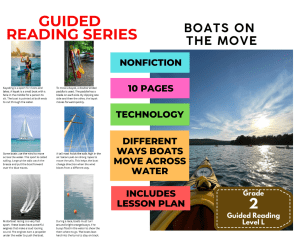
Guided Reading Level L - Boats on the Move (with Lesson Plan)
ELA, Resources for Teachers, Reading Comprehension, Reading, Science, Engineering, Technology, Physics, Sports, P.E. & Health, Grade 2, 3, 4, Worksheets & Printables, Worksheets, Teacher Tools, Centers, Activities, Literacy Readers, Quizzes, Quizzes and Tests, Assessments, Lesson Plans
This Guided Reading Book - Boats on the Move (Level L) with lesson plan includes: Guided Reading Color Label (front cover x1) This is a quick way to match the book’s demands to what students can generally handle.. The overall goal is to use the level/color to pick books for several smaller groups. To qualify for a certain level, a student is expected to read a book from that level with about 90–94% accuracy. If a student is consistently accurate and understands, move up a level. If the student is struggling at that level, drop down and add more support. Each student will improve at completely different rates, but it is generally one of the best ways to check progress across the class. DOWNLOAD THE CATALOG TO VIEW ALL GUIDED READING BOOKS AVAILABLE (SORTED LEVELS A-Z) Pre-Reading Question (x1) Teacher asks the prompt aloud, can be while showing the cover or first page. Students share what they already know, or make educated guesses from the cover. Prompt them to use the target vocabulary. Write some of their responses on the board to look back at during the reading. Vocabulary Words (x5) Introduce the five words, best doing it one at a time. Start by saying it, while students repeat and then see if anyone knows what it means before reading further. Read through the meaning and try to briefly connect each word to a picture or gesture so it’s meaningful. Ask students to flip through the book pages and point to where they see each of the vocabulary words. While reading the book pause upon coming across one of the vocab words or read the sentence twice to make sure students understand the word has appeared. Optional: Ask students to raise hands whenever they see/hear one of the new words. Guided Reading Pages (x10) Check the book snapshot (below) for: primary topic - do you need to prep extra reading or intro materials on this? what is taught best - decide on 1-2 bullets to focus on, use the prompt or words provided here for best results. learning goals - what you are checking for students to be able to do after the session, elicit answers using prompts or words provided. key vocabulary (see section above). questions overview - so you know what is coming up and if you need to prep extra materials to assist understanding. Run the lesson You may have already looked at a few of the pages together, but you can show them some of the pictures again first to set meaning. Depending on how much time you have and how familiar your students are with guided reading class, you may want to read the book aloud first with the group first. Students whisper or partner read, while you listen in. If time, do it as a group, one student reading a page each. Use the guided page’s prompts to coach: “Check the picture / does it make sense?” “Point under the words / try the first sound” “Reread the sentence smoothly”. Try to focus more on one student per session (rotating every time), so you can work out if they are ready to move up or need to move down a level. Comprehension Questions (back cover x3) This is your way to check that students didn’t just say the words, but actually understood the text. First, let students answer by pointing to the page/picture and saying a short sentence. After any answer, follow with: “Show me where you found that in the text.” In bigger groups, have partners answer first (10–20 seconds), then call on 2–3 students to share. Differentiation tips: Emerging speakers/struggling readers: oral + pointing On-level: oral in a full sentence Higher: one written sentence or draw + label Book Snapshot Title: Boats on the Move Genre: Nonfiction (informational) Subject: Science (Forces & Motion) / Reading (Informational Text) Primary Topic: Different ways boats move across water Estimated Guided Reading Level (A–Z): L What This Book Teaches Best Different ways boats move on water (wind, oars, paddles, engines). How specific boat parts help movement (sails, mast, ropes, propeller). How coordinated actions affect motion (oars dipping “at the same time” to go straight). How markers guide movement during a race (boats turn around bright orange buoys to stay on track). Comparing speed and movement styles (quiet glide vs fast roar; forward motion by alternating paddle sides). Learning Goals Students will identify several ways boats move across the water using details from the text. Students will explain how sails and wind help pull a boat forward. Students will describe how rowers use oars together to move a boat straight ahead. Students will describe how a double-ended paddle helps a kayak move forward quickly. Students will explain how an engine and propeller help push a motorboat through the water. Students will describe why boats turn around buoys during a race, based on the text. Key Vocabulary From the Text mast — a tall pole that holds sails up. rhythm — a steady pattern of movement. double-ended — having an end on both sides. propeller — a spinning part that helps push a boat. buoys — floating markers that show where to go. Discussion Prompts Pre-reading question: What are some different ways a boat could move across the water? Comprehension questions: How do large white sails help a boat move forward? What do rowers do “at the same time,” and what does that help the boat do? Why must boats turn around bright orange buoys during a race? Printing Tips 1. Best Printing Method (Recommended) “Booklet” Printing (Best if Available) If your printer or PDF viewer supports Booklet Printing , use this. Settings to use: Print mode: Booklet Paper size: Letter or A4 (either works) Orientation: Landscape Print on both sides: Yes Flip on: Short edge Scaling: Fit to printable area Booklet subset: First test: Front sides only Then: Back sides only This will automatically: Pair pages correctly Put the cover on the outside Align everything for folding After printing, fold in half and staple along the spine . 2. If “Booklet” Printing Is NOT Available You can still print this correctly with manual duplex printing . Step-by-step: Open the PDF. Choose Print . Set: Orientation: Landscape Pages per sheet: 1 Print on both sides: Yes Flip on: Short edge Print all pages . Because each PDF page already contains two facing book pages, the result will still fold cleanly into a book. Thousands of Cored Education products are included with your TeachSimple membership. Download links and encyclopedia index available here.
Author Cored Education
Rating
Tags Reading Comprehension, Reading Passages, Reading, Guided Reading, Guided Reading Lesson Plan, Guided Reading Activity, Pre-reading, Science Lesson Plans, Physics, Technology

Plants Science Center
ELA, Language Development, Vocabulary, Science, Basic Science, Kindergarten, Preschool, Grade 1, 2, 3, Centers, Activities
Plants Science Center The Plants Science Center is a teaching resource designed specifically to enhance the learning experience of preschool through 3rd grade students. This tool focuses on key areas such as visual discrimination, sorting observations, nonstandard measurement, and expressing thoughts through writing and drawing. The kit is centered around understanding plants in a fun and engaging manner. This ready-to-use center includes seven different activities: Build a Garden encourages learners to visualize roots below the soil by placing magnet plants onto a garden template. Plant Observation: students classify plants by various features or select one vegetable for detailed examination and documentation. Not Like the Others: makes children identify differences in pictorial representations. Seed Journal: invites them to chart their plant's growth over time. Vegetable Measurement: introduces nonstandard units of measurements with life-sized vegetable cards that learners can measure using connecting cubes or other items. Plant Parts Sorting Cards: kids categorize food items according to which part of the plant we eat (e.g., potatoes as root or celery as stem). The set also comes with relevant supplements like "Plants We Eat" bulletin board title, five food accent circles etc. This teaching resources revolves around topics like: - Weather - Animal Habitats during Winter months; - Exploring Outer Space;- Study of Magnets plus more. Please note: The content provided here comes in PDF format requiring access suitable app/programs displaying digital documents correctly
Author The Proactive Classroom
Tags Plant Science, Hands-on Learning, Nature Education, Science Kit, Classroom Resources
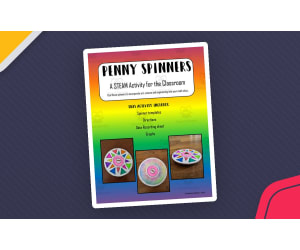
Penny Spinners STEAM Activity
Science, Engineering, STEM, Math, Statistics, Graphing, Grade 2, 3, 4, Activities
This Penny Spinners STEAM Activity will allow you to incorporate art, science and engineering into your math classroom. This activity includes: - Spinner templates - Directions - Data Recording sheet - Graphs Directions are included for creating spinners. Students will create their spinners and begin collecting data!
Author O'Hoppy Day
Tags Science, Penny Spinners, STEAM, Cross-curricular, Template, Craft
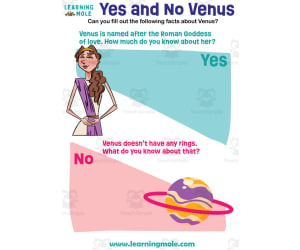
Yes and No Venus Activity
Space, Earth and Environmental Sciences, Science, Grade 3, 4, 5, 6, 7, 8, 9, 10, Activities
Activity Introduction An amazing activity designed for the students to learn more about space facts. Yes and No Venus Do you like reading about space? If yes, what is your favorite topic? What do you know about our solar system? What is the smallest planet in our solar system? What is the biggest planet in our solar system? What is the hottest planet in our solar system? And what is the coldest one? Do you think there are aliens? If yes, what do you think they look like? What do they eat and how they speak to each other? Where do they live? What is a galaxy? And what is a milky way? Have you recently saw a shooting star? If yes, tell us more about it, like when did it happen and where? What is a blackhole? Can a blackhole gets bigger by time? Do you like counting the stars? What do you think a star is made of? Yes and No Venus Activity The activity is perfect for encouraging the researching skills for the students, while learning more about the fantastic space. Yes and No Venus This friendly designed worksheet is suitable for students at school, homeschooling, and as a group activity. Instructions Can you fill out the following facts about Venus? Format Available in a PDF format.
Author Educational Voice
Tags Yes And No Venus Activity, Venus Activity, Venus, Venus Facts, Venus Facts For Kids, Planet, Planets, Planets Facts, Planets Facts For Kids, Space

Science Reading Comprehension Passage: Eel Power (Word)
Science, ELA, Reading, Reading Comprehension, Strategies, Resources for Teachers, Physics, Grade 6, 7, 8, 9, Writing Prompts, Worksheets & Printables, Centers, Activities, Teacher Tools, Assessments, Quizzes and Tests, Quizzes, Tests
Science Reading Comprehension Passage and Questions: Eal Power (Word) This very engaging science reading passage is about electric eels and how their natural electrical pulses can make holiday lights flicker . More specifically, it explains how electric eels use special cells called electrocytes to produce electricity for sensing, communication, hunting, and defense. It then describes how aquariums in Japan and Utah use safe equipment, such as aluminum panels and wires, to collect the eel’s brief pulses and make Christmas tree lights flicker. The passage also introduces the broader idea of bioelectricity , or electricity made by living things. This passage is designed to bridge the gap between science and literacy through strengthening reading comprehension and sparking scientific curiosity in middle school students. The passage blends English Language Arts skills with accurate science content that supports NGSS classroom practice. Ideal for interdisciplinary learning in ELA and Science. Suitable for Grade 9 review, too! Student Tasks for The Passage: 5 multiple-choice questions targeting main idea, key details, inference, vocabulary in context, and use of evidence 5 vocabulary matching items with clear, student-friendly definitions 5 text-based questions that require citing specific lines or facts 1 summary prompt that asks students to condense central ideas accurately Full answer key for every section Available Formats for this Resource PDF Fillable PDF Google Docs FULL CATALOG OF DOWNLOADING LINKS HERE Product Details Length: 5 pages total Grades: 6–8, also suitable for Grade 9 review Use cases: close reading, stations, homework, intervention, test prep, and sub plans Standards support: reinforces informational-text skills and supports NGSS-style sense making through observation, modeling, and clear use of claim, evidence, and reasoning Why Teachers Choose This Set Authentic science content paired with rigorous literacy practice Consistent task structure across all passages for easier planning and smoother student routines Clear, age-appropriate writing that builds confidence without oversimplifying Other Science Reading Collections you May find in the store: 1. Astronomy & Space Science 2. Volcanoes, Rocks, & Mountains 3. Rock Cycle, Soil, & Sinkholes 4. Mars, Glaciers, & Antarctica 5. Water Cycle, Acid Rain, & Wastewater 6. Insects, Animals, & Ecosystems 7. Bioluminescence & Insects 8. Animal Skin, Cats, & T. Rex 9. Human Body and Senses 10. Health & Applied Bioscience 11. Waves, Light, & Imaging 12. Electricity & Energy 13. Motion & Materials 14. Chemistry and Materials Science Use this set to reinforce ELA skills in science, to add literacy to your lessons, and to support independent work. The passages strengthen main idea, evidence use, vocabulary in context, inference, cause and effect, and summary writing. With ready-to-use assessments and complete answer keys, you can provide focused practice that is simple to run and fast to review.
Author Middle & High School - CORED Education
Rating
Tags Middle School, Reading Comprehension, Reading Strategies, ELA, Centers, Reading Passage, Assessments, Vocabulary, Physics, Electricity

Grassland Habitat animals flashlight cards hidden picture activity
Animals, Life Sciences, Science, Environmental Science, Earth and Environmental Sciences, Kindergarten, Preschool, Toddler, Grade 1, 2, Flashcards, Worksheets & Printables, Centers, Activities, Games
Make learning about grassland habitats and animals fun and interactive with these Grassland Habitat Animals Flashlight Cards! Students will use a flashlight to reveal hidden animal pictures while practicing animal recognition and building science vocabulary through an exciting hands-on activity. I like using these flashlight cards during grassland habitat units, animal science lessons, wildlife studies, nature-themed activities, preschool and kindergarten science centers, and homeschool learning. It's an engaging, low-prep activity that adds a fun element of discovery to habitat and animal learning. What You Will Get This printable Grassland Habitat Animals Flashlight Cards resource gives students an exciting way to discover hidden grassland animals and review animal and habitat vocabulary. What's Included in this Resource? • Printable grassland animal flashlight cards • Hidden picture reveal activity • Grassland animal and habitat vocabulary • Hands-on flashlight discovery activity • Student-friendly science center format • Easy-to-use printable cards • Great for independent or small-group learning This resource is perfect for: • Grassland habitat science units • Grassland animal studies • Wildlife and nature lessons • Animal science activities • Preschool and kindergarten science centers • Life science learning • Small-group activities • Homeschool learning Why you will love this? • Easy to prepare and use • Creates an exciting hands-on learning experience • Builds observation and visual recognition skills • Reinforces grassland animal vocabulary • Encourages curiosity and independent discovery • Great for science centers and habitat-themed units These Grassland Habitat Animals Flashlight Cards are a fun way for young learners to discover hidden grassland animals, practice animal recognition, and build observation skills through an interactive habitat science activity.
Author Perfect_Printables
Rating
Tags Animal Science, Science Center Activities, Hidden Picture Activities, Flashlight Cards, Wildlife Activities, Animal Adaptation, Animal Habitat Activity, Grassland Animals, Grassland, Grassland Activity