



5,415 products added recently
Page 145 - Newest Teaching Resources

 Show filters

Famous Explorers of the World word search, scramble and crossword
ELA, Vocabulary, Geography, Grade 4, 5, 6, Word Searches, Worksheets, Worksheets & Printables, Crosswords Puzzles
Famous Explorers of the World word search, scramble and crossword I made this famous explorers puzzle set for my 4th graders during our world history unit. The kids could name Columbus but had no idea about Magellan, da Gama, Cook, or other explorers from around the globe. So I put together a word search, a word scramble, and a crossword using words like Columbus, Magellan, da Gama, Cook, Cabot, Hudson, Pizarro, Cortes, Lewis, Clark, exploration, voyage, discovery, route, and navigation. Nothing fancy — just puzzles to help the names and their accomplishments finally stick. The PDF is four pages. Three puzzles plus one answer key page. The word search works well for quiet time after recess. The scramble gets them talking because they argue about who was the first to circumnavigate the globe. The crossword I use for partners. I added a couple simple ship and compass drawings but nothing too busy. Works for 4th through 5th grade. Print and go. Sometimes I have early finishers pick one explorer and write what they discovered on the back. The kids actually ask for these now.
Author Lapiiin Art Activities
Rating
Tags Word Search, Word Scramble, Printable Puzzles, Crossword, Explorers, Social Studies, Exploration

Creative Writing Prompts Grade 3 | I Turn Into an Animal
Creative Writing, Writing, ELA, Grade 2, 3, 4, Writing Prompts, Worksheets & Printables
Creative Writing Prompts Grade 3 | I Turn Into an Animal Get a creative writing prompt resource for 3rd grade on the topic of animals. What does this resource include? This resource contains 8 creative writing prompts on animal-related topics, each with sentence starters for each task, guiding questions to support ideas, word banks with helpful vocabulary, separate writing pages with plenty of space, “How to Write a Story” guide (beginning, middle, end), 3 example stories. Each reading passage is unique. The animal topics were carefully selected and each passage is accompanied by appropriate graphics. What is it suitable for? The material is suitable for English language arts classes. It is ideally suited for 3rd grade. This material is also suitable for weaker 4th-grade classes or particularly strong 2nd-grade classes. It is suitable for teachers looking for teaching materials that can be used immediately. No tedious adapting or formatting required. Simply print it out and use it directly in class. It is suitable for various teaching formats: - writing workshop - literacy centers - independent work - early finishers - homework What topics does the reading comprehension cover? 1 High Up in the Sky 2 A Day as a Wolf 3 Life in the Ocean 4 Quiet in the Jungle 5 A Cold Day 6 Strong Like an Elephant 7 Clever Like a Fox 8 Everything Is Slow In addition, there are two advanced-level problems (easy and hard). The material is provided as a PDF file to make it easy to print and use in class. It is part of a larger series. If you like this material, you can explore creative writing prompt resources on a variety of other topics in my shop that will enrich your lessons. In addition to creative writing prompts, I also offer reading comprehension, math word problems, informational texts, and reading tests.
Author Smart Learning Classroom
Rating
Tags Creative Writing, Writing, Pet, Animal, Writing Prompts, Grade 3, Writing Workshop, Story Writing, Animals, Fox

Reading Comprehension Birds | Grade 3 Reading Activities
Reading Comprehension, Reading, ELA, Grade 3, 4, Teacher Tools, Worksheets & Printables, Tests, Quizzes and Tests
Reading Comprehension Worksheets – Birds Theme | Grade 3 Get a reading comprehension resource for 3rd grade on the topic of Birds. What does this resource include? This resource contains 10 reading passages on bird-related topics, each with 5 exercises. These include multiple-choice, true or false, vocabulary, and creative tasks. Each reading passage is unique. The Bird topics were carefully selected and each passage is accompanied by appropriate graphics. Additionally, answers are provided at the end of the resource to facilitate its use in elementary school. What is it suitable for? The material is suitable for English language arts classes. It is ideally suited for 3rd grade. This material is also suitable for weaker 4th-grade classes or particularly strong 2nd-grade classes. It is suitable for teachers looking for teaching materials that can be used immediately. No tedious adapting or formatting required. Simply print it out and use it directly in class. It is suitable for various teaching formats: - Independent work - Literacy centers - Small group instruction - Homework - Reading workshops - Classroom literacy rotations What topics does the reading comprehension cover? 🐦 1 The Quick Sparrow 🐦⬛ 2 The Smart Crow 🦉 3 The Quiet Owl 🦅 4 The Proud Eagle 🦜 5 The Colorful Parrot 🕊 6 The Fast Swallows 🪵 7 The Pecking Woodpecker 🦩 8 The Elegant Flamingos 🌊 9 The Fast Seagulls 🌺 10 The Little Hummingbird The material is provided as a PDF file to make it easy to print and use in class. It is part of a larger series. If you like this material, you can explore reading comprehension resources on a variety of other topics in my shop that will enrich your lessons. In addition to reading comprehension, I also offer creative writing, math word problems, informational texts, and reading tests.
Author Smart Learning Classroom
Rating
Tags Reading Comprehension, Grade 3 Reading, Informational Texts, Reading Activities, Reading Passages, Grade 4 Reading, Vocabulary Activities, Animals, Birds, Bird
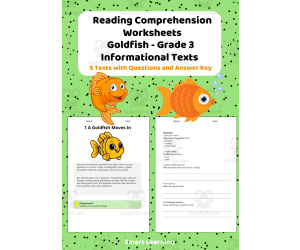
Reading Comprehension Goldfish | Grade 3 Informational Texts
Reading Comprehension, Reading, ELA, Grade 3, 4, Teacher Tools, Worksheets & Printables, Tests, Quizzes and Tests
Reading Comprehension Goldfish | Grade 3 Informational Texts Get a reading comprehension resource for 3rd grade on the topic of goldfish. What does this resource include? This resource contains 5 informational texts on goldfish-related topics, each with 5 exercises. These include multiple-choice, true or false, vocabulary, and creative tasks. Each reading passage is unique. The goldfish topics were carefully selected and each passage is accompanied by appropriate graphics. Additionally, answers are provided at the end of the resource to facilitate its use in elementary school. This material helps students develop their reading comprehension skills while also allowing them to gain a deeper understanding of a specific topic through short informational texts. What is it suitable for? The material is suitable for English language arts classes. It is ideally suited for 3rd grade. This material is also suitable for weaker 4th-grade classes or particularly strong 2nd-grade classes. It is suitable for teachers looking for teaching materials that can be used immediately. No tedious adapting or formatting required. Simply print it out and use it directly in class. It is suitable for various teaching formats: - Independent work - test preparation - Literacy centers - Small group instruction - Homework - Reading workshops - Classroom literacy rotations What topics does the reading comprehension cover? 🧭 1 A Goldfish Moves In 🚢 2 Breathing Under Water 🗺 3 Swimming in Water 🌎 4 Food for the Goldfish 🚢 5 A Goldfish Shows Behavior The material is provided as a PDF file to make it easy to print and use in class. It is part of a larger series. If you like this material, you can explore informational texts on a variety of other topics in my shop that will enrich your lessons. In addition to reading comprehension, I also offer creative writing, math word problems, reading comprehension and reading tests.
Author Smart Learning Classroom
Rating
Tags Reading Comprehension, Grade 3 Reading, Informational Texts, Reading Activities, Reading Passages, Grade 4 Reading, Vocabulary Activities, Animals, Goldfish, Goldfishs

Reading Comprehension Mouse | Grade 3 Informational Texts
Reading Comprehension, Reading, ELA, Grade 3, 4, Teacher Tools, Worksheets & Printables, Tests, Quizzes and Tests
Reading Comprehension Mouse | Grade 3 Informational Texts Get a reading comprehension resource for 3rd grade on the topic of mouse. What does this resource include? This resource contains 5 informational texts on mouse-related topics, each with 5 exercises. These include multiple-choice, true or false, vocabulary, and creative tasks. Each reading passage is unique. The mouse topics were carefully selected and each passage is accompanied by appropriate graphics. Additionally, answers are provided at the end of the resource to facilitate its use in elementary school. This material helps students develop their reading comprehension skills while also allowing them to gain a deeper understanding of a specific topic through short informational texts. What is it suitable for? The material is suitable for English language arts classes. It is ideally suited for 3rd grade. This material is also suitable for weaker 4th-grade classes or particularly strong 2nd-grade classes. It is suitable for teachers looking for teaching materials that can be used immediately. No tedious adapting or formatting required. Simply print it out and use it directly in class. It is suitable for various teaching formats: - Independent work - test preparation - Literacy centers - Small group instruction - Homework - Reading workshops - Classroom literacy rotations What topics does the reading comprehension cover? 🧭 1 A Mouse Exploring 🚢 2 The Mouse’s Home 🗺 3 What Mice Eat 🌎 4 Fast Movements 🚢 5 Small but Fast The material is provided as a PDF file to make it easy to print and use in class. It is part of a larger series. If you like this material, you can explore informational texts on a variety of other topics in my shop that will enrich your lessons. In addition to reading comprehension, I also offer creative writing, math word problems, reading comprehension and reading tests.
Author Smart Learning Classroom
Rating
Tags Reading Comprehension, Grade 3 Reading, Informational Texts, Reading Activities, Reading Passages, Grade 4 Reading, Vocabulary Activities, Animals, Mouse, Pet

ESL Novel Study - Enola Holmes and the Case of the Gypsy Goodbye
Language Development, ELA, ESL, Vocabulary, Creative Writing, Writing, Formal Writing, Grade 7, 8, 9, 10, 11, 12, Worksheets & Printables, Worksheets, Writing Prompts, Novel Studies
ESL Novel Study Worksheets - Enola Holmes and the Case of the Gypsy Goodbye - Nancy Springer This ESL - EFL - TESOL (English Second or Foreign Language) teaching resource is a comprehensive novel study worksheet activity (2 printable PDF pages; Worksheets) focused on the novel "Enola Holmes and the Case of the Gypsy Goodbye" (Nancy Springer's novels portraying Sherlock Holmes' sister's adventures in Victorian England). This Novel Study worksheets on "Enola Holmes and the Case of the Gypsy Goodbye" (Nancy Springer's novels portraying Sherlock Holmes' sister's adventures in Victorian England) is tailored for middle and high school ESL students (7th – 12th grade) and provide a variety of thought provoking and language building activities. Whether you're teaching English as a Second Language (ESL), English as a Foreign Language (EFL), or in a TESOL context, this resource is classroom-ready and easy to use. Within this ESL Novel Study on "Enola Holmes and the Case of the Gypsy Goodbye" (Nancy Springer's novels portraying Sherlock Holmes' sister's adventures in Victorian England) (2 printable PDF worksheets pages), English Second or Foreign Language (ESL - EFL - TESOL - TEFL) teachers can find the following activities: General information activity (author, genre, publishing date) Vocabulary building section – new words from the novel 1 Story timeline Personal reflection on a favorite chapter Student novel review and rating Creative writing task : pretending being a character you personally liked and writing 3 diary pages for 3 scenes as if you were this character This English Second or Foreign Language (ESL - EFL - TESOL - TEFL) Novel Study Activity Worksheets on the "Enola Holmes and the Case of the Gypsy Goodbye" (Nancy Springer's novels portraying Sherlock Holmes' sister's adventures in Victorian England) can be ideal for learners from 7th grade to 12th grade to study this Novel (middle school + High School Students + Adult learners + University Students) ESL with Alan is a high-quality ESL teaching resources that inspire both teachers and students. Our goal is to make learning English fun, interactive, and meaningful. Discover more English Second or Foreign Language activities by visiting our store – because learning English should always be fun! If you want to browse more of my English Language and Literature Novel Study Activity Teaching Resources, click here ESL with Alan!
Author Learning with Alan
Rating
Tags ESL, English Second Language, English, Novel Study, Books, Enola Holmes, Sherlock Holmes, Arthur Conan Doyle, Worksheets, Activity
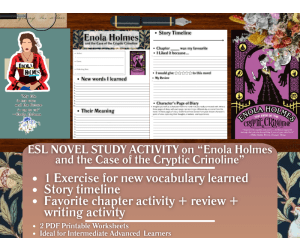
ESL Novel Study - Enola Holmes and the Case of the Cryptic Crinoline
ELA, Language Development, ESL, Vocabulary, Writing, Creative Writing, Formal Writing, Grade 7, 8, 9, 10, 11, 12, Worksheets & Printables, Novel Studies, Worksheets, Writing Prompts
ESL Novel Study Worksheets - Enola Holmes and the Case of the Cryptic Crinoline This ESL - EFL - TESOL (English Second or Foreign Language) teaching resource is a comprehensive novel study worksheet activity (2 printable PDF pages; Worksheets) focused on the novel "Enola Holmes and the Case of the Cryptic Crinoline" (Nancy Springer's novels portraying Sherlock Holmes' sister's adventures in Victorian England). This Novel Study worksheets on "Enola Holmes and the Case of the Cryptic Crinoline" (Nancy Springer's novels portraying Sherlock Holmes' sister's adventures in Victorian England) is tailored for middle and high school ESL students (7th – 12th grade) and provide a variety of thought provoking and language building activities. Whether you're teaching English as a Second Language (ESL), English as a Foreign Language (EFL), or in a TESOL context, this resource is classroom-ready and easy to use. Within this ESL Novel Study on "Enola Holmes and the Case of the Cryptic Crinoline" (Nancy Springer's novels portraying Sherlock Holmes' sister's adventures in Victorian England) (2 printable PDF worksheets pages), English Second or Foreign Language (ESL - EFL - TESOL - TEFL) teachers can find the following activities: General information activity (author, genre, publishing date) Vocabulary building section – new words from the novel 1 Story timeline Personal reflection on a favorite chapter Student novel review and rating Creative writing task : pretending being a character you personally liked and writing 3 diary pages for 3 scenes as if you were this character This English Second or Foreign Language (ESL - EFL - TESOL - TEFL) Novel Study Activity Worksheets on the "Enola Holmes and the Case of the Cryptic Crinoline" (Nancy Springer's novels portraying Sherlock Holmes' sister's adventures in Victorian England) can be ideal for learners from 7th grade to 12th grade to study this Novel (middle school + High School Students + Adult learners + University Students) ESL with Alan is a high-quality ESL teaching resources that inspire both teachers and students. Our goal is to make learning English fun, interactive, and meaningful. Discover more English Second or Foreign Language activities by visiting our store – because learning English should always be fun! If you want to browse more of my English Language and Literature Novel Study Activity Teaching Resources, click here ESL with Alan!
Author Learning with Alan
Rating
Tags ESL, English Second Language, English, Novel Study, Sherlock Holmes, Enola Holmes, Activity, Books, Worksheets, Writing Activity
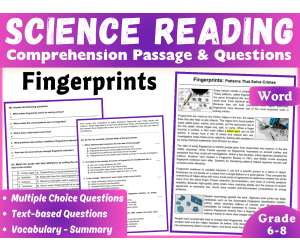
Science Reading Comprehension Passage: Fingerprints (Word)
Science, ELA, Reading, Reading Comprehension, Strategies, Resources for Teachers, Grade 6, 7, 8, 9, Writing Prompts, Worksheets & Printables, Centers, Activities, Teacher Tools, Assessments, Quizzes and Tests, Quizzes, Tests
Science Reading Comprehension Passage and Questions: Fingerprints (Word) This very engaging science reading passage is about fingerprints and how they are used to solve crimes . It explains that fingerprints are unique, permanent patterns formed by friction ridges on the skin. It describes how investigators find and develop latent prints left behind by sweat and natural skin oils, compare ridge details, and use modern tools such as AFIS and live-scan devices to search and record fingerprints. The passage also explains why fingerprint evidence can be strong when it is collected, documented, and compared carefully. This passage is designed to bridge the gap between science and literacy through strengthening reading comprehension and sparking scientific curiosity in middle school students. The passage blends English Language Arts skills with accurate science content that supports NGSS classroom practice. Ideal for interdisciplinary learning in ELA and Science. Suitable for Grade 9 review, too! Student Tasks for The Passage: 5 multiple-choice questions targeting main idea, key details, inference, vocabulary in context, and use of evidence 5 vocabulary matching items with clear, student-friendly definitions 5 text-based questions that require citing specific lines or facts 1 summary prompt that asks students to condense central ideas accurately Full answer key for every section Available Formats for this Resource PDF Fillable PDF Google Docs Product Details Length: 4 pages total Grades: 6–8, also suitable for Grade 9 review Use cases: close reading, stations, homework, intervention, test prep, and sub plans Standards support: reinforces informational-text skills and supports NGSS-style sense making through observation, modeling, and clear use of claim, evidence, and reasoning Why Teachers Choose This Set Authentic science content paired with rigorous literacy practice Consistent task structure across all passages for easier planning and smoother student routines Clear, age-appropriate writing that builds confidence without oversimplifying Other Science Reading Collections you May find in the store: 1. Astronomy & Space Science 2. Volcanoes, Rocks, & Mountains 3. Rock Cycle, Soil, & Sinkholes 4. Mars, Glaciers, & Antarctica 5. Water Cycle, Acid Rain, & Wastewater 6. Insects, Animals, & Ecosystems 7. Bioluminescence & Insects 8. Animal Skin, Cats, & T. Rex 9. Human Body and Senses 10. Health & Applied Bioscience 11. Waves, Light, & Imaging 12. Electricity & Energy 13. Motion & Materials 14. Chemistry and Materials Science Use this set to reinforce ELA skills in science, to add literacy to your lessons, and to support independent work. The passages strengthen main idea, evidence use, vocabulary in context, inference, cause and effect, and summary writing. With ready-to-use assessments and complete answer keys, you can provide focused practice that is simple to run and fast to review.
Author EduNation Creative Store
Rating
Tags Middle School, Reading Comprehension, Reading Strategies, ELA, Centers, Reading Passage, Assessments, Vocabulary, Technology

Science Reading Comprehension Passage: Fingerprints (Fillable PDF)
Science, ELA, Reading, Reading Comprehension, Strategies, Resources for Teachers, Grade 6, 7, 8, 9, Writing Prompts, Worksheets & Printables, Centers, Activities, Teacher Tools, Assessments, Quizzes and Tests, Quizzes, Tests
Science Reading Comprehension Passage and Questions: Fingerprints (Fillable PDF) This very engaging science reading passage is about fingerprints and how they are used to solve crimes . It explains that fingerprints are unique, permanent patterns formed by friction ridges on the skin. It describes how investigators find and develop latent prints left behind by sweat and natural skin oils, compare ridge details, and use modern tools such as AFIS and live-scan devices to search and record fingerprints. The passage also explains why fingerprint evidence can be strong when it is collected, documented, and compared carefully. This passage is designed to bridge the gap between science and literacy through strengthening reading comprehension and sparking scientific curiosity in middle school students. The passage blends English Language Arts skills with accurate science content that supports NGSS classroom practice. Ideal for interdisciplinary learning in ELA and Science. Suitable for Grade 9 review, too! These worksheets are designed as fillable PDFs , which means students can type their answers directly into the document on any computer or tablet . Each page includes highlighted text fields that show them exactly where to type! Student Tasks for The Passage: 5 multiple-choice questions targeting main idea, key details, inference, vocabulary in context, and use of evidence 5 vocabulary matching items with clear, student-friendly definitions 5 text-based questions that require citing specific lines or facts 1 summary prompt that asks students to condense central ideas accurately Full answer key for every section Available Formats for this Resource PDF Word Docs Google Docs Product Details Length: 4 pages total Grades: 6–8, also suitable for Grade 9 review Use cases: close reading, stations, homework, intervention, test prep, and sub plans Standards support: reinforces informational-text skills and supports NGSS-style sense making through observation, modeling, and clear use of claim, evidence, and reasoning Why Teachers Choose This Set Authentic science content paired with rigorous literacy practice Consistent task structure across all passages for easier planning and smoother student routines Clear, age-appropriate writing that builds confidence without oversimplifying Other Science Reading Collections you May find in the store: 1. Astronomy & Space Science 2. Volcanoes, Rocks, & Mountains 3. Rock Cycle, Soil, & Sinkholes 4. Mars, Glaciers, & Antarctica 5. Water Cycle, Acid Rain, & Wastewater 6. Insects, Animals, & Ecosystems 7. Bioluminescence & Insects 8. Animal Skin, Cats, & T. Rex 9. Human Body and Senses 10. Health & Applied Bioscience 11. Waves, Light, & Imaging 12. Electricity & Energy 13. Motion & Materials 14. Chemistry and Materials Science Use this set to reinforce ELA skills in science, to add literacy to your lessons, and to support independent work. The passages strengthen main idea, evidence use, vocabulary in context, inference, cause and effect, and summary writing. With ready-to-use assessments and complete answer keys, you can provide focused practice that is simple to run and fast to review.
Author EduNation Creative Store
Rating
Tags Middle School, Reading Comprehension, Reading Strategies, ELA, Centers, Reading Passage, Assessments, Vocabulary, Technology

Science Reading Comprehension Passage: Fingerprints (PDF)
Science, ELA, Reading, Reading Comprehension, Strategies, Resources for Teachers, Grade 6, 7, 8, 9, Writing Prompts, Worksheets & Printables, Centers, Activities, Teacher Tools, Assessments, Quizzes and Tests, Quizzes, Tests
Science Reading Comprehension Passage and Questions: Fingerprints (PDF) This very engaging science reading passage is about fingerprints and how they are used to solve crimes . It explains that fingerprints are unique, permanent patterns formed by friction ridges on the skin. It describes how investigators find and develop latent prints left behind by sweat and natural skin oils, compare ridge details, and use modern tools such as AFIS and live-scan devices to search and record fingerprints. The passage also explains why fingerprint evidence can be strong when it is collected, documented, and compared carefully. This passage is designed to bridge the gap between science and literacy through strengthening reading comprehension and sparking scientific curiosity in middle school students. The passage blends English Language Arts skills with accurate science content that supports NGSS classroom practice. Ideal for interdisciplinary learning in ELA and Science. Suitable for Grade 9 review, too! Student Tasks for The Passage: 5 multiple-choice questions targeting main idea, key details, inference, vocabulary in context, and use of evidence 5 vocabulary matching items with clear, student-friendly definitions 5 text-based questions that require citing specific lines or facts 1 summary prompt that asks students to condense central ideas accurately Full answer key for every section Available Formats for this Resource Fillable PDF Word Docs Google Docs Product Details Length: 4 pages total Grades: 6–8, also suitable for Grade 9 review Use cases: close reading, stations, homework, intervention, test prep, and sub plans Standards support: reinforces informational-text skills and supports NGSS-style sense making through observation, modeling, and clear use of claim, evidence, and reasoning Why Teachers Choose This Set Authentic science content paired with rigorous literacy practice Consistent task structure across all passages for easier planning and smoother student routines Clear, age-appropriate writing that builds confidence without oversimplifying Other Science Reading Collections you May find in the store: 1. Astronomy & Space Science 2. Volcanoes, Rocks, & Mountains 3. Rock Cycle, Soil, & Sinkholes 4. Mars, Glaciers, & Antarctica 5. Water Cycle, Acid Rain, & Wastewater 6. Insects, Animals, & Ecosystems 7. Bioluminescence & Insects 8. Animal Skin, Cats, & T. Rex 9. Human Body and Senses 10. Health & Applied Bioscience 11. Waves, Light, & Imaging 12. Electricity & Energy 13. Motion & Materials 14. Chemistry and Materials Science Use this set to reinforce ELA skills in science, to add literacy to your lessons, and to support independent work. The passages strengthen main idea, evidence use, vocabulary in context, inference, cause and effect, and summary writing. With ready-to-use assessments and complete answer keys, you can provide focused practice that is simple to run and fast to review.
Author EduNation Creative Store
Rating
Tags Middle School, Reading Comprehension, Reading Strategies, ELA, Centers, Reading Passage, Assessments, Vocabulary, Technology

Science Reading Comprehension Passage: The Science of Clothing (Word)
Science, ELA, Reading, Reading Comprehension, Strategies, Resources for Teachers, Technology, Engineering, Grade 6, 7, 8, 9, Writing Prompts, Worksheets & Printables, Centers, Activities, Teacher Tools, Assessments, Quizzes and Tests, Quizzes, Tests
Science Reading Comprehension Passage and Questions: The Hidden Science of Clothing (Word) This very engaging science reading passage is about how modern clothing uses science and technology to improve safety, performance, comfort, and exploration . It explains different examples of high-tech clothing and materials, including compression clothing for athletes, flame-resistant clothing for firefighters and workers, aerogel for astronaut suits and space rovers, and smart fabrics that can play music, answer calls, or track a heartbeat. The visuals on page 1 support these examples by showing athletic clothing, protective work gear, and space-related clothing. This passage is designed to bridge the gap between science and literacy through strengthening reading comprehension and sparking scientific curiosity in middle school students. The passage blends English Language Arts skills with accurate science content that supports NGSS classroom practice. Ideal for interdisciplinary learning in ELA and Science. Suitable for Grade 9 review, too! Student Tasks for The Passage: 5 multiple-choice questions targeting main idea, key details, inference, vocabulary in context, and use of evidence 5 vocabulary matching items with clear, student-friendly definitions 5 text-based questions that require citing specific lines or facts 1 summary prompt that asks students to condense central ideas accurately Full answer key for every section Available Formats for this Resource PDF Fillable PDF Google Docs Product Details Length: 4 pages total Grades: 6–8, also suitable for Grade 9 review Use cases: close reading, stations, homework, intervention, test prep, and sub plans Standards support: reinforces informational-text skills and supports NGSS-style sense making through observation, modeling, and clear use of claim, evidence, and reasoning Why Teachers Choose This Set Authentic science content paired with rigorous literacy practice Consistent task structure across all passages for easier planning and smoother student routines Clear, age-appropriate writing that builds confidence without oversimplifying Other Science Reading Collections you May find in the store: 1. Astronomy & Space Science 2. Volcanoes, Rocks, & Mountains 3. Rock Cycle, Soil, & Sinkholes 4. Mars, Glaciers, & Antarctica 5. Water Cycle, Acid Rain, & Wastewater 6. Insects, Animals, & Ecosystems 7. Bioluminescence & Insects 8. Animal Skin, Cats, & T. Rex 9. Human Body and Senses 10. Health & Applied Bioscience 11. Waves, Light, & Imaging 12. Electricity & Energy 13. Motion & Materials 14. Chemistry and Materials Science Use this set to reinforce ELA skills in science, to add literacy to your lessons, and to support independent work. The passages strengthen main idea, evidence use, vocabulary in context, inference, cause and effect, and summary writing. With ready-to-use assessments and complete answer keys, you can provide focused practice that is simple to run and fast to review.
Author EduNation Creative Store
Rating
Tags Middle School, Reading Comprehension, Reading Strategies, ELA, Centers, Reading Passage, Assessments, Vocabulary, Technology

Science Reading Passage: The Science of Clothing (Fillable PDF)
Science, ELA, Reading, Reading Comprehension, Strategies, Resources for Teachers, Technology, Engineering, Grade 6, 7, 8, 9, Writing Prompts, Worksheets & Printables, Centers, Activities, Teacher Tools, Assessments, Quizzes and Tests, Quizzes, Tests
Science Reading Comprehension Passage and Questions: The Hidden Science of Clothing (Fillable PDF) This very engaging science reading passage is about how modern clothing uses science and technology to improve safety, performance, comfort, and exploration . It explains different examples of high-tech clothing and materials, including compression clothing for athletes, flame-resistant clothing for firefighters and workers, aerogel for astronaut suits and space rovers, and smart fabrics that can play music, answer calls, or track a heartbeat. The visuals on page 1 support these examples by showing athletic clothing, protective work gear, and space-related clothing. This passage is designed to bridge the gap between science and literacy through strengthening reading comprehension and sparking scientific curiosity in middle school students. The passage blends English Language Arts skills with accurate science content that supports NGSS classroom practice. Ideal for interdisciplinary learning in ELA and Science. Suitable for Grade 9 review, too! These worksheets are designed as fillable PDFs , which means students can type their answers directly into the document on any computer or tablet . Each page includes highlighted text fields that show them exactly where to type! Student Tasks for The Passage: 5 multiple-choice questions targeting main idea, key details, inference, vocabulary in context, and use of evidence 5 vocabulary matching items with clear, student-friendly definitions 5 text-based questions that require citing specific lines or facts 1 summary prompt that asks students to condense central ideas accurately Full answer key for every section Available Formats for this Resource PDF Word Docs Google Docs Product Details Length: 4 pages total Grades: 6–8, also suitable for Grade 9 review Use cases: close reading, stations, homework, intervention, test prep, and sub plans Standards support: reinforces informational-text skills and supports NGSS-style sense making through observation, modeling, and clear use of claim, evidence, and reasoning Why Teachers Choose This Set Authentic science content paired with rigorous literacy practice Consistent task structure across all passages for easier planning and smoother student routines Clear, age-appropriate writing that builds confidence without oversimplifying Other Science Reading Collections you May find in the store: 1. Astronomy & Space Science 2. Volcanoes, Rocks, & Mountains 3. Rock Cycle, Soil, & Sinkholes 4. Mars, Glaciers, & Antarctica 5. Water Cycle, Acid Rain, & Wastewater 6. Insects, Animals, & Ecosystems 7. Bioluminescence & Insects 8. Animal Skin, Cats, & T. Rex 9. Human Body and Senses 10. Health & Applied Bioscience 11. Waves, Light, & Imaging 12. Electricity & Energy 13. Motion & Materials 14. Chemistry and Materials Science Use this set to reinforce ELA skills in science, to add literacy to your lessons, and to support independent work. The passages strengthen main idea, evidence use, vocabulary in context, inference, cause and effect, and summary writing. With ready-to-use assessments and complete answer keys, you can provide focused practice that is simple to run and fast to review.
Author EduNation Creative Store
Rating
Tags Middle School, Reading Comprehension, Reading Strategies, ELA, Centers, Reading Passage, Assessments, Vocabulary, Technology
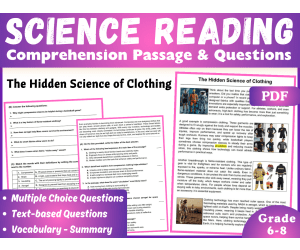
Science Reading Comprehension Passage: The Science of Clothing (PDF)
Science, ELA, Reading, Reading Comprehension, Strategies, Resources for Teachers, Technology, Engineering, Grade 6, 7, 8, 9, Writing Prompts, Worksheets & Printables, Centers, Activities, Teacher Tools, Assessments, Quizzes and Tests, Quizzes, Tests
Science Reading Comprehension Passage and Questions: The Hidden Science of Clothing (PDF) This very engaging science reading passage is about how modern clothing uses science and technology to improve safety, performance, comfort, and exploration . It explains different examples of high-tech clothing and materials, including compression clothing for athletes, flame-resistant clothing for firefighters and workers, aerogel for astronaut suits and space rovers, and smart fabrics that can play music, answer calls, or track a heartbeat. The visuals on page 1 support these examples by showing athletic clothing, protective work gear, and space-related clothing. This passage is designed to bridge the gap between science and literacy through strengthening reading comprehension and sparking scientific curiosity in middle school students. The passage blends English Language Arts skills with accurate science content that supports NGSS classroom practice. Ideal for interdisciplinary learning in ELA and Science. Suitable for Grade 9 review, too! Student Tasks for The Passage: 5 multiple-choice questions targeting main idea, key details, inference, vocabulary in context, and use of evidence 5 vocabulary matching items with clear, student-friendly definitions 5 text-based questions that require citing specific lines or facts 1 summary prompt that asks students to condense central ideas accurately Full answer key for every section Available Formats for this Resource Fillable PDF Word Docs Google Docs Product Details Length: 4 pages total Grades: 6–8, also suitable for Grade 9 review Use cases: close reading, stations, homework, intervention, test prep, and sub plans Standards support: reinforces informational-text skills and supports NGSS-style sense making through observation, modeling, and clear use of claim, evidence, and reasoning Why Teachers Choose This Set Authentic science content paired with rigorous literacy practice Consistent task structure across all passages for easier planning and smoother student routines Clear, age-appropriate writing that builds confidence without oversimplifying Other Science Reading Collections you May find in the store: 1. Astronomy & Space Science 2. Volcanoes, Rocks, & Mountains 3. Rock Cycle, Soil, & Sinkholes 4. Mars, Glaciers, & Antarctica 5. Water Cycle, Acid Rain, & Wastewater 6. Insects, Animals, & Ecosystems 7. Bioluminescence & Insects 8. Animal Skin, Cats, & T. Rex 9. Human Body and Senses 10. Health & Applied Bioscience 11. Waves, Light, & Imaging 12. Electricity & Energy 13. Motion & Materials 14. Chemistry and Materials Science Use this set to reinforce ELA skills in science, to add literacy to your lessons, and to support independent work. The passages strengthen main idea, evidence use, vocabulary in context, inference, cause and effect, and summary writing. With ready-to-use assessments and complete answer keys, you can provide focused practice that is simple to run and fast to review.
Author EduNation Creative Store
Rating
Tags Middle School, Reading Comprehension, Reading Strategies, ELA, Centers, Reading Passage, Assessments, Vocabulary, Technology

Media Literacy & Advertising Influence Analysis Worksheets
Science, Technology, Computer Science, Engineering, Research, Resources for Teachers, Classroom Management, Community Building, Special Resources, Social Emotional Learning (SEL), Grade 7, 8, 9, 10, 11, 12, Worksheets & Printables, Workbooks, Worksheets, Word Searches, Teacher Tools, Assessments, Lesson Plans, Quizzes and Tests, Quizzes, Tests
Are your students overwhelmed by the endless stream of digital information, unsure how to separate true facts from falsehoods and other types of media manipulation? With the rise of influencers, hyper-targeted algorithms, and an attention economy, media literacy as it was once traditionally defined is insufficient in the world of today. Your students will benefit from our Ultimate Media Literacy & Advertising Analysis Unit by gaining the critical thinking skills they'll need to make it in today's world. This thorough "turnkey" media literacy curriculum offers students an understanding of the psychological underpinnings of modern persuasion, going far beyond just an ability to identify "fake news." It uses proven theoretical concepts and real-world examples to give students tools for breaking down the actual media they consume each day. THIS PAGE CONTAINS OVER 50 PAGES OF VALUE! PHASE 1 CONTENT & THEORY: 4 Chapters full of valuable information about the major themes of the 21st century demonstrating the foundational knowledge needed to be an informed citizen on each of these themes, written in academic language but accessible to all. 1. The Attention Economy - (infinite scrolling, micro moment) 2. Psychological Exploitation - (Real vs Ideal self, FOMO, Parasitical relationships) 3. Semiotics: The Language Behind Language - (signifiers and signified, "greenwashing") 4. Algorithmic Targeting - (psychographics, echo chambers, microtargeting) PHASE 2 STUDENT WORKBOOK (10 RIGOROUS WORKSHEETS): Each worksheet has a modern and relevant case study for students to analyze using the following questions with a final creative application activity throughout each unit with regard to each of the case studies. - How do I deconstruct and identify possible target audiences? - How can I understand emotional and visual manipulation? - What is the role of algorithms and filter bubbles? - How do I identify logical fallacies in rhetoric? - What is native advertising and how does it work? - What is the economic value of social media influencers and how do I identify parasocial exploitation? - What is data harvesting and how does it contribute to surveillance capitalism? - What are dark patterns in user experience or user interface? - How do I manage a brand crisis? CAPSTONE PROJECT: Develop your own counter-narrative campaign! PHASE 3: Finish Teacher Materials – All the support materials you will need to teach this unit successfully! To provide visual frameworks for your students, you will receive three highly effective printable anchor charts or diagrams (Hyper-targeted advertising, The Disinformation Triangle and The SIFT Method) for students to use as visual scaffolds while they build their understanding. If you need a complete set of example answers for all ten of the worksheets, you will find a highly organized answer key that provides you with detailed exemplar responses to each of the ten worksheets. This resource will save you countless hours preparing for your classes. You will receive a comprehensive teacher implementation guide that provides a pedagogical overview along with a complete teacher 5-day pacing and lesson plan so that you can easily implement this complete unit successfully! While this isn't just a bundle of worksheets, it is a number of vital resources that will support students in developing digital citizenship, critical consumption and intellectual sovereignty. It is suitable for use in English, Media Studies, Social Studies and Business classes. Download this resource today so you can empower your students to be active decoders instead of passive consumers! Key terms: Media Literacy, Critical Thinking, Advertising, Propaganda, Fake News, Disinformation, Digital Citizenship, High School English, Social Studies, Rhetoric, Persuasion, Logical Fallacies, Worksheets, Printables, Lesson Plans, Unit Plans, Google Classroom. Parents and Schools Appreciate it Because: Real World Preparation - This unit looks at the digital world students live in today, provides students with critical thinking skills to evaluate the influencers, ads aimed at them, and social media platforms already used daily by students. Develops Deep Thinking Skills – This unit goes beyond the standard checklist used to identify "fake news" and teaches students about the psychological and economic constructs that allow manipulation of modern media. Relevant and Engaging Content – Lessons are told through modern examples such as the meal delivery subscription model, greenwashing by fast-fashion companies, and student-to-YouTuber relationships to make otherwise complex content relatable and interesting. Comprehensive and Teacher Friendly – This is a "turnkey" unit, including theory, 10 worksheets, graphic organizers, and an answer key, along with a 5-day lesson plan to allow educators to save dozens of hours of prep time. Target Student Audience : Based on the vocabulary, concepts and themes within the PDF document, it is targeted toward the following audiences: High School Students (Grades 9-12). The material is most relevant for high school students due to the fact that they are primarily marketed to by way of advertising and media tactics discussed. Complex vocabulary, including "semiotics," "psychographics" and "algorithmic panopticon"; may be challenging for some students but are age-appropriate. Early College/University Students (100 Level). This resource would be an excellent resource for introductory courses in communications, sociology or media studies. Copyright/Terms of Use: This Book is a copyrighted possession of Dr. Syed Hammad Rizvi. This resource can only be used for personal use and in a single class room only. No parts of this resource may be altered, redistributed, or sold. In other words, this resource may not be placed on the internet and publicly accessible or downloadable. We encourage you to share this resource with your colleagues; however, you must purchase additional licenses from 'Teachsimple. Thank you for understanding and following our Copyright Policy/Terms of Use. This product is proudly provided to you by Dr. Syed Hammad Rizvi
Author Creative Book Store
Rating
Tags MediaLiteracy, CriticalThinking, DigitalLiteracy, Advertising, Propaganda, Marketing, 21stCenturySkills, DigitalCitizenship, Disinformation, FakeNews

3rd Grade Summer Review Packet | Math & Fun Activities | End of year
Reading Comprehension, Reading, ELA, Math, Money, Measurements, Creative Writing, Writing, Grade 3, Activities, Worksheets, Worksheets & Printables, Centers, Assessments, Teacher Tools
Engaging and Comprehensive! Keep students learning and growing all summer long with this 3rd Grade Summer Review Packet. Designed to reinforce essential third-grade skills, this printable resource helps students review key concepts while staying engaged with fun and meaningful activities. The packet includes a variety of standards-based practice pages covering math, reading comprehension, grammar, writing, and summer-themed activities. Students will strengthen foundational skills, build confidence, and prepare for a successful transition into 4th grade. The engaging activities encourage independent learning while helping prevent summer learning loss. Perfect for summer learning programs, end-of-year review, summer school, homeschool learning, independent practice, learning centers, and review before entering 4th grade. The clear and student-friendly layout makes it easy for students to complete activities on their own while providing valuable skill reinforcement. This no-prep resource is ready to print and use, making it a convenient option for teachers, parents, and homeschool educators. File type: PDF Number of Pages: 37 Grade Level: 3rd Grade Black & White • No Prep • 8.5 x 11 Inches
Author Sadigitalart
Rating
Tags End Of Year Review, Summer Packet, Summer Workbook, Grammar Worksheets, Homeschool, Printable Worksheets, 3rd Grade Packet

Interoception Body Signals & Feelings SEL Therapy
Creative Arts, P.E. & Health, Special Resources, Not Grade Specific, Classroom Decor, Worksheets & Printables
This social-emotional learning (SEL) resource helps students identify where they feel emotions in their bodies, recognize physical warning signs, explore emotional triggers, and develop greater self-awareness. Using visual body signal icons, students can map sensations such as a fast heartbeat, shaky hands, tears, deep breathing, tense muscles, and more. What's Included: -My Body Signal Map Worksheets -Emotion & Trigger Mapping Pages -Body Signal Icon Bank -Reflection and Writing Activities -Visual Supports for Diverse Learners -Print-and-Go Format Perfect For: • Emotional Regulation Lessons • Social Emotional Learning (SEL) • Special Education Classrooms • Autism Support Programs • School Counseling Sessions • Occupational Therapy Activities • Social Skills Groups • Calm Corner Resources • Behavior Intervention Support • Self-Awareness Activities Why teachers love this: -Highly visual and engaging -Supports emotional awareness -Encourages meaningful discussions -Easy to differentiate -Low-prep and classroom-ready -Ideal for Autism and SPED learners -Helps students understand what their bodies are communicating
Author Smart Minds
Rating
Tags Interoception , Body Signals , Feeling And Emotions, Printable Worksheets, Interoception Lessons, Body Sensations, Self Regulation, BODY MAPPING & INTEROCEPTION

4th Grade Math Workbook, Back To School Multiplication, Division
Math, Fractions, Geometry, Multiplication and Division, Elementary, Worksheets & Printables
This 4th Grade Math Workbook is a tool for students who need more practice with the basic math ideas they learn in the 4th grade. The workbook is set up in a way that lets students work on one thing at a time which helps them feel more confident and get better at math. They can use the workbook in class when they are working on their own for homework when they are being tutored or when they are doing homeschool lessons. Some of the things that are covered in the workbook include: • Multiplication Facts • 2-Digit × 1-Digit Multiplication • 2-Digit × 2-Digit Multiplication • Area and Perimeter • Basic Division Facts • Long Division • Equivalent Fractions • Simplifying Fractions • Fractions with Different Denominators • Answer Key The worksheets in the workbook are made to give students a lot of practice and review of the math skills they are learning in the grade. Students can work on the worksheets by themselves. They can get help from their teacher or parents if they need it. This 4th Grade Math Workbook can be useful for things like math practice, homework, teaching small groups of students helping students who are having trouble with math and review activities. It can also be used for homeschool lessons reviewing what students learned at the beginning of the year or practicing math skills over the summer. Here are some details, about the Grade Math Workbook: Grade Level: 4th Grade Subject: Mathematics Format: PDF The workbook comes with an Answer Key it is easy to print and use and it does not use a lot of color so it will not be expensive to print. The workbook covers a lot of areas of math including Multiplication, Division, Fractions, Area, Perimeter and basic math skills and it helps students learn how to think mathematically.
Author Kind Minds Classroom Tech
Rating
Tags 4th Grade Math Workbook, Fourth Grade Math Worksheets, Multiplication Practice, Multiplication Facts, Multi Digit Multiplication, Division Practice, Long Division Worksheets, Fractions Workbook, Equivalent Fractions, Simplify Fractions, Area And Perimeter Worksheets, Grade 4 Math Review, Homeschool Math, Math Intervention, Printable Math Workbook, Independent Math Practice, Elementary Math Worksheets, Back To School Math Review

ESL Vocabulary Flashcards - Sports - Pictures
ELA, Language Development, Vocabulary, Middle School, Not Grade Specific, High School, Adult Education, Worksheets & Printables, Flashcards, Worksheets
ESL Vocabulary Flashcards - Sports - Pictures This high quality English language teaching resource is designed for students learning English as a second or foreign language . It includes 4 printable PDF pages featuring vocabulary flashcards and worksheets centered around the theme of "Sports" This ESL Vocabulary Flashcards on "Sports" Worksheets Activity can be ideal for Beginner level ESL - EFL - TESOL learners, including newcomers and English language learners of all ages. 🌟 What's Included? In this ESL Vocabulary Flashcards Activity on " Sports ", there are provided: ✅ 40 Printable Flashcards (4 Printable PDF worksheets) ✅ Essential vocabulary and phrases in English ✅ Engaging icons and emojis on select flashcards to support comprehension and vocabulary retention (not all flashcards) 🏫 Who Can Benefit from This Resource? 📌 Beginner ESL - EFL students looking to improve their English vocabulary 📌 Newcomers & English Language Learners (ESL - EFL - TESOL -TEFL) in schools, tutoring sessions, or self-study 📌 Teachers and tutors looking for fun and engaging vocabulary building activities 📌 Language centers, homeschool educators, and ESL programs 🎯 How Does this ESL Teaching Resource Help you and your Students? ✨ Strengthens essential English communication skills ✨ Provides English vocabulary (ESL - EFL - TESOL - TEFL) for better understanding ✨ Encourages engaging learning with printable flashcards that can be used in various ESL - EFL (English Second or Foreign Language) class activities Whether you're an ESL teacher or an English tutor these ESL Vocabulary Flashcards on " Sports " are a valuable and fun resource to improve basic conversation skills in English. Start learning today and make English introductions simple, engaging, and effective ! ESL with Alan is a Teaching Resources Store whose aim is to help English as a Second or foreign Language (ESL EFL TESOL) Teachers, Educators and Tutors around the world (be it online or offline) to achieve their teaching objectives while creating an enjoyable and stimulating learning environment. Learning is fun, So should English! Always If you want to browse more of my ESL, EFL, TESOL Teaching Resources, click here right ESL with Alan!
Author Learning with Alan
Rating
Tags ESL, English Second Language, English, Flashcards, Vocabulary, Sports, Activity, Worksheets, Printable, Pictures
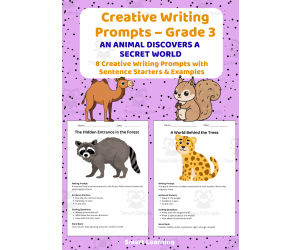
Creative Writing Prompts Grade 3 | An Animal Discovers a Secret World
Creative Writing, Writing, ELA, Grade 2, 3, 4, Writing Prompts, Worksheets & Printables
Creative Writing Prompts Grade 3 | An Animal Discovers a Secret World Get a creative writing prompt resource for 3rd grade on the topic of animals. What does this resource include? This resource contains 8 creative writing prompts on animal-related topics, each with sentence starters for each task, guiding questions to support ideas, word banks with helpful vocabulary, separate writing pages with plenty of space, “How to Write a Story” guide (beginning, middle, end), 3 example stories. Each reading passage is unique. The animal topics were carefully selected and each passage is accompanied by appropriate graphics. What is it suitable for? The material is suitable for English language arts classes. It is ideally suited for 3rd grade. This material is also suitable for weaker 4th-grade classes or particularly strong 2nd-grade classes. It is suitable for teachers looking for teaching materials that can be used immediately. No tedious adapting or formatting required. Simply print it out and use it directly in class. It is suitable for various teaching formats: - writing workshop - literacy centers - independent work - early finishers - homework What topics does the reading comprehension cover? 1 The Hidden Entrance in the Forest 2 A World Behind the Trees 3 The World Inside the Tree 4 A Secret Underwater World 5 The Secret in the Sand 6 The Cave by the Lake 7 The Secret Night World 8 The Secret in the River In addition, there are two advanced-level problems (easy and hard). The material is provided as a PDF file to make it easy to print and use in class. It is part of a larger series. If you like this material, you can explore creative writing prompt resources on a variety of other topics in my shop that will enrich your lessons. In addition to creative writing prompts, I also offer reading comprehension, math word problems, informational texts, and reading tests.
Author Smart Learning Classroom
Rating
Tags Creative Writing, Writing, Pet, Animal, Writing Prompts, Grade 3, Writing Workshop, Story Writing, Animals, Secret World

Reading Comprehension Insects | Grade 3 Reading Activities
Reading Comprehension, Reading, ELA, Grade 3, 4, Teacher Tools, Worksheets & Printables, Tests, Quizzes and Tests
Reading Comprehension Worksheets – Insect Theme | Grade 3 Get a reading comprehension resource for 3rd grade on the topic of Insects. What does this resource include? This resource contains 10 reading passages on insect-related topics, each with 5 exercises. These include multiple-choice, true or false, vocabulary, and creative tasks. Each reading passage is unique. The Insect topics were carefully selected and each passage is accompanied by appropriate graphics. Additionally, answers are provided at the end of the resource to facilitate its use in elementary school. What is it suitable for? The material is suitable for English language arts classes. It is ideally suited for 3rd grade. This material is also suitable for weaker 4th-grade classes or particularly strong 2nd-grade classes. It is suitable for teachers looking for teaching materials that can be used immediately. No tedious adapting or formatting required. Simply print it out and use it directly in class. It is suitable for various teaching formats: - Independent work - Literacy centers - Small group instruction - Homework - Reading workshops - Classroom literacy rotations What topics does the reading comprehension cover? 🐝 1 The Busy Bee 🦋 2 The Colorful Butterfly 🪲 3 The Crawling Beetle 🪶 4 The Fast Dragonfly 🐜 5 The Hardworking Ant 🐞 6 The Lucky Ladybug 🦗 7 The Jumping Grasshopper 🌿 8 The Quick Grasshopper 🐝 9 The Buzzing Bumblebee 🦟 10 The Little Mosquito The material is provided as a PDF file to make it easy to print and use in class. It is part of a larger series. If you like this material, you can explore reading comprehension resources on a variety of other topics in my shop that will enrich your lessons. In addition to reading comprehension, I also offer creative writing, math word problems, informational texts, and reading tests.
Author Smart Learning Classroom
Rating
Tags Reading Comprehension, Grade 3 Reading, Informational Texts, Reading Activities, Reading Passages, Grade 4 Reading, Vocabulary Activities, Animals, Insects, Insect
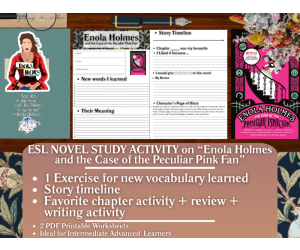
ESL Novel Study - Enola Holmes and the Case of the Peculiar Pink Fan
ELA, Language Development, ESL, Vocabulary, Writing, Creative Writing, Formal Writing, Grade 7, 8, 9, 10, 11, 12, Worksheets & Printables, Novel Studies, Worksheets, Writing Prompts
ESL Novel Study - Enola Holmes and the Case of the Peculiar Pink Fan - Nancy Springer This ESL - EFL - TESOL (English Second or Foreign Language) teaching resource is a comprehensive novel study worksheet activity (2 printable PDF pages; Worksheets) focused on the novel "Enola Holmes and the Case of the Peculiar Pink Fan" (Nancy Springer's novels portraying Sherlock Holmes' sister's adventures in Victorian England). This Novel Study worksheets on "Enola Holmes and the Case of the Peculiar Pink Fan" (Nancy Springer's novels portraying Sherlock Holmes' sister's adventures in Victorian England) is tailored for middle and high school ESL students (7th – 12th grade) and provide a variety of thought provoking and language building activities. Whether you're teaching English as a Second Language (ESL), English as a Foreign Language (EFL), or in a TESOL context, this resource is classroom-ready and easy to use. Within this ESL Novel Study on "Enola Holmes and the Case of the Peculiar Pink Fan" (Nancy Springer's novels portraying Sherlock Holmes' sister's adventures in Victorian England) (2 printable PDF worksheets pages), English Second or Foreign Language (ESL - EFL - TESOL - TEFL) teachers can find the following activities: General information activity (author, genre, publishing date) Vocabulary building section – new words from the novel 1 Story timeline Personal reflection on a favorite chapter Student novel review and rating Creative writing task : pretending being a character you personally liked and writing 3 diary pages for 3 scenes as if you were this character This English Second or Foreign Language (ESL - EFL - TESOL - TEFL) Novel Study Activity Worksheets on the "Enola Holmes and the Case of the Peculiar Pink Fan" (Nancy Springer's novels portraying Sherlock Holmes' sister's adventures in Victorian England) can be ideal for learners from 7th grade to 12th grade to study this Novel (middle school + High School Students + Adult learners + University Students) ESL with Alan is a high-quality ESL teaching resources that inspire both teachers and students. Our goal is to make learning English fun, interactive, and meaningful. Discover more English Second or Foreign Language activities by visiting our store – because learning English should always be fun! If you want to browse more of my English Language and Literature Novel Study Activity Teaching Resources, click here ESL with Alan!
Author Learning with Alan
Rating
Tags ESL, English Second Language, English, Sherlock Holmes, Enola Holmes, Arthur Conan Doyle, Detective, Novel Study, Activity, Worksheets

Country Study Presentation - Eritrea - Geography - East Africa
Social Studies, Economics, Geography, History: African, History, Grade 7, 8, 9, 10, 11, 12, Presentations, Teacher Tools
Country Study Presentation - Eritrea - Geography + Social Studies - East Africa Try this Teaching Resource on Eritrea (Introductory Presentation Lesson - PDF Printable), designed for Geography + African History (East Africa) + Social Studies lessons. Suitable for Grades 7–12 (Middle school and High School students), this Introductory PDF Presentation offers a ready to use lesson that requires little to no preparation. Geography and Social Studies students will learn about Eritrea ’s geography, history, culture, language and economy — making it perfect for classroom instruction, homeschooling, or online learning. 📘 Teachers can find the following topics in this Social Studies and Geograhy Teaching resource ✅ Greetings in Tigrinya ✅ Geography of Eritrea (East Africa) – Key facts, borders, and an interactive Google Maps link to its location. ✅ Quick Facts – Population, capital city, currency and other essential details. ✅ Languages of Eritrea : Tigrinya - introduction in the languages spoken + basic vocabuary ✅ History Overview – A concise summary of the most important events in the history of Eritrea (East Africa) ✅ Geography & Environment – Details about the country’s land area, regions, and climate zones. ✅ Eritrea's Economy – paragraph on Eritrea ’s industries, exports, currency and economic strengths (East Africa) ✅ Asmara – Explore the capital city of Eritrea , its famous landmarks, and cultural highlights. ✅ Other Major Cities – A map showcasing additional important cities in Eritrea (Eritrea Africa) ✅ Eritrea's Culture & Traditions – A look at the customs and values that define Eritrea (East Africa) ✅ Farewell in Tigrinya 🎯 This Geography and Social Studies Teaching Resource can be perfect for: Geography classes Social Studies lessons World cultures units Country study projects Substitute teacher toolbox Digital learning In-class or online teaching 📂 Resource Details Format: PDF Digital Presentation Grade Levels: 7th–12th Grade (Middle School and High School students) Learning with Alan is an educational resource store created to help teachers, educators, and tutors reach their teaching goals while building a fun, engaging, and stimulating learning environment . Because learning should always be meaningful—and fun! 🎓✨ If you want to browse more of my Teaching Resources, click here Learning with Alan!!
Author Learning with Alan
Rating
Tags Country Study, Social Studies, Geography, History, Africa, Tigrinya, Eritrea, East Africa, Lesson, Introduction

Square Root and Cube Root Mental Math Matching Game Estimating 8th 9th
Math, Algebra, Number Lines, Multiplication and Division, Grade 8, 9, Activities, Games, Worksheets & Printables, Worksheets
Here's a fun and hands-on way for your students to practice estimating square roots & cube roots using logical mental math strategies and known benchmarks. It's a simple matching game for students in 8th & 9th grade when they are learning about square roots & cube roots in math class. How to Use: Print a worksheet for each of your students along with a set of 24 matching cards for each group of two to four students. First, students need to complete their Square and Cube Roots Cheat Sheet. Give them time in class to do this in pairs or small groups. They should hold on to this sheet for the whole unit as it will be a useful resource. Let them practice estimating square and cube roots with the five practice questions. Go over mental math strategies as a class (use the answer key for ideas). When it’s time for the game, give groups of students one set of 24 cards. They need to shuffle the cards and match them up. They could do this several ways: Play as a memory matching game : spread cards facedown, flip 2 cards, see if they match, flip them back if they don’t. Play like Go Fish - ask the other players for certain cards. Or just spread all the cards out face-up, match up a pair, and explain why it’s a match . Grades to Use With: This game is designed to target 8th grade math learning outcomes about square roots, cube roots, mental math, and estimation. It could be used in 9th grade as a review activity. It could be used in high school special education classes where appropriate. What's Included: 6-Page PDF Ready to Print and Use! Teacher Instructions Square Root and Cube Root Cheat Sheet Answer Key for Square Root and Cube Root Cheat Sheet 3 pages (24 cards) for the Matching Game
Author Grace Under Pressure
Rating
Tags Square Root, Cube Root, Estimate Square Root, Estimate Cube Root, Square Root Game, Cube Root Game, Root Game, Perfect Square, Perfect Cube, Square Roots
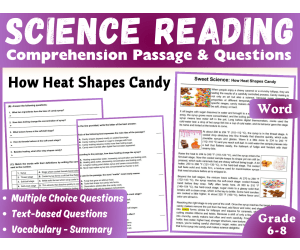
Science Reading Comprehension Passage: Making Candy (Word)
Science, ELA, Reading, Reading Comprehension, Strategies, Resources for Teachers, Chemistry, Grade 6, 7, 8, 9, Writing Prompts, Worksheets & Printables, Centers, Activities, Teacher Tools, Assessments, Quizzes and Tests, Quizzes, Tests
Science Reading Comprehension Passage and Questions: Making Candy (Word) This very engaging science reading passage is about how heat changes sugar syrup into different kinds of candy . It explains that candy making depends on temperature, water loss, and sugar concentration . As sugar syrup boils, water evaporates, the syrup becomes more concentrated, and different temperature ranges create different textures, such as thread, soft-ball, firm-ball, hard-ball, soft-crack, and hard-crack stages. It also explains how candy makers use molds, pulling, stretching, or cutting to shape the candy after heating. This passage is designed to bridge the gap between science and literacy through strengthening reading comprehension and sparking scientific curiosity in middle school students. The passage blends English Language Arts skills with accurate science content that supports NGSS classroom practice. Ideal for interdisciplinary learning in ELA and Science. Suitable for Grade 9 review, too! Student Tasks for The Passage: 5 multiple-choice questions targeting main idea, key details, inference, vocabulary in context, and use of evidence 5 vocabulary matching items with clear, student-friendly definitions 5 text-based questions that require citing specific lines or facts 1 summary prompt that asks students to condense central ideas accurately Full answer key for every section Available Formats for this Resource PDF Fillable PDF Google Docs Product Details Length: 4 pages total Grades: 6–8, also suitable for Grade 9 review Use cases: close reading, stations, homework, intervention, test prep, and sub plans Standards support: reinforces informational-text skills and supports NGSS-style sense making through observation, modeling, and clear use of claim, evidence, and reasoning Why Teachers Choose This Set Authentic science content paired with rigorous literacy practice Consistent task structure across all passages for easier planning and smoother student routines Clear, age-appropriate writing that builds confidence without oversimplifying Other Science Reading Collections you May find in the store: 1. Astronomy & Space Science 2. Volcanoes, Rocks, & Mountains 3. Rock Cycle, Soil, & Sinkholes 4. Mars, Glaciers, & Antarctica 5. Water Cycle, Acid Rain, & Wastewater 6. Insects, Animals, & Ecosystems 7. Bioluminescence & Insects 8. Animal Skin, Cats, & T. Rex 9. Human Body and Senses 10. Health & Applied Bioscience 11. Waves, Light, & Imaging 12. Electricity & Energy 13. Motion & Materials 14. Chemistry and Materials Science Use this set to reinforce ELA skills in science, to add literacy to your lessons, and to support independent work. The passages strengthen main idea, evidence use, vocabulary in context, inference, cause and effect, and summary writing. With ready-to-use assessments and complete answer keys, you can provide focused practice that is simple to run and fast to review.
Author EduNation Creative Store
Rating
Tags Middle School, Reading Comprehension, Reading Strategies, ELA, Centers, Reading Passage, Assessments, Vocabulary, Making Candy